Cybersecurity experts are warning that artificial intelligence is changing the threat landscape faster than many organizations expected. While AI has become an important tool for improving productivity and strengthening digital defenses, cybercriminals are also using the same technology to launch more convincing, automated, and large-scale attacks. In 2026, businesses of every size are facing a new generation of cyber threats that are smarter, faster, and more difficult to detect than traditional attacks.
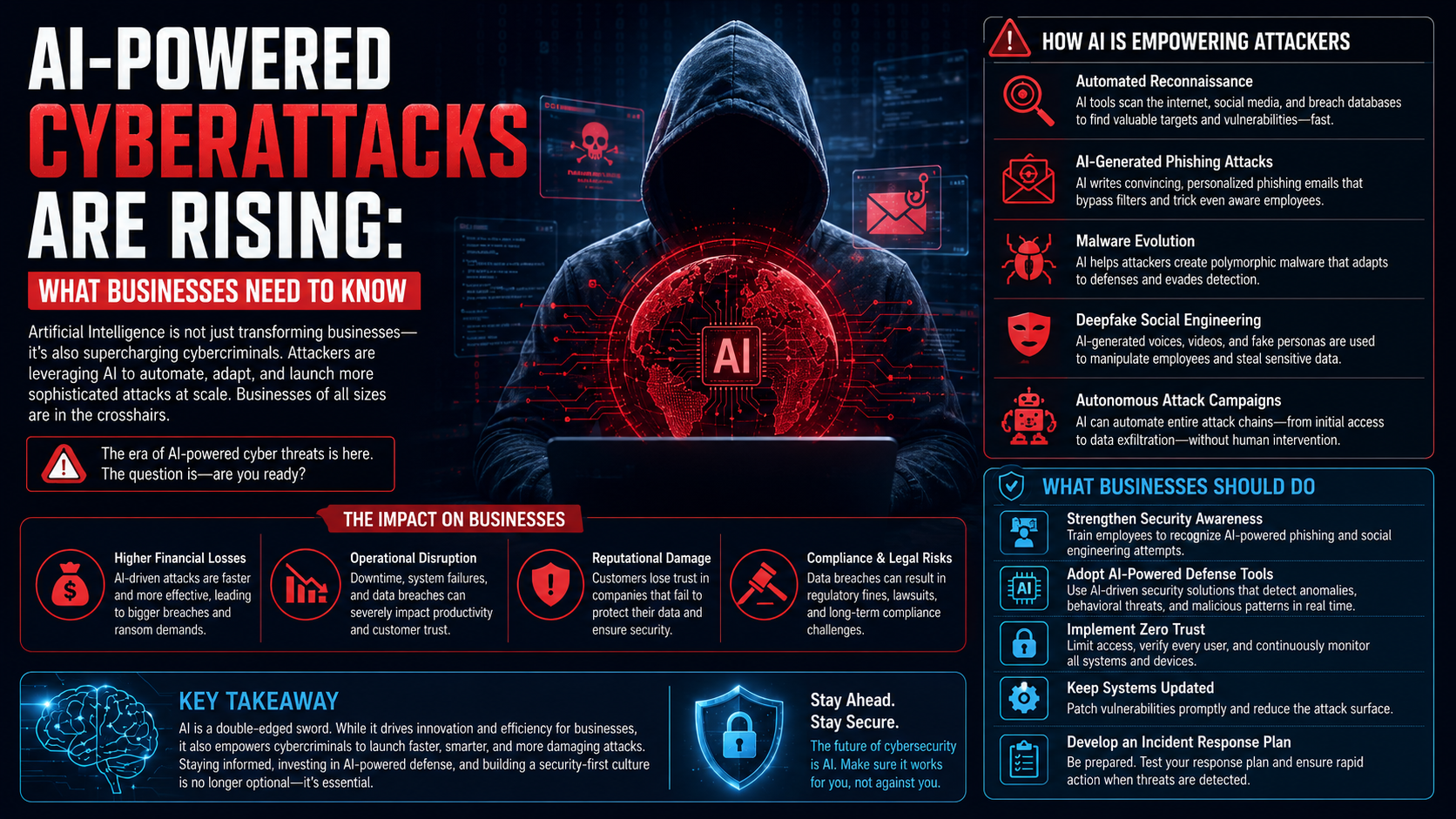
From AI-generated phishing emails to automated malware development and deepfake scams, attackers are finding new ways to exploit organizations. Small businesses, large enterprises, healthcare providers, financial institutions, and government agencies are all becoming potential targets. As AI technology becomes more accessible, experts believe these attacks will continue to increase, making cybersecurity a top priority for every organization.
AI Is Changing the Cyber Threat Landscape
Artificial intelligence has become a powerful tool for automation, but it is not only helping legitimate businesses. Cybercriminals are using AI to improve existing attack methods and develop entirely new strategies. Instead of spending days researching a target or writing malicious code manually, attackers can now automate many parts of the process.
AI systems can quickly analyze public information, identify potential victims, generate realistic emails, create fake websites, and even imitate writing styles. This allows attackers to launch campaigns at a scale that was previously impossible while increasing the chances of deceiving employees.
Unlike older cyberattacks that relied on generic messages, AI-powered attacks are becoming increasingly personalized and convincing.
Smarter Phishing Emails Are Fooling More Employees
Phishing remains one of the most common ways attackers gain access to business networks, but artificial intelligence has made these scams significantly more effective.
AI can generate professional emails with proper grammar, personalized greetings, and realistic business language. Attackers no longer need poor spelling or suspicious wording that once made phishing attempts easier to identify. Instead, employees may receive emails that appear to come from senior executives, trusted vendors, customers, or financial institutions.
Some campaigns even analyze publicly available information from company websites and social media profiles to create messages tailored to specific employees. This level of personalization increases the likelihood that someone will click a malicious link or open an infected attachment. Businesses that rely only on traditional email filters may struggle to detect these increasingly sophisticated attacks.
Deepfake Technology Is Creating New Security Risks
Deepfake technology has advanced rapidly over the past few years, making it easier to create realistic audio and video recordings that imitate real people.
Cybercriminals are using AI-generated voices to impersonate company executives during phone calls. In some reported incidents, employees have been instructed to approve financial transfers or share confidential information after believing they were speaking with a trusted manager.
Video deepfakes present another growing concern. As image and video generation technologies continue improving, attackers may use fake video meetings or recorded messages to manipulate employees into revealing sensitive data or approving unauthorized transactions. Organizations are beginning to adopt additional verification procedures for high-value financial requests and sensitive business decisions to reduce these risks.
AI Is Accelerating Malware Development
Developing sophisticated malware once required advanced programming skills and significant time. Artificial intelligence is making this process faster by helping attackers identify software weaknesses, modify malicious code, and generate multiple variations designed to bypass security software.
Some AI-assisted malware can adjust its behavior depending on the environment where it is running. Instead of following a fixed pattern, it can avoid detection by changing execution methods or delaying malicious actions until security monitoring becomes less active. This adaptability makes malware analysis more difficult and increases the importance of behavioral detection rather than relying only on known malware signatures.
Password Attacks Are Becoming More Efficient
Weak passwords continue to be a major cybersecurity problem, and artificial intelligence is helping attackers improve password-cracking techniques. AI can analyze leaked credential databases, identify common password patterns, and predict likely password combinations based on user behavior. This allows attackers to optimize brute-force and credential-stuffing attacks while reducing the number of failed login attempts. Organizations that still depend only on passwords are exposing themselves to unnecessary risk. Multi-factor authentication, password managers, and strong password policies remain essential defenses against these attacks.
Automated Vulnerability Discovery
Attackers no longer need to manually scan every target for security weaknesses. AI-powered tools can automatically search websites, cloud environments, web applications, APIs, and connected devices for vulnerabilities.
Once weaknesses are identified, attackers can prioritize the most valuable targets and begin exploitation much faster than before. This increased speed means businesses have less time to apply software updates or security patches before vulnerabilities are exploited. Regular vulnerability assessments and timely patch management have become even more important in 2026.
Ransomware Is Becoming More Intelligent
Ransomware continues to be one of the most damaging cyber threats affecting businesses worldwide. Artificial intelligence is making these attacks more targeted and efficient.
Instead of encrypting every file immediately, AI-assisted ransomware may first analyze an organization’s network, identify critical systems, locate backup servers, and determine the most valuable data before launching the attack.
Some ransomware groups also use AI to estimate a company’s financial resources and adjust ransom demands accordingly. This allows attackers to maximize profits while increasing pressure on victims. Organizations with strong backup strategies, network segmentation, and incident response plans are generally better prepared to recover from these attacks.
Social Engineering Is Reaching a New Level
Cybercriminals have always relied on human psychology, but AI is making social engineering campaigns much more convincing. By analyzing publicly available information, attackers can learn about employee roles, business relationships, recent projects, and organizational structures. This information helps create highly believable conversations that appear legitimate. Employees may receive messages referencing recent meetings, ongoing projects, or real business partners, making fraudulent requests much harder to identify. Security awareness training remains one of the most effective ways to reduce the success of these attacks.
Small Businesses Are Also at Risk
Many small business owners believe cybercriminals primarily target large corporations, but this is no longer the case. Artificial intelligence allows attackers to automate campaigns against thousands of organizations simultaneously. Small businesses often have fewer cybersecurity resources, making them attractive targets. A successful attack can result in financial losses, operational disruption, legal challenges, and damage to customer trust. Even organizations with fewer employees should implement essential cybersecurity measures to reduce their exposure.
AI Is Also Strengthening Cybersecurity
Although attackers are using AI aggressively, businesses are also benefiting from artificial intelligence. Modern cybersecurity platforms use AI to detect unusual network activity, identify suspicious login attempts, monitor endpoint behavior, and prioritize security alerts. Instead of forcing analysts to review thousands of notifications, AI helps identify the incidents that require immediate attention. Some security platforms can automatically isolate compromised devices or block malicious traffic before attackers achieve their objectives. This balance between offensive and defensive AI is becoming one of the defining characteristics of cybersecurity in 2026.
Best Practices for Businesses
Organizations cannot eliminate cyber risks entirely, but they can significantly reduce their chances of becoming victims by strengthening their cybersecurity programs. Regular employee awareness training helps staff recognize phishing attempts and social engineering tactics before they cause damage. Multi-factor authentication should be enabled across all business accounts to protect against credential theft. Keeping operating systems, applications, and security software fully updated closes vulnerabilities that attackers frequently exploit. Businesses should also perform regular data backups, implement endpoint detection and response solutions, monitor network activity continuously, restrict administrative privileges, and maintain a tested incident response plan. Conducting periodic security assessments allows organizations to identify weaknesses before attackers do. A layered cybersecurity strategy remains the most effective defense against evolving AI-powered threats.
Why Human Oversight Still Matters
Despite rapid advances in artificial intelligence, cybersecurity cannot rely entirely on automated systems. Human analysts remain essential for investigating complex attacks, making strategic decisions, responding to major security incidents, and evaluating emerging threats. AI can process large amounts of information quickly, but experienced security professionals provide context, judgment, and expertise that automated systems cannot fully replace. The most effective security operations combine AI-powered detection with skilled cybersecurity teams working together to protect business assets.
Looking Ahead
Artificial intelligence will continue shaping both cybersecurity defenses and cybercrime throughout the coming years. As AI models become more powerful and widely available, attackers are expected to develop increasingly sophisticated phishing campaigns, malware, deepfake scams, and automated exploitation techniques.
At the same time, cybersecurity vendors are investing heavily in AI-driven defense technologies that improve threat detection, automate incident response, and strengthen enterprise security. This ongoing competition between attackers and defenders will define the cybersecurity landscape for years to come. Businesses that remain proactive, invest in employee education, adopt modern security technologies, and regularly review their cybersecurity strategies will be better prepared to face the challenges of an AI-driven threat environment.
Conclusion
AI-powered cyberattacks are no longer a future concern—they are already affecting businesses across industries in 2026. Criminal groups are using artificial intelligence to automate phishing campaigns, create convincing deepfakes, develop smarter malware, discover vulnerabilities, and improve social engineering attacks. These capabilities are making cyber threats more efficient and harder to detect than ever before.
The good news is that organizations can respond effectively by combining strong cybersecurity practices with AI-powered defensive technologies. Regular training, multi-factor authentication, timely software updates, continuous monitoring, and well-prepared incident response plans remain essential. As artificial intelligence continues to evolve, businesses that prioritize cybersecurity today will be far better positioned to protect their operations, customers, and reputation against tomorrow’s increasingly sophisticated digital threats.

