Cloud computing continues to evolve as one of the most important technologies driving digital transformation. In 2026, organizations are moving beyond simple cloud migration and focusing on building intelligent, secure, and flexible cloud environments that support artificial intelligence, advanced analytics, and modern business applications. Enterprises are also reassessing their cloud investments as they balance innovation with rising infrastructure costs, stricter regulations, and growing cybersecurity risks.
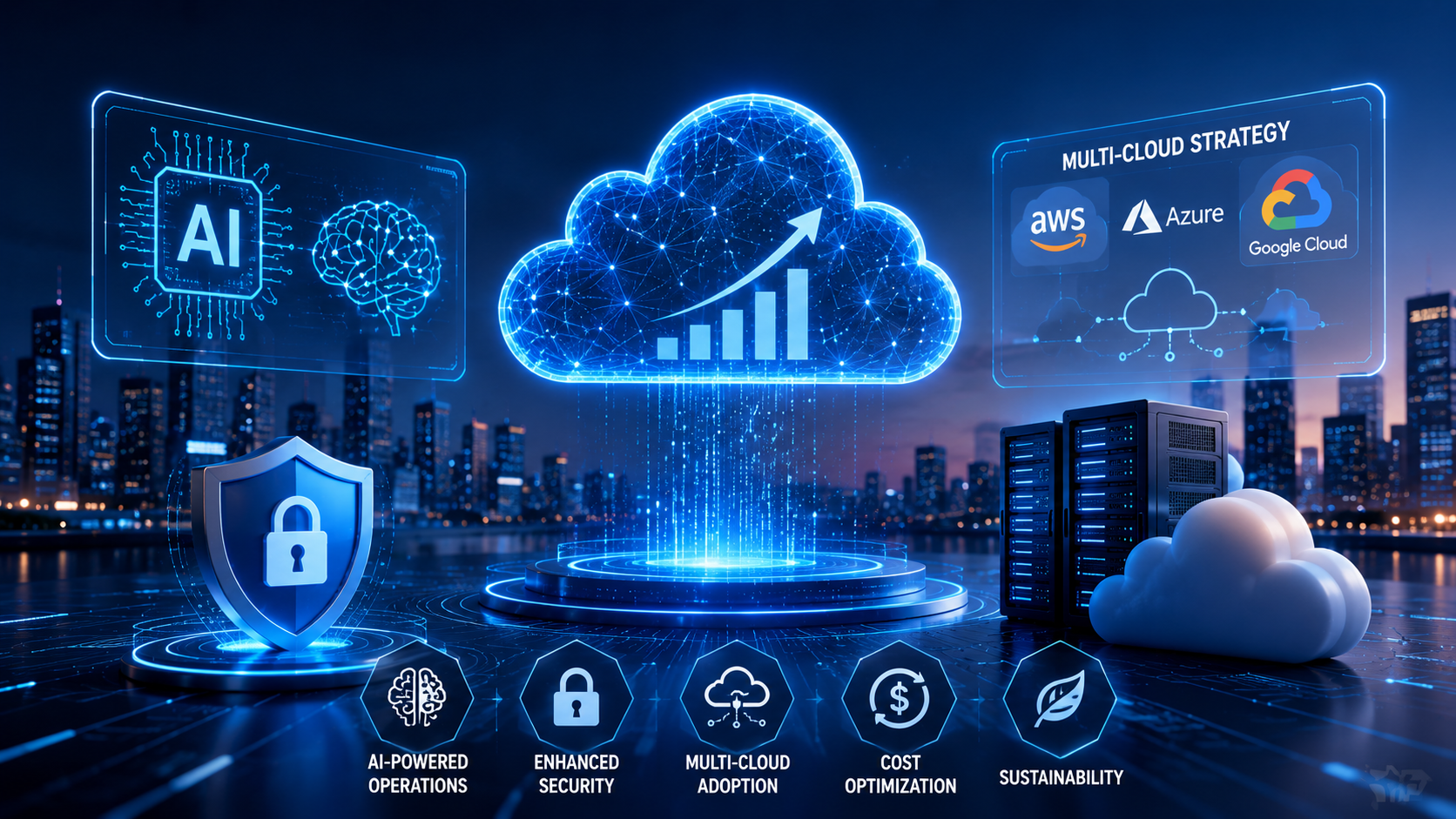
Artificial intelligence is now influencing how cloud platforms are designed, managed, and optimized. At the same time, businesses are strengthening security, adopting multi-cloud strategies, and investing in cloud architectures that reduce vendor lock-in while improving resilience. These trends are shaping the future of enterprise IT and influencing technology decisions across industries.
AI Is Becoming the Driving Force Behind Cloud Innovation
Artificial intelligence is no longer an optional feature in cloud computing. It has become one of the primary reasons organizations are expanding their cloud infrastructure. AI models require significant computing power, scalable storage, and high-performance networking, making cloud platforms the preferred environment for developing and deploying intelligent applications.
Cloud providers are introducing AI-focused services that allow businesses to build, train, and manage machine learning models without investing in expensive on-premises hardware. Organizations are also using cloud-based AI to automate customer service, analyze business data, improve software development, detect cyber threats, and streamline business operations.
Rather than treating AI as a separate technology, enterprises are increasingly integrating it into their cloud strategies to improve productivity and accelerate innovation. Industry analysts expect AI workloads to become one of the largest drivers of cloud spending throughout 2026.
Multi-Cloud Strategies Continue to Gain Momentum
One of the biggest cloud computing trends in 2026 is the continued growth of multi-cloud adoption. Instead of relying on a single cloud provider, organizations are distributing workloads across multiple platforms to improve flexibility, reduce operational risks, and avoid vendor lock-in.
A multi-cloud strategy allows businesses to select different providers based on workload requirements. One provider may offer better AI services, while another delivers stronger analytics, storage, or networking capabilities. This approach enables organizations to optimize performance while maintaining greater control over costs and infrastructure.
Businesses also recognize that depending entirely on one cloud platform creates potential risks if service outages, pricing changes, or regional disruptions occur. By spreading workloads across multiple providers, organizations improve business continuity while maintaining operational flexibility. Surveys conducted during the past year indicate that multi-cloud and hybrid cloud environments have become the preferred deployment model for many enterprise IT teams.
Security Is Becoming the Highest Priority
As organizations migrate more critical workloads to the cloud, cybersecurity remains one of the biggest concerns for business leaders. Cloud environments now store sensitive customer information, financial records, intellectual property, healthcare data, and operational systems. Protecting these assets requires much more than traditional perimeter security.
Enterprises are investing in identity and access management, encryption, continuous monitoring, cloud-native security platforms, and zero trust architectures. Security teams are also adopting AI-powered threat detection systems capable of identifying suspicious behavior before attackers gain access to critical resources.
Instead of treating security as an afterthought, organizations are embedding security controls throughout the entire cloud lifecycle, from application development to deployment and ongoing operations. Security experts also emphasize the importance of consistent policies across hybrid and multi-cloud environments to eliminate configuration gaps that attackers often exploit.
AI Is Strengthening Cloud Security
While cybercriminals are increasingly using artificial intelligence to automate attacks, cloud providers are also using AI to strengthen their defensive capabilities. Modern cloud security platforms use machine learning to monitor billions of events every day. These systems identify unusual login behavior, detect abnormal network traffic, analyze application activity, and prioritize security alerts that require immediate investigation.
AI also helps security teams automate repetitive tasks such as vulnerability assessment, incident classification, malware detection, and policy enforcement. By reducing manual workloads, organizations can respond to security incidents much faster while allowing cybersecurity professionals to focus on more complex threats. The combination of AI-driven automation and human expertise is becoming the standard approach to cloud security in 2026.
Cost Optimization Is Receiving Greater Attention
Although cloud computing provides flexibility, many organizations are discovering that uncontrolled cloud spending can become a significant challenge. Businesses are increasingly adopting cloud cost optimization strategies to improve resource utilization without affecting performance. AI-powered monitoring tools now analyze infrastructure usage continuously, identify idle virtual machines, recommend storage optimization, and forecast future capacity requirements.
Many enterprises are also implementing FinOps practices, bringing finance, operations, and engineering teams together to improve visibility into cloud expenses. Better cost management allows organizations to maximize the value of their cloud investments while avoiding unnecessary infrastructure costs. Cloud providers are also introducing more intelligent pricing models and automation features that help customers optimize workloads based on real-time demand.
Data Sovereignty Is Influencing Cloud Decisions
Regulatory compliance has become another important factor shaping cloud strategies in 2026. Many organizations operate across multiple countries, each with different regulations regarding data privacy, storage, and cross-border transfers. Businesses handling financial information, healthcare records, or government data must ensure sensitive information remains within approved geographic regions.
As a result, sovereign cloud solutions and regional cloud deployments are becoming increasingly popular. These environments provide greater control over where data is stored while helping organizations comply with local regulatory requirements. Data sovereignty is no longer viewed as a niche concern but as an important consideration for multinational organizations adopting cloud technologies.
Hybrid Cloud Remains a Practical Choice
Despite continued investment in public cloud services, many organizations are not moving every workload to the cloud. Hybrid cloud environments, which combine public cloud platforms with private infrastructure or on-premises data centers, continue to play an important role in enterprise IT. Businesses often keep sensitive workloads on private infrastructure while using public cloud resources for scalability, application development, disaster recovery, and AI workloads.
This balanced approach provides flexibility while allowing organizations to meet compliance requirements and optimize operational costs. Hybrid cloud also enables gradual modernization, allowing businesses to upgrade legacy systems without disrupting existing operations.
Cloud-Native Applications Continue to Grow
Organizations are increasingly building applications specifically for cloud environments instead of adapting older software. Cloud-native development uses containers, microservices, Kubernetes, serverless computing, and automated deployment pipelines to create scalable and resilient applications. These technologies allow development teams to release updates more frequently while improving reliability and reducing downtime.
Artificial intelligence is further accelerating cloud-native development by assisting developers with code generation, testing, deployment automation, and performance optimization. As enterprises continue modernizing software infrastructure, cloud-native applications are expected to remain one of the fastest-growing areas of cloud computing.
Skills Shortages Are Driving Automation
The demand for cloud engineers, cybersecurity professionals, AI specialists, and DevOps experts continues to exceed supply. To address this challenge, organizations are using AI-driven automation to simplify cloud management and reduce manual workloads. Intelligent monitoring systems can automatically detect performance issues, optimize infrastructure, recommend security improvements, and perform routine maintenance tasks.
At the same time, businesses are investing in workforce training to help IT professionals develop expertise in cloud architecture, AI integration, cybersecurity, and automation technologies. Building internal cloud expertise remains an important priority as enterprise cloud environments become more sophisticated.
Sustainability Is Becoming Part of Cloud Strategy
Environmental sustainability is influencing technology investments across many industries. Cloud providers continue investing in energy-efficient data centers, renewable energy projects, advanced cooling technologies, and carbon reduction initiatives. Organizations are also evaluating cloud providers based on sustainability goals alongside performance and pricing.
AI is helping optimize energy consumption by automatically adjusting computing resources according to workload demand. This reduces wasted infrastructure capacity while lowering operational costs and environmental impact. Businesses are increasingly viewing cloud sustainability as both an environmental responsibility and a long-term business advantage.
Challenges Businesses Still Face
Despite rapid innovation, cloud adoption continues to present several challenges. Managing multiple cloud providers increases operational complexity and requires stronger governance. Security configurations must remain consistent across different environments to prevent vulnerabilities. Compliance requirements continue evolving, particularly for businesses operating internationally.
Organizations also face challenges integrating legacy systems with modern cloud platforms while controlling infrastructure costs. As AI adoption accelerates, businesses must ensure cloud environments provide sufficient computing resources without creating unnecessary financial burdens. Addressing these challenges requires careful planning, skilled personnel, and ongoing investment in cloud management practices.
Looking Ahead
Cloud computing is entering a new phase where artificial intelligence, automation, cybersecurity, and flexible infrastructure strategies are becoming closely connected. Businesses are no longer evaluating cloud platforms based solely on storage or computing capacity. Instead, they are looking for intelligent ecosystems capable of supporting AI applications, protecting sensitive information, reducing operational costs, and adapting to changing business requirements.
Multi-cloud strategies will likely continue expanding as organizations seek greater flexibility and resilience. Security will remain a top priority as AI-driven cyber threats become more sophisticated. At the same time, cloud providers are expected to introduce increasingly advanced AI services that simplify infrastructure management and accelerate digital transformation.
Conclusion
Cloud computing in 2026 is defined by three major priorities: artificial intelligence, stronger security, and flexible multi-cloud strategies. Enterprises are investing in AI-powered cloud services to improve automation and decision-making while strengthening cybersecurity to defend against increasingly sophisticated threats. Multi-cloud and hybrid cloud environments are helping organizations reduce vendor dependence, improve resilience, and optimize performance across diverse workloads.
Although challenges such as rising costs, compliance requirements, and operational complexity remain, cloud computing continues to evolve as the foundation of modern enterprise technology. Organizations that embrace AI responsibly, implement comprehensive security practices, and develop well-planned multi-cloud strategies will be better positioned to compete in an increasingly digital business environment.

