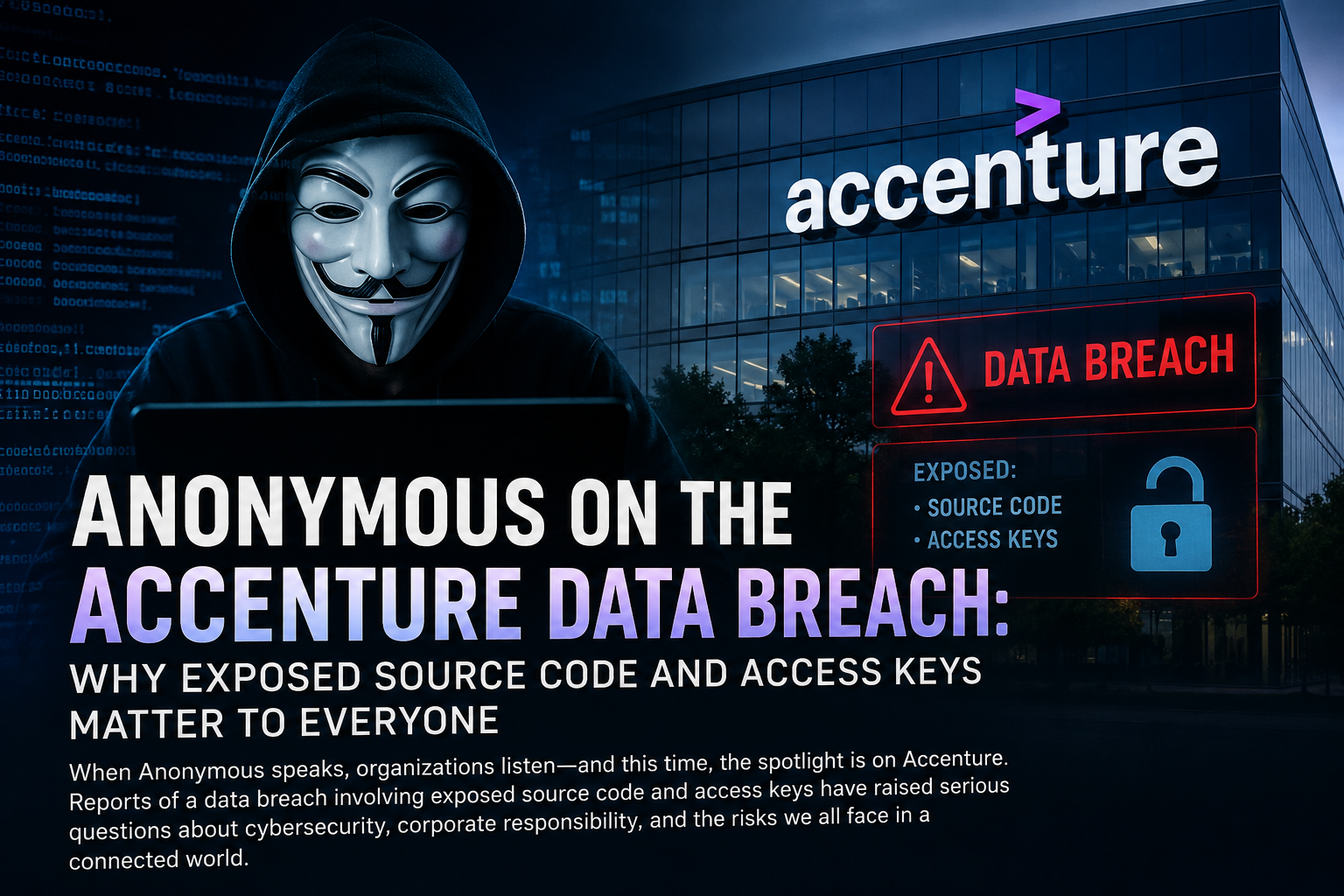
One of the world’s largest consulting and technology companies, Accenture, has confirmed a cybersecurity incident after a threat actor claimed to have stolen approximately 35 GB of internal data, including source code, cloud credentials, cryptographic keys, and configuration files. While the company stated that it had remediated the source of the incident and that there was no impact on operations or service delivery, the claims have raised serious questions about software supply chain security and enterprise credential management. Public reports indicate that the full scope of the alleged stolen data has not yet been independently verified.
Why Source Code Matters
Unlike customer databases or financial records, source code represents the blueprint of an organization’s software. If attackers gain access to proprietary code, they may:
- Study application architecture.
- Search for undiscovered vulnerabilities.
- Identify hard-coded credentials or secrets.
- Better understand internal security controls.
- Develop more sophisticated future attacks.
Source code alone does not automatically compromise systems, but when combined with cloud credentials, encryption keys, or deployment configurations, the overall risk increases significantly.
The Bigger Concern: Access Keys and Tokens
According to publicly reported claims, the alleged data includes Azure access tokens, SSH keys, RSA keys, and configuration files. These types of credentials are often more valuable than the source code itself because they may provide direct access to cloud resources if they remain active.
Modern organizations typically rotate credentials, revoke compromised tokens, and audit privileged access immediately after discovering an incident. If these actions are performed quickly, the practical risk can be greatly reduced. At this stage, there is no public confirmation that the alleged credentials remain valid.
Why Large Consulting Firms Are Attractive Targets
Global consulting firms manage or help operate critical systems for governments, financial institutions, healthcare organizations, manufacturers, and Fortune 500 companies. Because of this central position, attackers often view them as high-value targets.
Compromising a major consulting company can potentially provide intelligence about enterprise environments, cloud deployments, development practices, and trusted business relationships—even if customer systems themselves are not directly breached.
What Organizations Should Learn
This incident highlights several cybersecurity best practices:
- Store secrets outside source code repositories.
- Rotate access keys regularly.
- Apply least-privilege access controls.
- Monitor repositories for exposed credentials.
- Protect DevOps environments with strong authentication.
- Continuously audit cloud identities and service accounts.
- Maintain rapid incident response procedures for credential revocation.
Organizations should also implement automated secret-scanning tools within development pipelines to prevent sensitive credentials from being committed into repositories.
Avoid Jumping to Conclusions
Cybersecurity investigations evolve over time. Although Accenture has acknowledged a security incident, many details surrounding the alleged stolen data—including the exact attack method, the complete scope of the breach, and whether client information was affected—have not been publicly confirmed.
Separating verified facts from claims made by threat actors is essential. Cybercriminals sometimes exaggerate the amount or sensitivity of stolen information to increase its value on underground forums or to pressure victims.
Final Thoughts
The Accenture incident serves as another reminder that cybersecurity is no longer just about protecting customer information. Development environments, cloud infrastructure, source code repositories, and access credentials have become prime targets for modern attackers.
Whether or not every public claim about this breach proves accurate, the event reinforces an important lesson: protecting software development infrastructure is now just as critical as protecting production systems. In an era where digital services underpin nearly every industry, securing code, credentials, and cloud environments has become a fundamental requirement for maintaining trust and resilience.

