When people hear the word Anonymous, different images come to mind. Some may picture a group of masked hackers sitting behind computer screens, others may imagine activists fighting against injustice, and some may think of mysterious figures whose identity is hidden from the world. But what exactly does the term Anonymous group mean? Is it one single organization, or is it something bigger, more fluid, and harder to define?
In this article, we will break down the meaning of the Anonymous group, its origins, its philosophy, and why it has become one of the most intriguing movements of the digital age. We will also explore how the group is viewed by society, governments, and the media. By the end, you will understand that Anonymous is not just about hacking—it’s about a unique form of digital activism that combines mystery, power, and a sense of global unity.
The Word “Anonymous” – A Simple Beginning
To understand the group, we first need to understand the word itself. The term “anonymous” simply means without a name or unknown identity. It suggests someone or something that cannot be traced to an individual. In daily life, you might receive an anonymous letter, an anonymous donation, or even browse the internet anonymously.
When applied to the group, this meaning becomes the foundation of their identity. Members of Anonymous hide their real names and faces. They don’t work for fame or recognition; instead, they work behind the mask of secrecy. Their power comes from not being tied to a single person or leader.
How the Anonymous Group Started
The Anonymous movement did not begin as a political force or a hacking organization. Its roots go back to the early 2000s on websites such as 4chan, an imageboard known for its chaotic and unfiltered culture. On these platforms, people often posted without revealing their identities. Users began signing their posts simply as “Anonymous.”
Over time, this shared identity grew into something larger. By 2006–2007, Anonymous users were collaborating on pranks, internet memes, and online campaigns. What began as internet humor slowly evolved into a collective force for protest.
The real turning point came in 2008 when Anonymous launched Project Chanology, a protest against the Church of Scientology. Thousands of people wearing the now-famous Guy Fawkes mask took to the streets, demanding transparency and freedom of information. This was the first time the world saw Anonymous not just as a group of internet pranksters, but as a movement with political and social goals.
The Symbol of the Mask
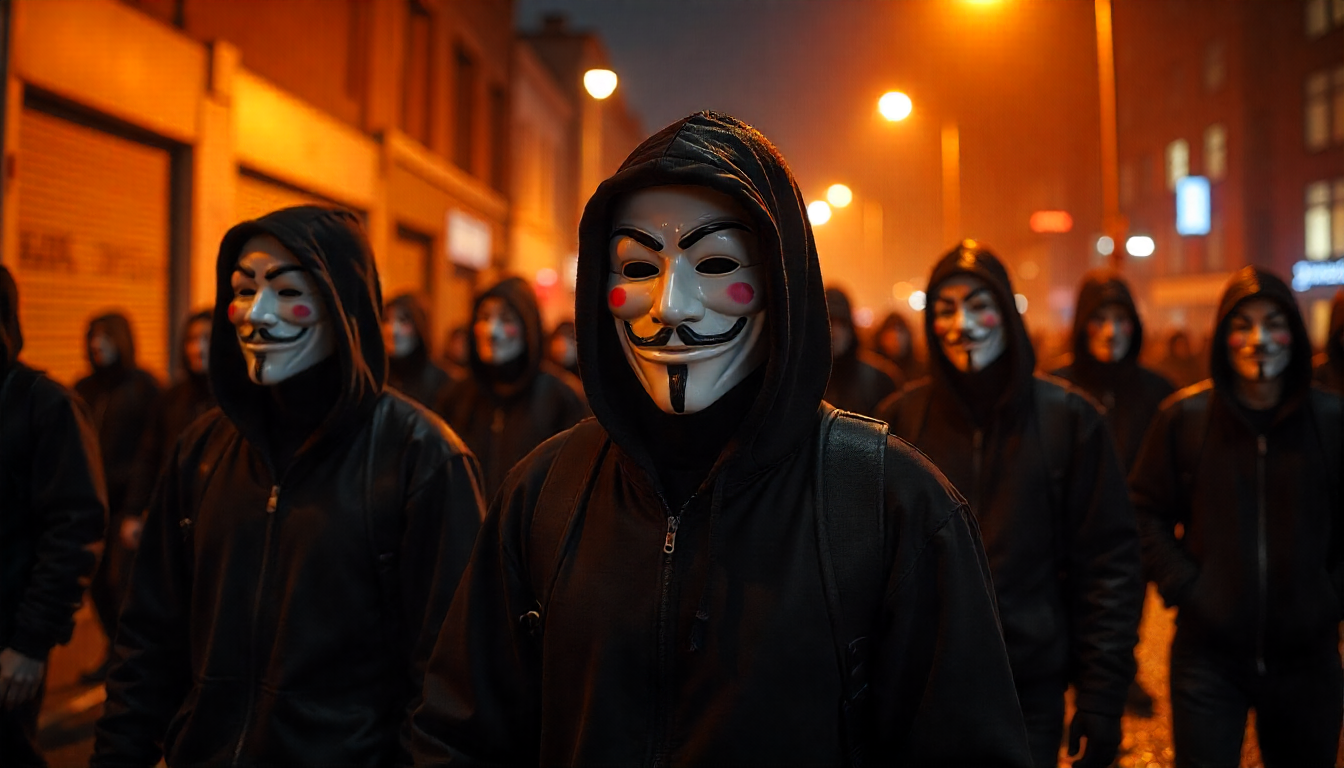
If you think about Anonymous, one of the first things that comes to mind is the Guy Fawkes mask—the white smiling face with a pointed beard and mustache. The mask comes from the movie V for Vendetta, which itself was inspired by the story of Guy Fawkes, a man who tried to blow up the English Parliament in 1605.
The mask represents rebellion against corruption, control, and injustice. For Anonymous, it became the perfect symbol. Wearing the mask means anyone can be Anonymous, and no one can tell who is behind it. It gives power to the idea rather than to the individual.
What Does the Anonymous Group Stand For?
This is where things get interesting. Anonymous is not a traditional organization. There are no membership cards, no headquarters, no leaders, and no rules written in stone. Instead, it is often described as a decentralized movement or a collective idea.
Despite this lack of structure, there are some common values that unite people under the Anonymous banner:
-
Freedom of Information – Anonymous strongly believes that information should be free and accessible to all. They often target organizations that try to hide information or restrict knowledge.
-
Anti-Censorship – The group opposes censorship on the internet or in society. They believe people should have the right to speak freely without fear.
-
Fighting Corruption – Many of their operations are against governments, corporations, or groups accused of corruption or abuse of power.
-
Defending the People – Anonymous often takes action in defense of ordinary citizens, especially when they feel that people are being silenced, exploited, or oppressed.
In short, Anonymous stands for digital activism, freedom, and justice, though their methods are controversial.
Is Anonymous a Hacking Group?
One of the most common questions is whether Anonymous is purely a hacking group. The answer is not exactly.
While many operations involve hacking—such as taking down websites (DDoS attacks), leaking secret documents, or defacing pages—Anonymous is broader than just hacking. It also includes activists, street protesters, whistleblowers, and even regular internet users who support their causes.
Some members are skilled hackers, but others may only share information, spread awareness, or participate in online campaigns. This diversity makes Anonymous unique—it is a combination of hacktivism and social activism.
The Decentralized Nature of Anonymous
To truly understand the meaning of the Anonymous group, you need to realize that it has no central control. Unlike political parties or NGOs, there is no boss or manager. Anyone, anywhere, can declare themselves part of Anonymous.
For example, if a group of people launches an operation against a corrupt government and uses the name Anonymous, they become part of it. There is no official verification needed. This decentralized nature makes it both powerful and chaotic.
-
Powerful because it cannot be easily destroyed. Arresting one member does not end Anonymous.
-
Chaotic because not everyone agrees on the same goals, and sometimes actions carried out under the Anonymous name are controversial.
Famous Operations of Anonymous
To understand the group better, let’s look at some of its major operations:
-
Project Chanology (2008) – The protest against the Church of Scientology that brought Anonymous into global spotlight.
-
Operation Payback (2010) – In response to companies cutting off donations to WikiLeaks, Anonymous launched cyberattacks on PayPal, Visa, and Mastercard.
-
Arab Spring Support (2011) – Anonymous supported uprisings in Tunisia and Egypt by attacking government websites and spreading information to citizens.
-
Operation Ferguson (2014) – In response to police violence in the U.S., Anonymous leaked police information and supported protest movements.
-
Operations against Russia (2022) – During the Russia-Ukraine conflict, Anonymous carried out large-scale cyberattacks against Russian state media and government institutions.
These examples show that Anonymous is not just about pranks—it often positions itself as a defender of freedom and justice.
Criticism of Anonymous
While many admire Anonymous for standing up against corruption and censorship, critics argue that their actions are sometimes reckless or even harmful.
-
Illegal Methods – Hacking and DDoS attacks are against the law in most countries. Governments see these actions as cybercrime.
-
Collateral Damage – Sometimes innocent people or organizations get caught in the middle of Anonymous operations.
-
Lack of Accountability – Since anyone can act under the name Anonymous, it is hard to know who is truly responsible for certain actions.
-
Mixed Messages – With no leadership, different factions of Anonymous sometimes pursue conflicting goals, which confuses the public.
These criticisms highlight the complexity of the group. While it can be a force for good, it can also be unpredictable.
Anonymous as an Idea
Perhaps the best way to understand the meaning of the Anonymous group is not to think of it as a traditional organization, but as an idea.
Anonymous is like a banner under which people gather when they want to challenge power. It is a symbol of resistance, digital freedom, and unity among strangers. You cannot destroy Anonymous because it does not exist as a physical entity—it lives in the minds of people.
As the famous phrase often linked to the group says: “We are Anonymous. We are Legion. We do not forgive. We do not forget. Expect us.”
This phrase reflects both the mystery and the power of the movement.
The Human Side of Anonymous
Behind the masks and computer screens are real people. They may be students, workers, activists, or even ordinary citizens. What unites them is a feeling of injustice and a desire to make a difference.
Unlike traditional activists, Anonymous members often choose to remain in the shadows. This anonymity allows them to act without fear but also removes personal credit. It is activism without ego, where the cause matters more than the individual.
In a way, Anonymous represents the modern age of protest—where people do not need to stand on a stage with a microphone but can still make their voices heard across the world.
The Future of Anonymous
So, what does the future hold for the Anonymous group?
Technology is constantly changing, and so are the challenges of society. Governments are becoming more advanced in surveillance, corporations are tightening their grip on data, and conflicts around the world are increasingly fought in cyberspace.
In this environment, movements like Anonymous may continue to grow. They may evolve with new tools such as artificial intelligence, blockchain, or advanced hacking techniques. However, the decentralized and unpredictable nature of Anonymous means that it will likely remain a mystery.
Whether you see them as heroes or villains, Anonymous has already secured its place in history as one of the most fascinating digital movements of our time.
Final Thoughts
The meaning of the Anonymous group cannot be explained in one simple sentence. It is not a company, not a political party, and not a traditional hacking collective. Instead, it is a decentralized movement of people united by shared values of freedom, justice, and resistance to corruption.
For some, Anonymous is a dangerous threat to order. For others, it is a modern-day Robin Hood standing up for the powerless. But no matter which side you are on, one thing is clear: Anonymous represents the power of ordinary people in the digital age. The mask, the name, and the idea remind us that anyone—anywhere—can rise up and become part of something bigger than themselves. And perhaps, that is the true meaning of the Anonymous group.

