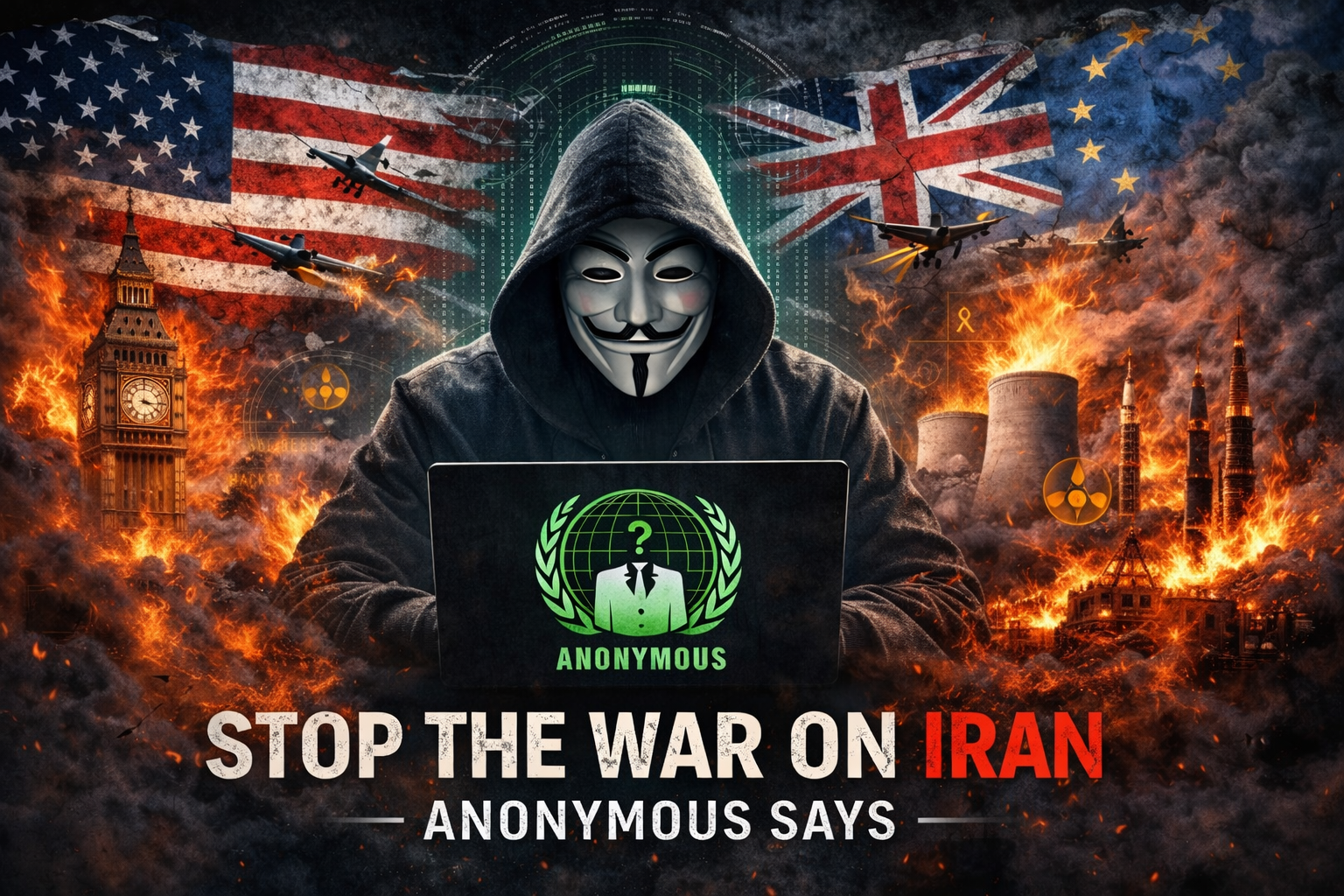
The internet is no longer just a place for communication. It has become a battlefield of ideas, influence, and resistance. As tensions rise in the Middle East, a powerful message is spreading rapidly across social media and online communities:
“Stop the War on Iran.”
This message, widely linked to Anonymous and similar digital activists, is gaining attention around the world. While governments continue military operations, a different kind of resistance is unfolding online—one driven by public opinion, emotion, and a growing demand for accountability.
A Conflict That Escalated Quickly
The current situation involving Iran has developed faster than many expected. What started as targeted strikes has grown into a much larger conflict, with multiple countries involved and increasing global consequences.
Major cities have been affected, critical infrastructure has been damaged, and thousands of lives have been disrupted. The impact is not limited to the region alone. Rising fuel prices, economic uncertainty, and political tension are being felt worldwide.
Instead of moving toward peace, the situation appears to be intensifying. Strong responses from all sides have created a cycle where each action leads to another, making it harder to step back and de-escalate.
Why Anonymous Is Speaking Out
Anonymous has always positioned itself as a voice against power when it believes that power is being misused. In conflicts like this, the group often amplifies messages that question authority and highlight humanitarian concerns.
The slogan “Stop the War on Iran” reflects several key concerns that are being discussed widely online.
Perceived Imbalance of Power
Many people believe that Iran is facing pressure from stronger military forces. This has created a narrative where one side appears significantly more powerful, leading to questions about fairness and proportional response.
Human Cost of the War
Images and stories of civilians affected by the conflict have spread quickly online. Families losing homes, communities being disrupted, and everyday life turning into uncertainty have made the situation more emotional for people around the world.
Doubts and Debate
There is also growing discussion about whether the conflict was unavoidable. Different viewpoints are emerging, with some questioning decisions made by governments and others defending them. This debate has fueled online activism and increased interest in alternative perspectives.
The Rise of Digital Resistance
In today’s world, conflicts are not limited to physical battlefields. The digital space plays a major role, and in this case, it has become highly active.
Hacktivist groups and online communities are using various methods to express their stance:
-
Trending hashtags and viral posts
-
Online campaigns raising awareness
-
Website disruptions and symbolic actions
-
Calls for protests and global attention
Anonymous is part of this broader wave. Its influence does not come from a central authority, but from the collective voice of individuals who share similar beliefs. These digital efforts may not directly stop a war, but they shape how people see it. And public perception can influence decisions in powerful ways.
Iran’s Stand and Ongoing Tension
Iran has shown no clear intention of backing down. The country’s leadership has taken a firm position, emphasizing resistance and long-term security. At the same time, actions taken in response to attacks have demonstrated that the conflict is not one-sided. This ongoing exchange has created a situation where both sides continue to escalate rather than step back. One of the biggest concerns is how this affects global stability. Trade routes, energy supplies, and international relations are all being impacted, making this more than just a regional issue.
A Conflict With Global Impact
Even countries not directly involved are feeling the consequences of the situation. Fuel prices are rising, markets are reacting, and cybersecurity threats are increasing. The world is closely watching, knowing that any further escalation could have serious global effects. What makes this conflict different is how quickly information spreads. Every development is shared instantly, and people everywhere are forming opinions in real time.
The Power of a Message
Anonymous understands the importance of narrative. In the digital age, the way a story is told can be just as powerful as the events themselves.
By promoting the message “Stop the War on Iran,” the group is trying to shift attention toward:
-
The human impact of the conflict
-
The need for accountability
-
The importance of questioning decisions
-
The urgency of finding peaceful solutions
A single phrase, when repeated by millions, can create pressure that leaders cannot ignore.
Activism or Oversimplification?
Not everyone agrees with the approach taken by Anonymous. Critics argue that complex geopolitical situations cannot be reduced to simple slogans. They believe that such messages may overlook important details and realities.
Supporters, however, see it differently. They argue that strong, simple messages are necessary to bring attention to urgent issues. Without them, many people might remain unaware or uninvolved. Both perspectives highlight an important truth: modern conflicts are not just about strategy and power, but also about perception and communication.
What Happens Next?
The future of this conflict remains uncertain. There are no clear signs of immediate resolution, and tensions continue to rise. However, history shows that public opinion can play a role in shaping outcomes. When enough voices come together, they can influence discussions and decisions at the highest levels. The message “Stop the War on Iran” is part of that growing chorus. Whether it leads to real change or not, it reflects a widespread desire for peace and stability.
Final Thoughts
The situation in Iran is not just a regional issue—it is a global concern with far-reaching consequences. As military actions continue, the digital world is becoming a space where people express resistance, share information, and demand answers. Anonymous, as a symbol of online activism, has once again entered the conversation. Its message is simple, but its impact depends on how many people choose to listen and respond. In a time when information travels faster than ever, voices from around the world are coming together. And while they may not control the outcome of the war, they are shaping how it is understood. Sometimes, that is where change begins.

