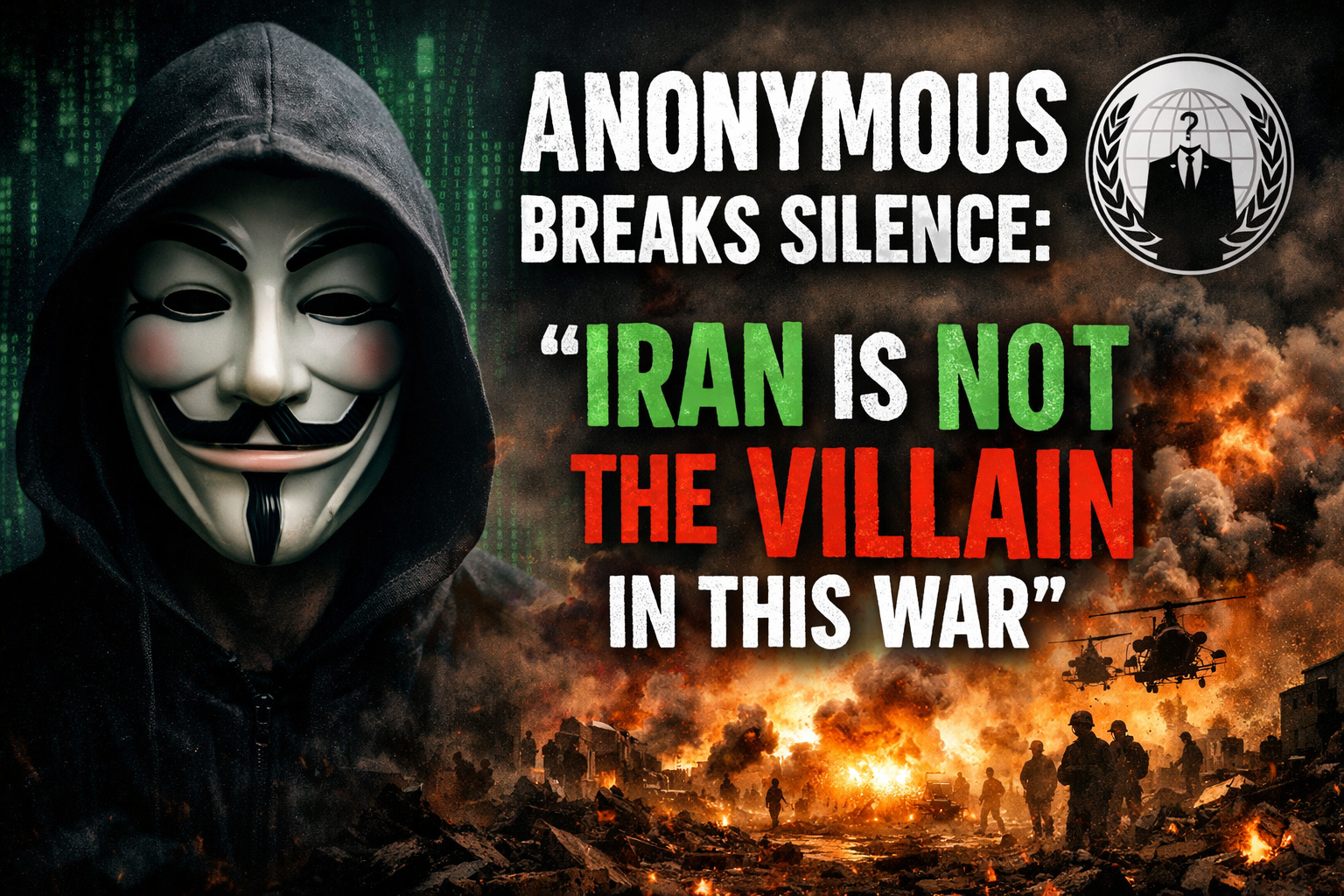
The Middle East is once again at the center of global attention as a fast-moving conflict reshapes political alliances, public opinion, and digital discourse. Missiles, airstrikes, and rising tensions have created a volatile situation—but alongside the physical war, another battle is unfolding online. In recent days, voices associated with Anonymous have begun pushing a controversial message: Iran is not the villain in this war. This statement has sparked intense debate across social media and forums. Some see it as a bold truth, others as a dangerous oversimplification. But one thing is certain—it has forced people to question how wars are framed and who gets labeled as the enemy.
A Conflict That Escalated Rapidly
What began as targeted military operations quickly turned into a broader confrontation. Strikes aimed at high-value targets escalated tensions almost overnight. In response, retaliation followed, spreading the conflict across multiple regions. The speed of escalation has been alarming. Within a short period, the situation shifted from controlled actions to widespread instability. Military responses intensified, and both sides showed no immediate signs of stepping back. For ordinary people, this rapid escalation means uncertainty, fear, and disruption to daily life.
The Power of Narratives in War
Every war is fought on two fronts: the battlefield and the story surrounding it. Governments, media outlets, and analysts all attempt to shape how events are perceived. One side is often presented as the aggressor, while the other is framed as defending itself. These narratives influence global reactions, alliances, and even public support. In this conflict, many mainstream narratives paint Iran as the primary threat. However, alternative voices argue that the situation is far more complex. This is where Anonymous enters the conversation.
Why Anonymous Is Taking This Position
Anonymous has never operated like a traditional organization. It does not have a central leadership or official spokesperson. Instead, it is a loose collective driven by shared ideas—often focused on exposing power imbalances and challenging dominant narratives. The message circulating now aligns with that pattern. From this perspective, the argument is not necessarily about defending Iran as a government. Instead, it is about questioning whether the global narrative is too one-sided.
Supporters of this view believe:
-
The conflict did not begin with a single act of aggression
-
Early actions triggered a chain reaction of escalation
-
Civilian suffering is not being equally highlighted
For Anonymous-aligned voices, the issue is less about choosing a side and more about challenging what they see as selective storytelling.
Looking at the Starting Point
Understanding any conflict requires looking at how it began. The early stages of this war involved high-impact military actions that targeted leadership and strategic infrastructure. These moves were seen by some as necessary and by others as provocative. From one angle, they were preemptive measures. From another, they were the spark that ignited a larger war. Anonymous supporters argue that these initial actions are often overshadowed by later developments. As a result, public focus shifts toward retaliation rather than the original trigger.
The Human Cost Often Gets Lost
Behind every headline are real people dealing with the consequences. Airstrikes damage homes, infrastructure, and essential services. Families are forced to leave their communities. Access to food, water, and healthcare becomes uncertain. At the same time, retaliatory actions also cause harm beyond borders, spreading the impact across the region. One of the key points emphasized in Anonymous messaging is that suffering exists on all sides. When one side is labeled as the sole villain, it can reduce empathy for those caught in the middle. This doesn’t change the facts of the conflict, but it changes how people emotionally respond to it.
The Rise of Digital Warfare
Modern wars are no longer limited to physical attacks. Cyber operations now play a major role in shaping outcomes. Systems can be disrupted, communications can be intercepted, and information can be manipulated—all without a single missile being launched. In this environment, Anonymous naturally becomes part of the conversation. Various online accounts linked to the movement have begun sharing posts, leaks, and opinions related to the conflict. These messages often aim to challenge official narratives and encourage independent thinking. This digital presence adds another layer to an already complex situation.
Power Dynamics and Perception
Another factor influencing this debate is the perception of power. When a conflict involves highly advanced military forces on one side and a regionally strong but comparatively constrained power on the other, public perception can shift. Anonymous has historically shown support for what it views as the less dominant side in such situations. This doesn’t necessarily mean endorsement of policies or actions—it often reflects a reaction to perceived imbalance. In this case, the message suggests that the stronger side’s actions deserve just as much scrutiny as those of its opponent.
The Other Side of the Argument
Of course, not everyone agrees with this perspective. Critics argue that focusing only on one part of the story can be just as misleading as ignoring it entirely. Iran’s military actions, regional influence, and strategic decisions are also significant factors in the conflict. Ignoring these elements risks creating a different kind of imbalance—one where responsibility is unevenly distributed. This is why the debate continues. Each side believes it is correcting a narrative, while the other sees it as distorting reality.
Information Warfare Is Changing Everything
One of the most striking aspects of modern conflicts is how quickly information spreads. Social media platforms allow messages to reach millions within minutes. Narratives evolve in real time, influenced by reactions, emotions, and viral content. Anonymous thrives in this environment. Its decentralized nature makes it difficult to control, and its messages often resonate with people who distrust traditional sources.
However, this also raises important questions:
-
How do we verify what we see online?
-
Where do opinions end and facts begin?
-
Can multiple conflicting narratives all hold some truth?
These questions are becoming just as important as the events themselves.
A Shift in How People View War
The growing influence of alternative voices signals a larger change. People are no longer relying solely on official statements to understand global events. They are exploring different perspectives, comparing viewpoints, and forming their own conclusions. This shift has both positive and negative effects. On one hand, it encourages critical thinking and reduces blind acceptance. On the other, it can lead to confusion, misinformation, and polarized opinions.The statement “Iran is not the villain” fits into this evolving landscape. It challenges people to rethink what they believe—but it also adds another layer of complexity.
Conclusion: A War Without Simple Answers
The idea that Iran is not the villain does not mean the situation is simple or one-sided. It highlights the fact that conflicts of this scale rarely fit into clear categories of right and wrong. There are actions, reactions, and consequences on all sides. Anonymous, as a movement, often steps into these gray areas—questioning dominant narratives and encouraging deeper analysis. Whether you agree with its stance or not, the conversation it sparks is important. Because in today’s world, understanding a war is not just about watching events unfold. It is about understanding the stories being told—and the ones that are not.


I still only have my perspective as to the reason for this war. Blackmail keeps associating itself with perspective.