Space exploration has always pushed the limits of human knowledge, technology, and imagination. From the first satellites orbiting Earth to robotic missions exploring distant planets, progress in space has depended on increasingly sophisticated tools. Today, artificial intelligence is becoming one of the most important enablers of modern space exploration. The vast distances, extreme environments, and communication delays involved in space missions make constant human control impractical. AI addresses these challenges by enabling spacecraft, rovers, and satellites to operate autonomously, analyze massive volumes of data, and adapt to unexpected conditions. As space agencies and private companies pursue more ambitious missions, AI is no longer optional. It is essential for expanding humanity’s reach beyond Earth and unlocking deeper understanding of the universe.
Why Space Exploration Needs Artificial Intelligence
Space is an environment defined by uncertainty, limited resources, and delayed communication. Signals between Earth and distant spacecraft can take minutes or even hours to travel, making real-time human control impossible. AI systems allow space missions to operate independently, making decisions without waiting for instructions from Earth. This autonomy is critical for mission success, especially in deep space exploration.
AI also addresses the overwhelming scale of space data. Telescopes, satellites, and scientific instruments generate enormous amounts of information, far more than human teams can analyze manually. AI processes this data efficiently, identifying patterns, anomalies, and discoveries that might otherwise go unnoticed. In this way, AI acts as both an explorer and an analyst, extending human capability across vast cosmic distances.
From Assisted Operations to Full Autonomy
Early space missions relied heavily on human oversight, with limited onboard decision-making. Modern missions increasingly depend on AI-driven autonomy, allowing systems to navigate, diagnose problems, and prioritize scientific tasks. This shift reduces risk, improves efficiency, and enables missions that would be impossible under constant human control.
AI in Autonomous Spacecraft and Navigation
Autonomous navigation is one of the most critical applications of AI in space exploration. Spacecraft must travel through complex gravitational environments, avoid obstacles, and adjust trajectories with extreme precision. AI algorithms analyze sensor data to determine position, velocity, and orientation, enabling spacecraft to navigate accurately without continuous input from Earth.
AI-powered navigation systems are particularly important for missions to asteroids, comets, and planetary surfaces. These environments are unpredictable and poorly mapped. AI allows spacecraft and landers to adapt in real time, adjusting paths to avoid hazards and identify optimal landing sites. This capability significantly increases mission safety and success rates.
Real-Time Decision-Making in Extreme Conditions
Spacecraft operate in harsh conditions where equipment failures can be catastrophic. AI systems monitor onboard systems continuously, detecting anomalies and responding automatically. By diagnosing issues early and executing corrective actions, AI reduces reliance on delayed human intervention and increases mission resilience.
AI-Driven Planetary Rovers and Surface Exploration
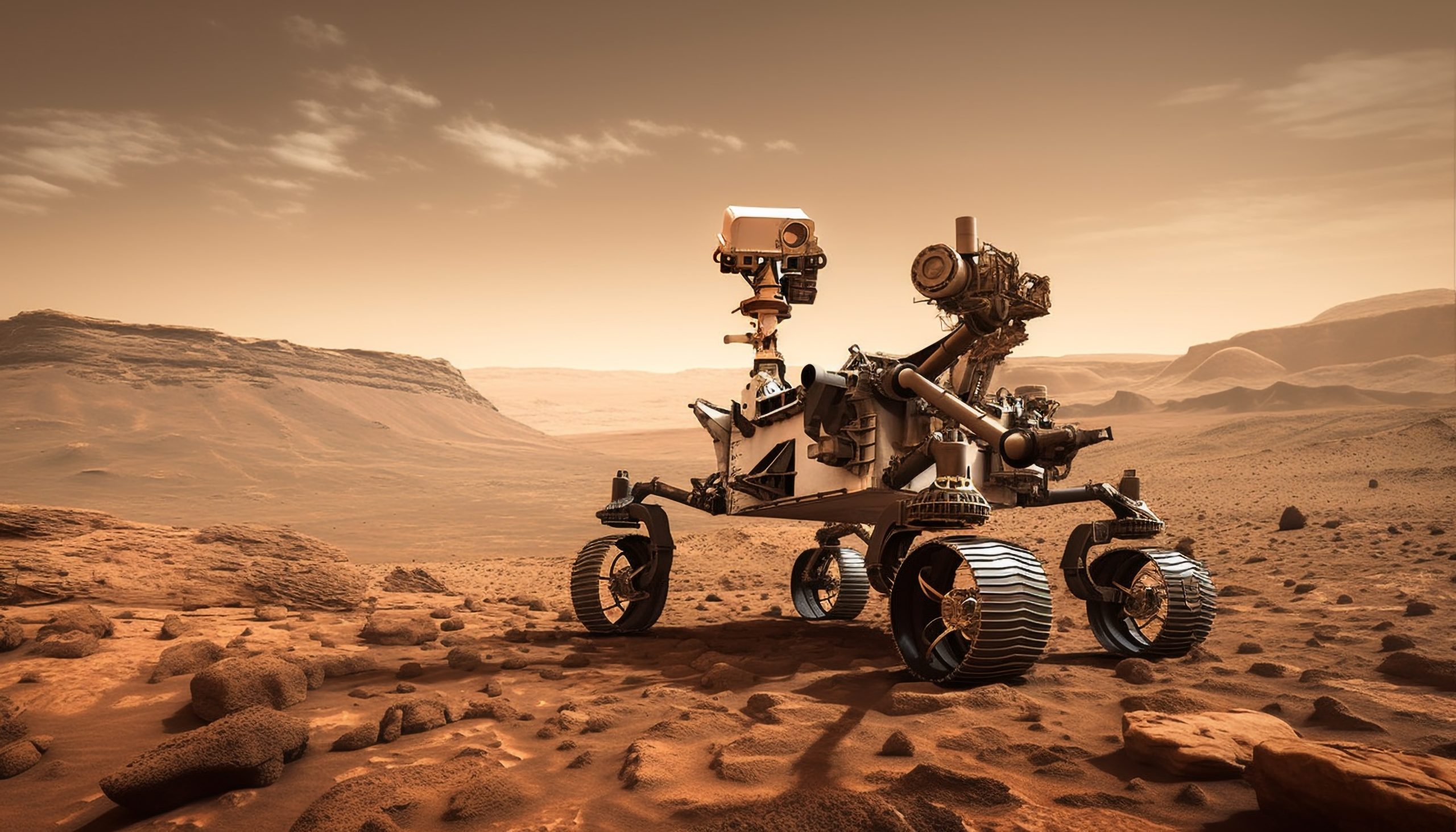
Planetary rovers represent one of the most visible uses of AI in space exploration. Operating on distant worlds such as Mars, rovers must navigate rocky terrain, conduct scientific experiments, and manage limited energy supplies. AI enables these machines to make independent decisions about movement, sampling, and data collection.
Computer vision systems analyze images from rover cameras to identify obstacles, geological features, and scientifically interesting targets. Machine learning models prioritize exploration areas based on mission objectives, maximizing scientific return within limited mission lifespans. This level of autonomy allows rovers to operate more efficiently than ever before.
Enhancing Scientific Discovery on Planetary Surfaces
AI helps rovers identify unusual rock formations, mineral compositions, or potential signs of past life. By flagging high-value targets, AI ensures that limited time and resources are focused on the most promising scientific opportunities. This targeted approach accelerates discovery and deepens understanding of planetary history.
AI and Space Data Analysis
Space exploration generates data on an unprecedented scale. Observatories and satellites collect images, spectra, and measurements across multiple wavelengths. AI plays a crucial role in processing and interpreting this data, transforming raw signals into meaningful scientific insights.
Machine learning algorithms classify celestial objects, detect transient events, and identify subtle patterns in astronomical data. These capabilities enable discoveries such as new exoplanets, distant galaxies, and cosmic phenomena. AI’s ability to analyze data continuously also allows scientists to respond quickly to unexpected events, such as supernovae or asteroid flybys.
Accelerating Astronomical Research
Traditional data analysis methods can take years to process large datasets. AI dramatically shortens this timeline by automating pattern recognition and anomaly detection. This acceleration allows researchers to test hypotheses faster and explore new questions that were previously impractical due to data constraints.
AI in Satellite Operations and Earth Observation
Satellites play a vital role in communication, navigation, and Earth observation. AI enhances satellite operations by optimizing orbital management, power usage, and data transmission. Autonomous systems adjust satellite behavior to conserve energy, avoid collisions, and respond to changing mission requirements.
In Earth observation, AI analyzes satellite imagery to monitor environmental changes, weather patterns, and human activity. These insights support climate research, disaster response, and resource management. AI-driven satellites provide more timely and accurate information, improving decision-making on Earth.
Space Traffic Management and Collision Avoidance
As Earth’s orbit becomes increasingly crowded, AI is essential for space traffic management. AI systems predict potential collisions between satellites and debris, enabling timely evasive maneuvers. This capability helps protect critical infrastructure and ensures the long-term sustainability of space operations.
Mission Planning and Optimization with AI
Planning space missions involves balancing scientific goals, technical constraints, and limited resources. AI assists mission planners by simulating countless scenarios and identifying optimal strategies. These systems evaluate trade-offs between fuel usage, time, and scientific return, enabling more efficient mission designs.
AI also supports adaptive mission planning. As missions progress and conditions change, AI systems update plans dynamically. This flexibility allows missions to respond to unexpected discoveries or challenges without requiring extensive human intervention.
Reducing Costs and Increasing Mission Success
Space missions are expensive and high-risk. AI reduces costs by improving efficiency, minimizing errors, and extending mission lifespans. By increasing the likelihood of success, AI makes ambitious exploration goals more achievable for both public and private space programs.
AI and the Search for Extraterrestrial Life
The search for life beyond Earth is one of the most profound scientific pursuits. AI contributes by analyzing complex data for potential biosignatures, such as chemical imbalances or unusual patterns in planetary atmospheres. Machine learning models help distinguish between biological and non-biological signals, reducing false positives.
AI also supports the design of experiments and instruments tailored to detecting life. By modeling potential habitats and environmental conditions, AI guides exploration strategies toward the most promising locations.
Expanding the Scope of Astrobiology
AI enables astrobiologists to explore vast parameter spaces that would be impossible to analyze manually. This expands the scope of life-detection efforts and increases the chances of meaningful discovery. Even negative results provide valuable insights into the conditions required for life.
Challenges and Ethical Considerations in AI Space Exploration
Despite its benefits, AI in space exploration presents challenges. Reliability is critical, as errors can lead to mission failure. AI systems must be thoroughly tested and validated under extreme conditions. Transparency and explainability are also important, particularly when autonomous systems make high-stakes decisions.
Ethical considerations include the potential militarization of AI-driven space technologies and the responsibility to preserve extraterrestrial environments. As AI expands exploration capabilities, clear governance frameworks are needed to ensure responsible use.
The Future of AI in Space Exploration
AI will play an increasingly central role in future space missions. Concepts such as self-repairing spacecraft, fully autonomous exploration fleets, and AI-driven interstellar probes are becoming more feasible. Collaboration between AI systems and human astronauts will enhance safety and efficiency in crewed missions.
As private space companies and international partnerships expand, AI will help coordinate complex, multi-actor missions. The integration of AI into space exploration represents a new era where intelligent systems extend human curiosity deeper into the cosmos.
Conclusion
Artificial intelligence is transforming space exploration by enabling autonomy, accelerating discovery, and overcoming the limitations of distance and scale. From navigating spacecraft and analyzing cosmic data to exploring planetary surfaces and searching for extraterrestrial life, AI expands humanity’s ability to explore the universe. While technical and ethical challenges remain, the potential of AI in space is vast. By combining human vision with machine intelligence, space exploration enters a new phase defined by deeper reach, greater resilience, and unprecedented discovery.

