The U.S. Securities and Exchange Commission (SEC) has intensified its focus on decentralized finance (DeFi), warning that certain on-chain lending platforms, crypto vaults, and yield-generating investment products may still fall under existing federal securities laws. The latest guidance marks another important step in the evolving regulatory landscape for digital assets and signals that simply operating on a blockchain does not automatically exempt financial products from oversight.
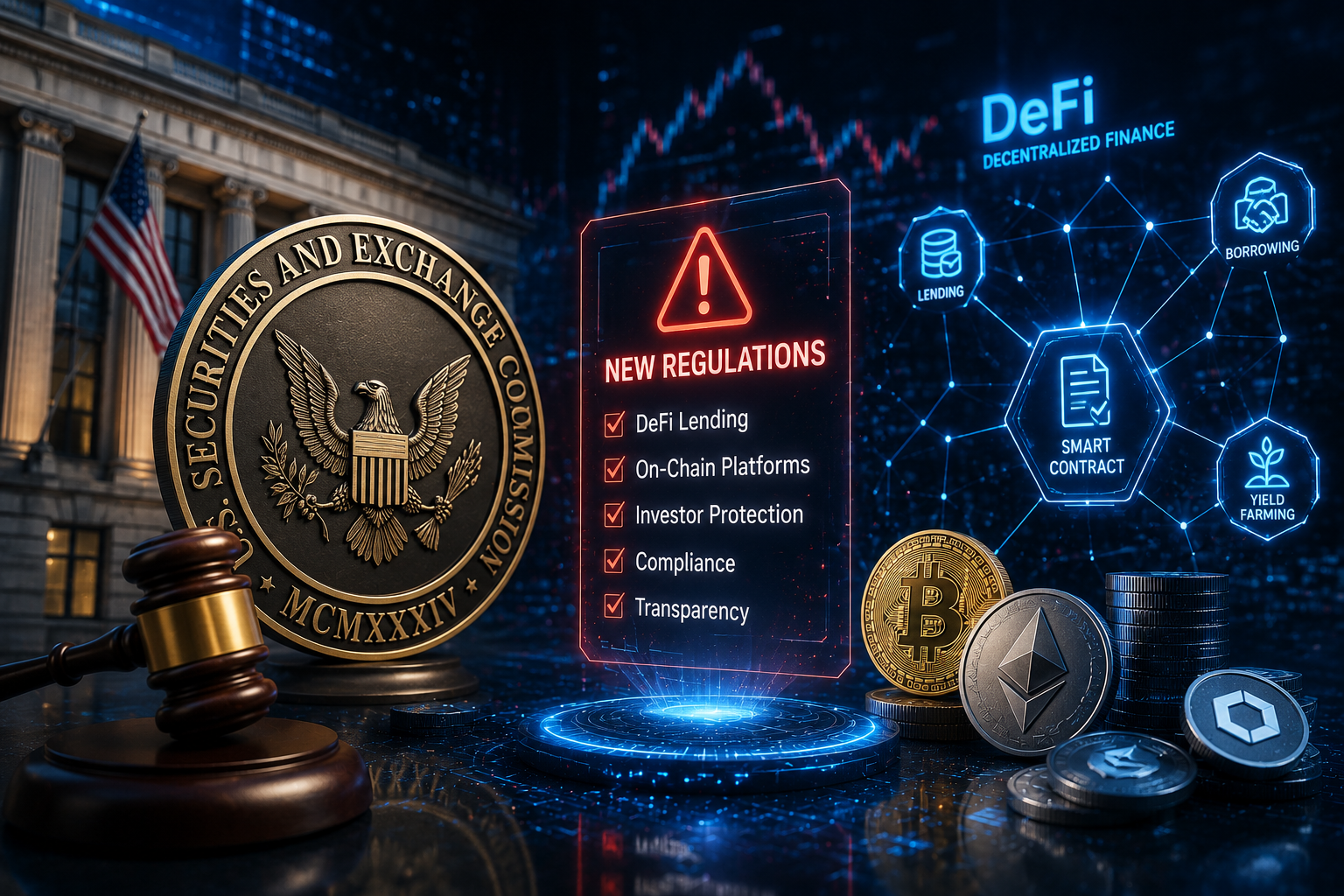
The announcement has sparked fresh debate across the crypto industry, with developers, investors, and blockchain companies assessing how stricter regulatory scrutiny could reshape decentralized finance in the United States.
SEC Turns Its Attention to DeFi
For years, regulators primarily focused on cryptocurrency exchanges, token issuers, and initial coin offerings. However, as decentralized finance has grown into a multi-billion-dollar sector, regulators are increasingly examining the financial services being built directly on blockchain networks. The SEC’s latest position suggests that certain DeFi products could be treated similarly to traditional investment products if they perform comparable financial functions or involve active management. Rather than targeting blockchain technology itself, regulators appear to be focusing on how specific platforms operate and whether they fit within existing securities laws.
Why DeFi Lending Is Under Scrutiny
DeFi lending platforms allow users to lend, borrow, and earn yield without relying on traditional banks or financial intermediaries. These protocols use smart contracts to automate lending, collateral management, interest calculations, and liquidations. While decentralization remains a defining feature of these platforms, regulators argue that some lending products may function similarly to traditional investment funds or managed financial products. If a protocol actively manages user assets, determines investment strategies, or exercises discretionary control over funds, it could fall within the scope of federal securities regulations.
Crypto Vaults Face Greater Attention
One area receiving particular attention is crypto vaults. Vaults automatically allocate digital assets across different strategies to maximize returns for users. Many investors use these products to generate passive income without actively managing their portfolios. According to SEC officials, some vault structures may resemble investment companies or investment advisers depending on how they operate, how decisions are made, and who controls the assets. This distinction could become increasingly important as more institutions enter decentralized finance.
On-Chain Investment Platforms Could Be Affected
The SEC’s comments also extend beyond lending protocols. Blockchain-based investment platforms that pool assets, manage portfolios, or generate yield through automated investment strategies may face additional regulatory obligations. Projects offering tokenized investment products or structured on-chain portfolios could be required to demonstrate compliance with existing securities regulations if their services closely resemble traditional financial products. This approach reflects the SEC’s position that technology alone does not determine whether securities laws apply.
What This Means for Developers
Blockchain developers may need to pay closer attention to protocol design as regulatory expectations evolve.
Future projects may increasingly focus on:
- Greater decentralization
- Reduced discretionary management
- Transparent governance
- Clear documentation
- Compliance-ready infrastructure
Developers building fully autonomous protocols could face fewer regulatory concerns than platforms where centralized teams actively manage user assets.
Many companies are already consulting legal experts during product development to minimize future regulatory risks.
Institutional Investors Welcome Greater Clarity
Although tighter regulation often creates short-term uncertainty, many institutional investors support clearer legal frameworks. Banks, asset managers, and financial institutions have repeatedly identified regulatory uncertainty as one of the largest barriers to entering decentralized finance. More defined compliance expectations could encourage broader institutional participation while improving investor protection and market transparency. For many professional investors, predictable regulation is preferable to prolonged legal uncertainty.
Impact on the DeFi Market
The market reaction has been mixed. Some investors worry that increased oversight could slow innovation and increase compliance costs for blockchain projects. Others believe stronger regulation could strengthen the industry’s credibility by removing uncertainty surrounding decentralized financial products. Protocols operating with transparent governance and strong legal structures may benefit if institutional adoption continues expanding under a clearer regulatory framework.
DeFi Continues to Evolve
Despite growing regulatory attention, decentralized finance remains one of blockchain’s fastest-growing sectors. Developers continue building innovative products across lending, borrowing, derivatives, tokenized assets, and decentralized asset management. Many industry participants believe regulation and innovation can coexist, provided rules remain technology-neutral and focus on financial activity rather than blockchain infrastructure itself. The long-term success of DeFi may depend on balancing decentralization with investor protection.
Challenges Ahead
Implementing securities regulations within decentralized ecosystems presents significant challenges. Many DeFi protocols operate globally without centralized organizations, making traditional regulatory models difficult to apply. Questions remain regarding governance tokens, decentralized autonomous organizations (DAOs), protocol upgrades, and responsibility for compliance. These issues will likely remain central topics as regulators continue developing policies for blockchain-based financial services.
Industry Response
Several blockchain organizations have called for constructive dialogue between regulators and the crypto industry. Developers argue that decentralized finance offers meaningful improvements in financial accessibility, efficiency, and transparency. Rather than opposing regulation entirely, many projects are encouraging policymakers to establish practical frameworks that protect consumers while allowing responsible innovation to continue. The outcome of these discussions could shape the future direction of decentralized finance for years to come.
Looking Ahead
The SEC’s latest guidance does not represent an outright ban on DeFi lending or on-chain investment platforms. Instead, it signals that regulators will examine products based on how they function rather than the technology powering them. Projects that resemble traditional investment products may face additional compliance requirements, while fully decentralized protocols could be evaluated differently depending on their governance structures and operational models.
As the digital asset industry matures, regulatory clarity is expected to play an increasingly important role in attracting institutional investment and supporting sustainable market growth.
Conclusion
The SEC’s renewed focus on DeFi lending platforms, crypto vaults, and on-chain investment strategies marks another significant milestone in the evolution of cryptocurrency regulation. By emphasizing that blockchain technology does not automatically exempt financial products from securities laws, regulators are sending a clear message that decentralized finance must continue evolving alongside legal and compliance standards.
While increased oversight may create short-term challenges for some projects, it could also encourage stronger governance, improved investor protections, and greater institutional confidence. As decentralized finance continues expanding, the balance between innovation and regulation will remain one of the industry’s defining challenges.

