In today’s hyper-connected digital world, businesses no longer operate in isolation. Every company depends on a web of vendors, software providers, cloud services, and third-party tools to function smoothly. While this interconnected ecosystem brings efficiency and speed, it also introduces a hidden risk that many organizations underestimate. That risk is known as a supply chain attack.
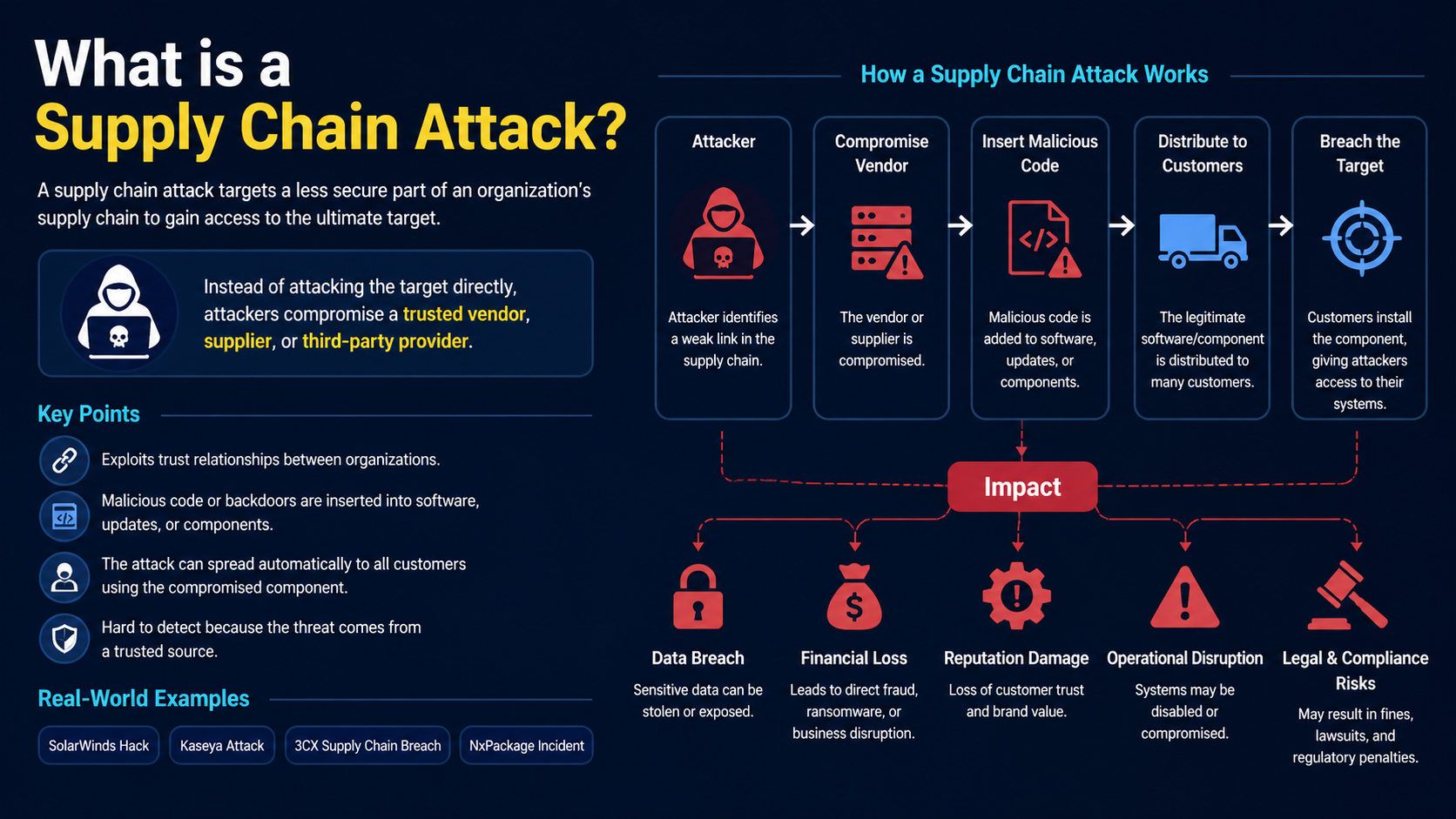
A supply chain attack is a type of cyberattack where hackers target a trusted third-party provider to gain access to a larger organization or multiple organizations at once. Instead of attacking a company directly, attackers find a weaker link in the supply chain and exploit it. This approach allows them to bypass strong security defenses and infiltrate systems more easily. To understand it better, imagine a burglar who cannot break into a heavily secured house. Instead of forcing the front door, they sneak in through a delivery service that the homeowner trusts. That is essentially how a supply chain attack works in the digital world.
How Supply Chain Attacks Work
Supply chain attacks are clever and often difficult to detect. Attackers carefully choose their entry point, usually a vendor or service provider that has access to many clients. These vendors may include software companies, IT service providers, hardware manufacturers, or even cloud platforms.
Once attackers compromise the third party, they inject malicious code or gain unauthorized access. This malicious element is then passed on to all the customers who rely on that vendor. Because the software or service comes from a trusted source, companies often install updates or integrations without suspicion. The attack spreads silently. By the time it is discovered, the damage may already be widespread. Hackers can steal sensitive data, disrupt operations, or even gain full control over systems.
This indirect approach is what makes supply chain attacks so dangerous. Organizations may have strong internal security, but if their partners are vulnerable, they are still at risk.
Why Supply Chain Attacks Are Increasing
The rise of digital transformation has made supply chains more complex than ever. Companies now rely heavily on external tools and services to remain competitive. While this brings convenience, it also expands the attack surface. One major reason for the increase in supply chain attacks is the growing dependence on third-party software. Businesses use dozens or even hundreds of applications to manage operations, communication, and data. Each of these tools becomes a potential entry point for attackers.
Another reason is efficiency from the attacker’s perspective. Instead of targeting one company at a time, hackers can compromise a single vendor and reach hundreds or thousands of organizations. This makes supply chain attacks highly rewarding. Additionally, not all vendors maintain the same level of security. Smaller providers may lack the resources to implement strong cybersecurity measures, making them easier targets.
Real-World Examples of Supply Chain Attacks
Supply chain attacks are not just theoretical. Some of the biggest cyber incidents in recent years have involved this method. One well-known case involved a widely used software update system. Attackers managed to insert malicious code into a legitimate update. Thousands of organizations unknowingly installed the compromised update, giving hackers access to their systems.
Another example includes attacks on hardware supply chains, where devices were tampered with before reaching customers. In such cases, the compromise happens even before the product is used. These incidents highlight how supply chain attacks can impact businesses of all sizes, from small startups to large enterprises and even government organizations.
Types of Supply Chain Attacks
Supply chain attacks can take different forms depending on the target and method used. One common type involves software compromise. Attackers inject malicious code into software updates or applications, which then spreads to users. Another type focuses on hardware. Hackers may manipulate physical components during manufacturing or distribution. Although less common, these attacks can be extremely difficult to detect.
There are also attacks that target service providers, such as managed IT services or cloud platforms. By gaining access to these providers, attackers can move laterally into multiple client systems. Phishing and credential theft within the supply chain is another method. Attackers may trick employees of a vendor into revealing login details, which are then used to access connected systems. Each type shares the same core idea: exploiting trust within the supply chain.
Impact of Supply Chain Attacks
The consequences of a supply chain attack can be severe and long-lasting. One of the most immediate impacts is data theft. Sensitive information such as customer data, financial records, and intellectual property can be exposed. Operational disruption is another major concern. Businesses may experience downtime, system failures, or even complete shutdowns. This can lead to significant financial losses.
Reputation damage is equally important. When customers lose trust in a company’s ability to protect their data, it can take years to rebuild that trust. Legal and regulatory consequences may also follow. Companies can face fines, lawsuits, and compliance issues if they fail to secure their systems properly. What makes supply chain attacks particularly challenging is their scale. A single compromised vendor can affect many organizations simultaneously, amplifying the overall impact.
Why Traditional Security Is Not Enough
Many organizations focus on securing their internal systems, using firewalls, antivirus software, and encryption. While these measures are essential, they are not enough to protect against supply chain attacks. The problem lies in the trust factor. Companies often trust their vendors and partners without fully verifying their security practices. This trust creates a blind spot that attackers exploit.
Traditional security models are built around the idea of protecting a defined perimeter. However, in a supply chain attack, the threat comes from inside that perimeter, through a trusted source. This is why modern cybersecurity strategies must go beyond internal defenses and include supply chain risk management.
How to Prevent Supply Chain Attacks
Preventing supply chain attacks requires a proactive and comprehensive approach. It starts with understanding that every vendor and partner is a potential risk. Organizations need to evaluate the security practices of their suppliers before working with them. This includes reviewing their policies, certifications, and past security incidents.
Regular monitoring is also important. Companies should continuously assess the behavior of third-party systems and look for unusual activity. Implementing strict access controls can limit the damage if a breach occurs. Vendors should only have access to the resources they absolutely need.
Software integrity checks are another key measure. Verifying updates and using secure distribution methods can help prevent the installation of compromised software. Employee awareness also plays a role. Training staff to recognize phishing attempts and suspicious behavior can reduce the risk of credential theft. Ultimately, prevention is about reducing trust-based vulnerabilities and increasing visibility across the entire supply chain.
The Role of Zero Trust Security
One of the most effective approaches to defending against supply chain attacks is the zero trust model. This concept is based on the idea that no user or system should be trusted by default, even if it is inside the network. In a zero trust environment, every access request is verified, authenticated, and monitored. This reduces the chances of attackers moving freely within a system after gaining initial access.
Zero trust also emphasizes segmentation. By dividing the network into smaller sections, organizations can contain potential breaches and prevent them from spreading. This approach aligns well with the challenges of supply chain security, where threats often come from trusted sources.
Future of Supply Chain Security
As technology continues to evolve, supply chain attacks are likely to become more sophisticated. Attackers are constantly developing new methods to exploit vulnerabilities. At the same time, organizations are becoming more aware of these risks. There is a growing focus on building resilient supply chains and improving collaboration between companies and their vendors. Regulations and standards are also evolving. Governments and industry bodies are introducing guidelines to strengthen supply chain security and reduce risks. Artificial intelligence and advanced analytics are expected to play a larger role in detecting and preventing attacks. These technologies can identify patterns and anomalies that may indicate a breach. The future will require a balance between innovation and security, ensuring that businesses can grow without exposing themselves to unnecessary risks.
Conclusion
A supply chain attack is a powerful and often underestimated threat in the world of cybersecurity. By targeting trusted vendors and partners, attackers can bypass traditional defenses and cause widespread damage. Understanding how these attacks work is the first step toward prevention. Organizations must recognize that security is not limited to their own systems but extends to every part of their supply chain. Building strong relationships with secure vendors, implementing modern security practices, and staying vigilant are essential strategies in today’s digital environment. As businesses continue to rely on interconnected systems, the importance of supply chain security will only grow. Those who take proactive steps today will be better prepared to face the challenges of tomorrow.

