Cyber resilience has become one of the most important topics in modern business security. Organizations today face a growing number of cyber threats, ranging from ransomware attacks and data breaches to insider threats and supply chain compromises. While traditional cybersecurity focuses on preventing attacks, cyber resilience goes a step further. It ensures that an organization can continue operating, recover quickly, and adapt even when a cyber incident occurs. This is where a cyber resilience framework becomes essential.
Cyber Resilience Framework: Building Stronger Security for the Digital Age
In today’s interconnected world, cyber threats are no longer a question of “if” but “when.” Businesses of all sizes are constantly targeted by cybercriminals seeking to steal data, disrupt operations, or demand ransom payments. As attacks become more sophisticated, organizations need more than just firewalls and antivirus software. They need a comprehensive cyber resilience framework that helps them prepare for, withstand, recover from, and adapt to cyber incidents.
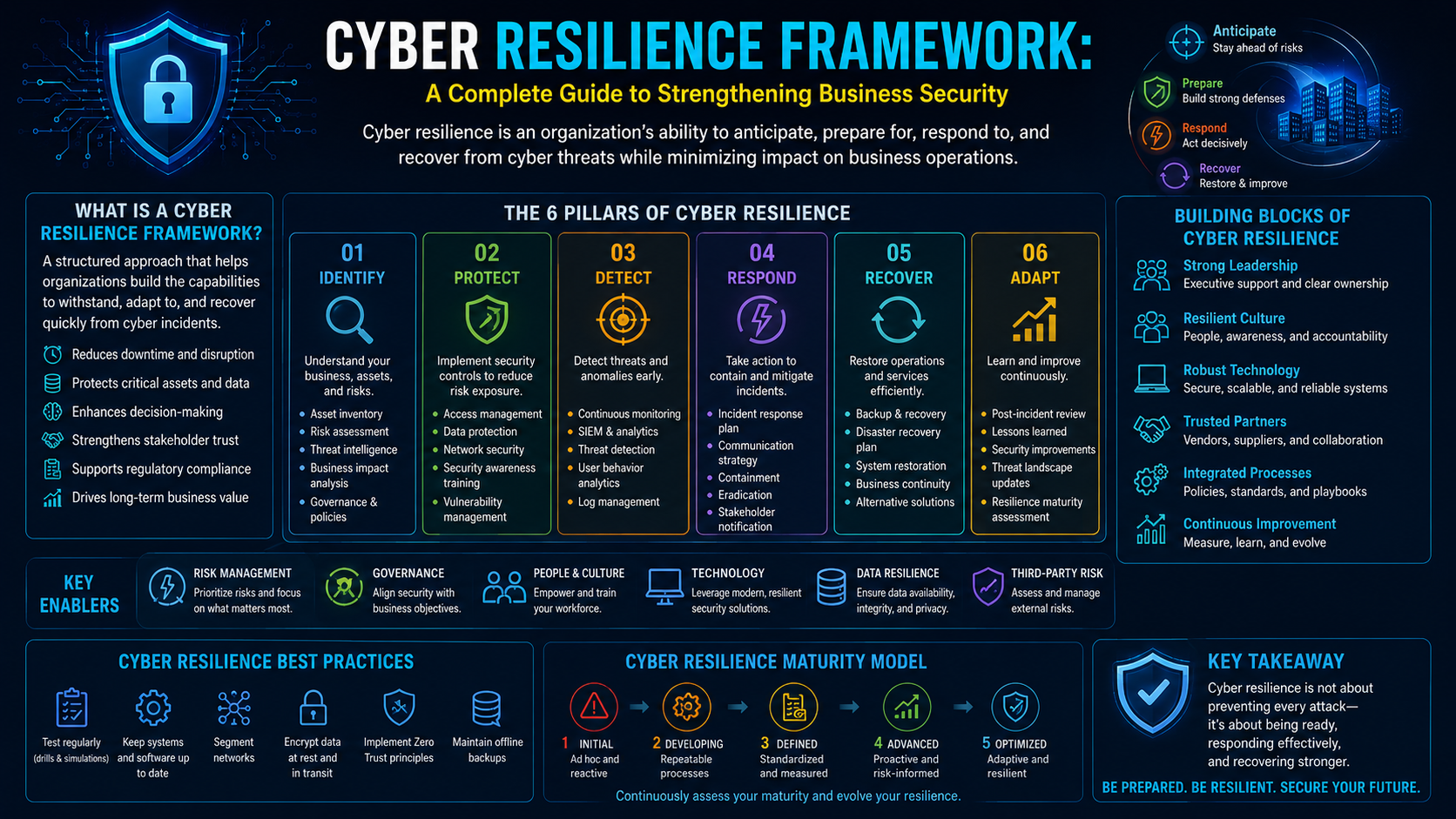
A cyber resilience framework provides a structured approach to managing cybersecurity risks while ensuring business continuity. It combines security, risk management, disaster recovery, incident response, and operational resilience into a single strategy. Organizations that adopt a strong cyber resilience framework are better equipped to minimize downtime, protect critical assets, and maintain customer trust during cyber crises.
Understanding the Cyber Resilience Framework
A cyber resilience framework is a set of principles, processes, and technologies designed to help organizations anticipate cyber threats and maintain essential operations during and after an attack. Unlike traditional cybersecurity strategies that focus mainly on prevention, cyber resilience acknowledges that some attacks will succeed despite the best defenses.
The framework helps organizations create a balanced approach that includes prevention, detection, response, recovery, and continuous improvement. The ultimate goal is not only to defend against threats but also to ensure that business operations remain functional even when systems are compromised.
As businesses become increasingly dependent on digital technologies, cloud platforms, and remote work environments, cyber resilience has become a critical component of long-term organizational success.
Why Cyber Resilience Matters
Cyberattacks can have devastating consequences. A successful attack may lead to financial losses, regulatory penalties, operational disruptions, and reputational damage. In some cases, organizations may take weeks or months to fully recover from a major cyber incident.
A cyber resilience framework helps reduce these risks by ensuring that organizations are prepared before an attack occurs. It provides clear guidance on how to identify vulnerabilities, protect critical systems, detect suspicious activity, respond effectively, and recover quickly. Organizations that prioritize cyber resilience are often able to limit the impact of incidents and restore normal operations much faster than those that rely solely on preventive security measures.
The increasing frequency of ransomware attacks highlights the importance of resilience. Even companies with advanced security controls have become victims. Those with strong resilience programs can restore systems from backups, maintain essential services, and avoid prolonged downtime.
Core Principles of a Cyber Resilience Framework
A successful cyber resilience framework is built on several interconnected principles that work together to strengthen an organization’s ability to handle cyber threats. The first principle is preparation. Organizations must understand their assets, identify critical business functions, and assess potential risks. This creates a foundation for effective resilience planning.
The second principle is protection. Security controls such as encryption, access management, endpoint protection, and network segmentation help reduce the likelihood of successful attacks.
The third principle is detection. Early identification of suspicious activities enables organizations to respond before an incident escalates into a major crisis.
The fourth principle is response. A well-defined incident response process helps security teams contain threats and minimize damage.
The fifth principle is recovery. Recovery plans ensure that systems, applications, and services can be restored quickly following an incident.
The final principle is adaptation. Organizations must learn from incidents, improve defenses, and continuously strengthen their resilience capabilities.
Together, these principles form the backbone of an effective cyber resilience framework.
Risk Assessment as the Foundation
Every cyber resilience framework begins with a comprehensive risk assessment. Organizations need a clear understanding of their digital environment, including assets, systems, applications, and data. Risk assessments help identify vulnerabilities that attackers may exploit. They also evaluate the potential impact of various threat scenarios on business operations.
By understanding which systems are most critical, organizations can prioritize resources and focus protection efforts where they are needed most. This risk-based approach ensures that resilience investments align with business objectives. Regular risk assessments are essential because cyber threats evolve continuously. New technologies, changing business processes, and emerging attack techniques can introduce previously unknown vulnerabilities.
The Role of Governance in Cyber Resilience
Strong governance is a key element of any cyber resilience framework. Leadership must actively support resilience initiatives and ensure that cybersecurity is integrated into organizational decision-making. Effective governance establishes accountability across the organization. Senior executives, managers, and employees all have roles in maintaining resilience.
Policies, procedures, and security standards should be clearly documented and regularly reviewed. Organizations should also establish reporting mechanisms that allow leaders to monitor cybersecurity performance and risk levels. When leadership prioritizes resilience, it creates a culture where cybersecurity becomes everyone’s responsibility rather than solely the concern of the IT department.
Strengthening Security Controls
Security controls remain an essential part of cyber resilience. While resilience goes beyond prevention, strong defenses still play a critical role in reducing risk. Organizations should implement multiple layers of protection to create a defense-in-depth strategy. This includes identity and access management, multi-factor authentication, endpoint security, intrusion detection systems, and secure configuration practices.
Employee awareness training is equally important. Human error continues to be one of the leading causes of cybersecurity incidents. Educating employees about phishing attacks, password security, and safe online behavior helps reduce vulnerabilities. Continuous monitoring of systems and networks enables organizations to identify unusual activities and respond quickly to potential threats.
Incident Response and Crisis Management
No cyber resilience framework is complete without a robust incident response capability. Even the strongest security defenses cannot guarantee complete protection. Incident response plans provide step-by-step guidance for handling cybersecurity incidents. These plans define roles, responsibilities, communication procedures, and escalation paths.
When an incident occurs, response teams must quickly assess the situation, contain the threat, and minimize damage. Effective communication is critical during this process, particularly when customers, regulators, or business partners may be affected. Regular testing of incident response plans helps ensure that teams are prepared for real-world scenarios. Tabletop exercises and simulated cyber attacks allow organizations to evaluate their readiness and identify areas for improvement.
Business Continuity and Disaster Recovery
One of the primary goals of a cyber resilience framework is maintaining business operations during disruptions. Business continuity planning focuses on keeping essential functions running despite cyber incidents. This may involve alternative processes, backup systems, or temporary workarounds that allow operations to continue. Disaster recovery planning focuses on restoring technology systems and data after an incident. Recovery objectives should be clearly defined to ensure that critical services can be restored within acceptable timeframes.
Organizations should maintain secure and regularly tested backups. Backup systems should be protected from ransomware and other threats that could compromise recovery efforts. A strong recovery strategy can mean the difference between a minor disruption and a major business crisis.
Cyber Resilience in Cloud Environments
Cloud computing offers significant business benefits, but it also introduces unique security challenges. Organizations increasingly rely on cloud services for data storage, collaboration, and application hosting.
A cyber resilience framework must address cloud-specific risks such as misconfigurations, unauthorized access, and third-party dependencies. Organizations should understand the shared responsibility model used by cloud providers. While providers secure the underlying infrastructure, customers remain responsible for securing their own data, applications, and configurations.
Regular security assessments, cloud monitoring, and data protection measures help strengthen resilience in cloud environments. As cloud adoption continues to grow, cloud resilience has become a critical aspect of overall organizational security.
Supply Chain Cyber Resilience
Modern organizations depend heavily on vendors, suppliers, and third-party service providers. These external relationships can introduce significant cybersecurity risks. Attackers often target supply chain partners as a way to gain access to larger organizations. A cyber resilience framework should therefore include third-party risk management processes. Organizations should evaluate vendor security practices, establish contractual security requirements, and monitor third-party risks continuously.
Building resilience across the supply chain helps reduce the likelihood of disruptions caused by external cybersecurity incidents. Strong collaboration with trusted partners can improve visibility and strengthen collective defenses against evolving threats.
Continuous Improvement and Adaptation
Cyber resilience is not a one-time project. It is an ongoing process that requires continuous evaluation and improvement. Threat landscapes change rapidly, and organizations must adapt accordingly. Lessons learned from incidents, security assessments, and industry developments should be incorporated into resilience strategies.
Metrics and performance indicators can help organizations measure the effectiveness of their resilience efforts. These insights support informed decision-making and resource allocation. Regular reviews ensure that the cyber resilience framework remains aligned with business objectives, regulatory requirements, and emerging threats. Organizations that embrace continuous improvement are better positioned to withstand future cyber challenges.
The Future of Cyber Resilience
As digital transformation accelerates, cyber resilience will become even more important. Technologies such as artificial intelligence, the Internet of Things, and advanced cloud computing create new opportunities but also introduce additional risks. Future cyber resilience frameworks will increasingly rely on automation, threat intelligence, and predictive analytics. These capabilities will help organizations identify threats earlier and respond more effectively.
Regulators around the world are also placing greater emphasis on operational resilience and cybersecurity preparedness. Organizations that invest in resilience today will be better prepared to meet future compliance requirements. Cyber resilience is no longer just an IT concern. It is a business priority that affects every aspect of organizational success.
Conclusion
A cyber resilience framework provides organizations with a structured approach to managing cyber risks while ensuring operational continuity. Instead of focusing solely on preventing attacks, it prepares organizations to withstand disruptions, recover quickly, and emerge stronger from cyber incidents.
By combining risk assessment, governance, security controls, incident response, business continuity, disaster recovery, and continuous improvement, a cyber resilience framework creates a comprehensive defense strategy for the modern digital environment. As cyber threats continue to evolve, organizations that prioritize resilience will be better equipped to protect their assets, maintain customer trust, and sustain long-term growth. Investing in a strong cyber resilience framework is not simply a cybersecurity decision—it is a critical business strategy for navigating the challenges of the digital age.

