Cybersecurity has changed dramatically over the last few years. Organizations are facing more sophisticated cyberattacks than ever before, while attackers are also using artificial intelligence (AI) to improve their methods. This has created a new challenge where traditional security tools alone are no longer enough to protect businesses, governments, and individuals.
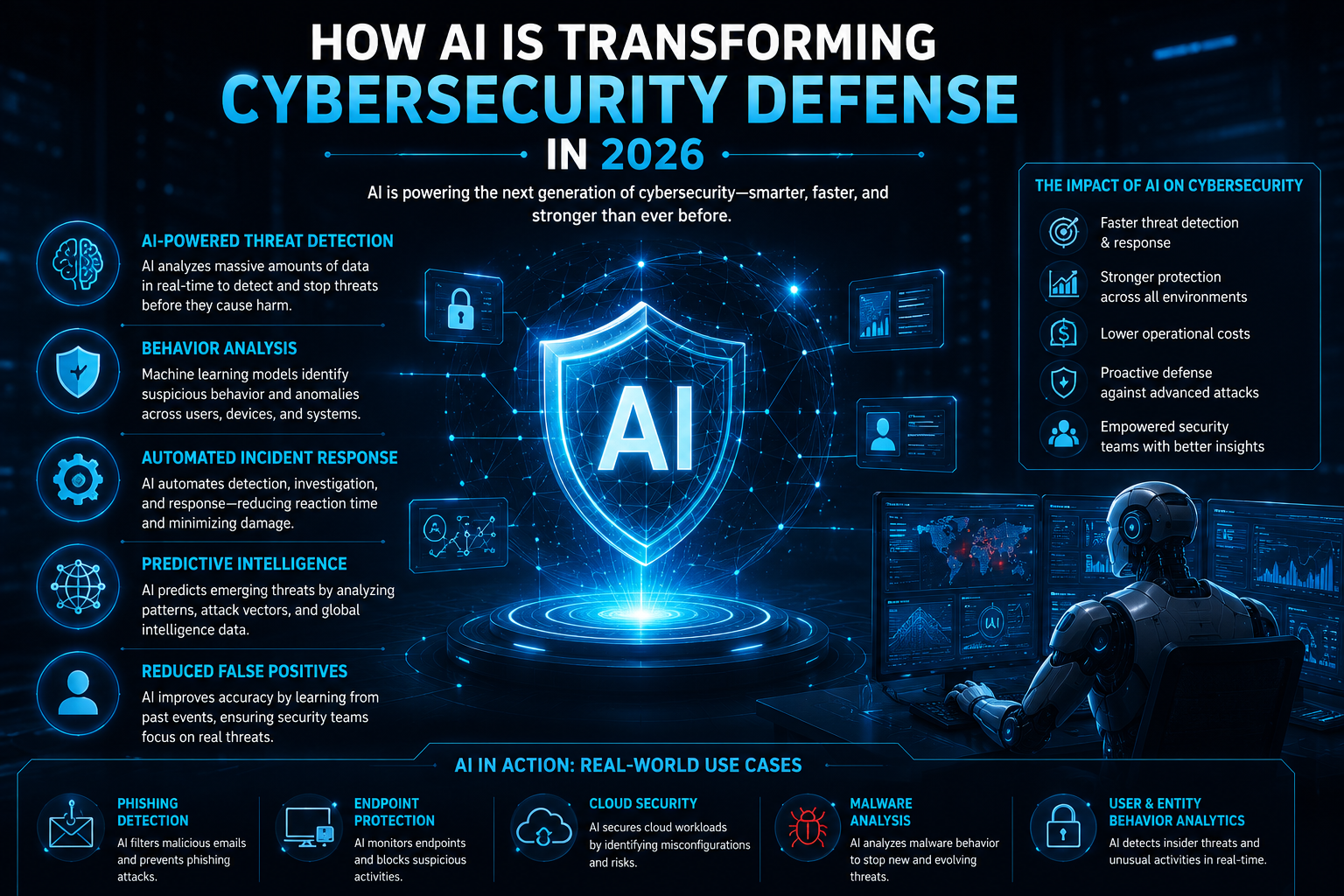
In 2026, AI has become one of the most valuable technologies in cybersecurity. Instead of simply reacting after an attack happens, AI-powered security systems can detect unusual activity, predict threats, automate responses, and reduce the time needed to stop cybercriminals. While AI is helping security professionals defend networks faster than ever, it is also creating new risks because attackers are using the same technology to launch smarter attacks. This ongoing competition between defenders and hackers is shaping the future of cybersecurity.This article explores how AI is transforming cybersecurity defense in 2026, its biggest advantages, its limitations, and what organizations should expect in the years ahead.
Why AI Has Become Essential in Cybersecurity
Every day, organizations generate enormous amounts of digital data. Security teams must monitor network traffic, user activity, cloud services, applications, emails, and connected devices. Manually analyzing millions of security events every day is impossible. AI helps solve this problem by processing large volumes of information within seconds. Instead of waiting for human analysts to review every alert, AI continuously monitors systems and identifies suspicious behavior that may indicate a cyberattack. This allows security teams to focus on serious threats rather than spending hours investigating harmless alerts.
Faster Threat Detection
One of AI’s biggest strengths is speed.
Traditional security software relies heavily on known attack signatures. If hackers develop a completely new attack, older security systems may not recognize it immediately.
AI analyzes behavior rather than depending only on known malware signatures.
For example, AI may notice:
- An employee logging in from two countries within minutes
- A server suddenly transferring large amounts of confidential data
- A user attempting to access files they have never opened before
- Multiple failed login attempts across different accounts
Even if these activities involve unknown malware, AI can recognize that something is unusual and notify security teams before significant damage occurs.
This faster detection often prevents attackers from moving deeper into a network.
Smarter Malware Detection
Cybercriminals constantly modify malware to avoid detection.
Traditional antivirus programs may miss newly created malware because its signature has never been seen before.
AI-powered security platforms examine how files behave rather than simply checking their code.
For example, AI can detect if a program:
- Encrypts thousands of files rapidly
- Modifies critical system settings
- Attempts to disable security software
- Creates suspicious background processes
By analyzing behavior instead of relying only on signatures, AI identifies many new threats before they spread.
This approach has become especially important as ransomware attacks continue to evolve.
AI Reduces Alert Fatigue
Large organizations often receive thousands of security alerts every day.
Many of these alerts are harmless, yet security analysts still need to review them.
This creates alert fatigue, where analysts become overwhelmed and may accidentally miss genuine threats.
AI helps solve this problem by prioritizing alerts based on risk.
Instead of showing every event equally, AI ranks incidents according to:
- Potential business impact
- Confidence level
- Attack severity
- Number of affected systems
- User behavior
This enables analysts to respond to the most dangerous threats first.
Automated Incident Response
One of the biggest improvements in cybersecurity during 2026 is automated response.
Previously, security teams manually investigated attacks before taking action.
Today, AI can immediately perform defensive actions such as:
- Isolating infected devices
- Blocking malicious IP addresses
- Disabling compromised user accounts
- Ending suspicious processes
- Preventing malware from spreading
- Blocking dangerous email attachments
Automation dramatically reduces the time attackers have to compromise additional systems.
Many attacks that once required hours to contain can now be stopped within minutes.
AI Strengthens Email Security
Email remains one of the most common ways attackers gain access to organizations.
Phishing emails continue to trick users into clicking malicious links or downloading infected attachments.
Modern AI email security solutions analyze:
- Writing style
- Sender reputation
- Domain characteristics
- Attachment behavior
- URL destinations
- Email context
Instead of relying only on spam filters, AI understands patterns that indicate phishing attempts.
Some advanced systems even compare writing styles to identify business email compromise attacks where criminals impersonate executives.
Better Protection Against Insider Threats
Not every cybersecurity incident comes from external hackers.
Employees, contractors, or former staff members can accidentally or intentionally expose sensitive information.
AI helps identify insider threats by monitoring user behavior over time.
It learns what is considered normal activity for each employee.
If someone suddenly begins downloading thousands of confidential files or accessing restricted systems at unusual hours, AI immediately flags the activity.
This helps organizations prevent both malicious actions and accidental data leaks.
AI Improves Cloud Security
Businesses continue moving applications and data to cloud platforms.
Managing cloud security has become increasingly complex because organizations often use multiple cloud providers simultaneously.
AI continuously monitors cloud environments to identify:
- Misconfigured storage
- Weak permissions
- Suspicious login attempts
- Unusual workloads
- Unauthorized applications
- Data exposure risks
Instead of waiting for periodic security audits, AI provides continuous monitoring that helps organizations discover problems much earlier.
Predicting Future Attacks
AI is not limited to detecting ongoing attacks.
Modern cybersecurity platforms also use predictive analytics.
By studying previous attack patterns, vulnerability trends, and global threat intelligence, AI estimates where attackers may strike next.
For example, AI can identify:
- Systems requiring urgent patches
- Employees at higher phishing risk
- Frequently targeted applications
- Vulnerable internet-facing services
This allows organizations to strengthen defenses before attackers exploit weaknesses.
AI Supports Security Operations Centers
Security Operations Centers (SOCs) monitor organizational security around the clock.
Analysts often work under significant pressure because they must respond quickly to incidents.
AI assists SOC teams by:
- Correlating alerts
- Investigating suspicious events
- Collecting threat intelligence
- Generating incident summaries
- Recommending response actions
- Eliminating duplicate alerts
Rather than replacing analysts, AI serves as a powerful assistant that speeds up investigations.
Human expertise remains essential for making final security decisions.
AI Helps Detect Zero-Day Attacks
Zero-day vulnerabilities are software flaws that attackers exploit before developers release a patch.
These attacks are particularly dangerous because traditional security tools often lack signatures to detect them.
AI identifies unusual behavior associated with exploitation attempts.
Even without knowing the exact vulnerability, AI may detect:
- Unexpected memory activity
- Privilege escalation attempts
- Abnormal application behavior
- Unauthorized code execution
This provides organizations with valuable time to respond before attackers achieve their objectives.
AI Improves Vulnerability Management
Organizations often struggle with thousands of software vulnerabilities.
Not every vulnerability carries the same level of risk.
AI helps prioritize patches by considering factors such as:
- Active exploitation
- Asset importance
- Exposure to the internet
- Business impact
- Ease of exploitation
Instead of patching systems randomly, organizations can focus on vulnerabilities most likely to be targeted.
AI and Threat Intelligence
Threat intelligence helps organizations understand emerging cyber risks.
AI processes enormous amounts of information from:
- Security reports
- Malware databases
- Dark web discussions
- Attack indicators
- Vulnerability disclosures
- Security research
It identifies patterns much faster than humans can.
This enables organizations to stay informed about evolving cyber threats without manually reviewing countless reports every day.
The Rise of AI-Powered Cyberattacks
Although AI strengthens defense, cybercriminals also benefit from the technology.
Attackers now use AI to:
- Generate convincing phishing emails
- Automate vulnerability scanning
- Create realistic fake voices
- Produce deepfake videos
- Develop adaptive malware
- Improve password guessing techniques
This means cybersecurity professionals must continually improve defensive AI systems to stay ahead.
The battle between offensive and defensive AI is expected to intensify throughout the coming years.
Challenges of Using AI in Cybersecurity
Despite its many advantages, AI is not perfect.
Organizations still face several challenges.
False Positives
AI sometimes identifies legitimate activity as suspicious.
Excessive false alerts can still waste valuable time if systems are not properly tuned.
Data Quality
AI performs best when trained using accurate and diverse security data.
Poor-quality data can reduce detection accuracy.
Privacy Concerns
Some AI security systems analyze user behavior extensively.
Organizations must balance security monitoring with employee privacy and data protection regulations.
Skilled Professionals Are Still Needed
AI does not replace cybersecurity experts.
Human analysts remain responsible for:
- Making strategic decisions
- Investigating complex incidents
- Performing digital forensics
- Developing security policies
- Responding to large-scale attacks
AI works best when combined with experienced professionals.
Best Practices for Organizations
Businesses planning to strengthen cybersecurity with AI should follow several best practices:
- Keep AI security tools updated.
- Train employees to recognize phishing attacks.
- Combine AI with human oversight.
- Apply security patches promptly.
- Monitor cloud environments continuously.
- Implement multi-factor authentication.
- Perform regular security assessments.
- Back up important data securely.
- Develop an incident response plan.
- Test AI systems regularly to ensure accurate detection.
A balanced approach provides stronger protection than relying on technology alone.
The Future of AI in Cybersecurity
AI will continue becoming more intelligent over the next several years.
Future cybersecurity systems may automatically predict attacks with greater accuracy, coordinate defenses across multiple organizations, and detect threats before attackers fully execute their campaigns.
Security automation will become increasingly common, allowing organizations to respond to incidents almost instantly.
At the same time, cybercriminals will continue experimenting with AI to create more advanced malware, phishing campaigns, and social engineering attacks.
This means cybersecurity will remain an ongoing race between attackers and defenders.
Organizations that embrace AI responsibly while maintaining strong security practices and skilled cybersecurity teams will be better prepared for future threats.
Conclusion
Artificial intelligence has become one of the most powerful tools in cybersecurity defense during 2026. From detecting malware and identifying phishing attacks to automating incident response and strengthening cloud security, AI enables organizations to protect digital assets faster and more efficiently than traditional security methods alone.
However, AI is not a complete replacement for human expertise. Security professionals are still needed to interpret complex threats, make informed decisions, and manage incidents that require judgment and experience.
As cyber threats continue to evolve, combining AI-driven automation with skilled cybersecurity teams, employee awareness, and strong security policies will provide the best defense against modern attacks. Organizations that invest in this balanced approach will be far better equipped to face the cybersecurity challenges of today and tomorrow.

