Every organization depends on technology to run its daily operations. Websites, mobile applications, cloud platforms, and internal networks all play a critical role in modern business. While these systems make work easier, they also create opportunities for cybercriminals to exploit security weaknesses.
Hackers are constantly searching for vulnerabilities they can use to steal data, deploy ransomware, or gain unauthorized access. The best way to stop these attacks is to find and fix security flaws before criminals discover them.
This is where ethical hackers come in.
Ethical hackers, also known as white hat hackers, use the same techniques and tools as malicious hackers, but they work with permission from organizations to improve security instead of causing harm. Their goal is to identify weaknesses, demonstrate how attackers could exploit them, and help businesses strengthen their defenses.
In this article, we’ll explore how ethical hackers identify security vulnerabilities before attackers do, the methods they use, and why their work has become essential in 2026.
What Is Ethical Hacking?
Ethical hacking is the authorized process of testing computer systems, networks, websites, and applications for security weaknesses.
Unlike cybercriminals, ethical hackers operate with written permission and follow clearly defined rules. They simulate real-world cyberattacks to discover vulnerabilities before they can be exploited by malicious actors.
Their work helps organizations:
- Protect sensitive information
- Improve system security
- Meet compliance requirements
- Reduce the risk of cyberattacks
- Build customer trust
Ethical hacking is now an important part of every mature cybersecurity strategy.
Understanding the Attacker’s Mindset
One of the reasons ethical hackers are so effective is that they think like attackers.
Instead of assuming systems are secure, they ask questions such as:
- How could someone gain unauthorized access?
- Which systems are exposed to the internet?
- Are passwords easy to guess?
- Can confidential data be accessed without permission?
- Are software updates missing?
- Could employees be tricked into revealing sensitive information?
By approaching systems from an attacker’s perspective, ethical hackers often discover weaknesses that routine security checks may overlook.
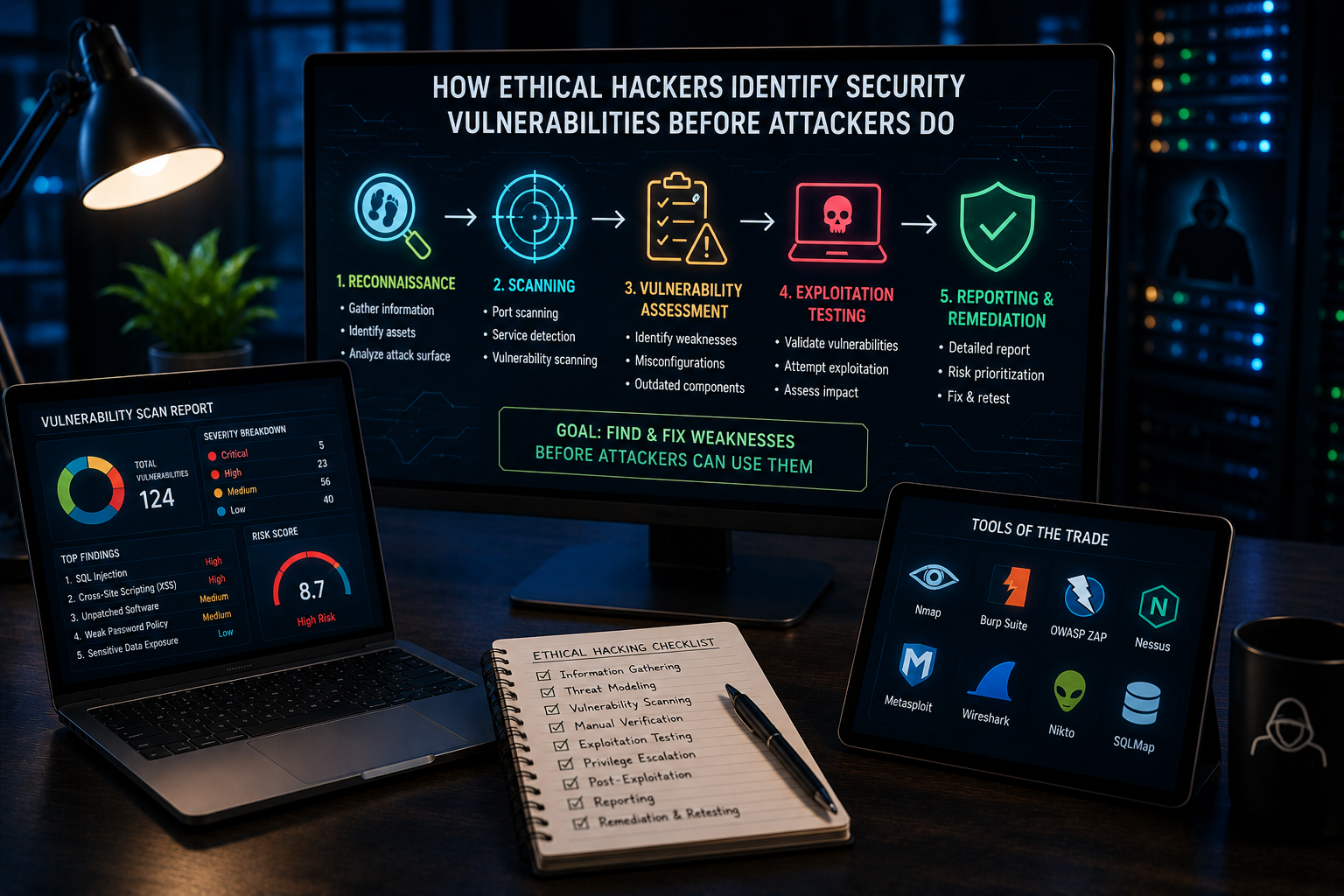
Step 1: Gathering Information
The first stage of ethical hacking is information gathering, often called reconnaissance.
Before attempting to test a system, ethical hackers collect publicly available information about the target.
This may include:
- Company websites
- Public IP addresses
- Domain records
- Email addresses
- Social media profiles
- Technology used by the organization
- Cloud services
- Publicly exposed servers
Understanding the target environment helps ethical hackers identify potential attack paths.
Step 2: Network Scanning
Once basic information has been collected, ethical hackers begin scanning the network.
The goal is to identify:
- Active devices
- Open ports
- Running services
- Operating systems
- Network architecture
Open ports can reveal services that may contain known vulnerabilities or unnecessary software.
Network scanning also helps identify forgotten or outdated systems that could become entry points for attackers.
Step 3: Vulnerability Assessment
After mapping the environment, ethical hackers perform vulnerability assessments.
This involves checking systems for known security weaknesses.
Common vulnerabilities include:
- Outdated software
- Missing security patches
- Weak encryption
- Default passwords
- Misconfigured servers
- Exposed administrative interfaces
Vulnerability assessments help organizations prioritize which issues should be fixed first.
Step 4: Penetration Testing
Finding a vulnerability is only part of the process.
Ethical hackers often perform penetration testing to determine whether a weakness can actually be exploited.
During penetration testing, they safely simulate attacks without damaging systems.
Examples include:
- Testing login security
- Attempting privilege escalation
- Exploiting software vulnerabilities
- Accessing restricted files
- Demonstrating lateral movement inside a network
Penetration testing helps organizations understand the real-world impact of security weaknesses.
Testing Web Applications
Web applications remain one of the most common targets for attackers.
Ethical hackers examine websites and web applications for vulnerabilities such as:
- SQL injection
- Cross-site scripting (XSS)
- Broken authentication
- Insecure file uploads
- Cross-site request forgery (CSRF)
- Security misconfigurations
Even a small flaw can sometimes provide attackers with access to sensitive customer information.
Regular web application testing significantly improves online security.
Evaluating Password Security
Weak passwords continue to be a leading cause of security breaches.
Ethical hackers assess password security by reviewing:
- Password policies
- Password complexity
- Password reuse
- Multi-factor authentication
- Account lockout settings
Rather than stealing passwords, they demonstrate how weak authentication could allow unauthorized access.
Organizations can then strengthen their authentication policies.
Identifying Cloud Security Weaknesses
Cloud computing has become a major focus for ethical hackers.
Many security incidents occur because cloud environments are configured incorrectly rather than because cloud providers are compromised.
Ethical hackers examine:
- Storage permissions
- Identity management
- Access controls
- Publicly exposed resources
- API security
- Logging configurations
Correcting these issues helps prevent accidental data exposure.
Reviewing Network Security
Networks contain numerous devices that require protection.
Ethical hackers evaluate:
- Firewalls
- Routers
- Wireless networks
- VPN configurations
- Remote access systems
- Network segmentation
Improper network configurations can allow attackers to move between systems once they gain initial access.
Testing Employee Awareness
Technology alone cannot stop every cyberattack.
Many attacks target employees through phishing emails and social engineering.
With approval from the organization, ethical hackers may conduct simulated phishing campaigns to evaluate employee awareness.
These exercises measure:
- Email recognition skills
- Reporting behavior
- Password handling
- Response to suspicious requests
The results help organizations improve cybersecurity training.
Finding Misconfigurations
Many successful cyberattacks exploit configuration mistakes rather than software bugs.
Ethical hackers carefully review systems for issues such as:
- Unnecessary services
- Publicly accessible databases
- Weak security settings
- Improper user permissions
- Disabled security features
Correcting simple configuration errors often provides significant security improvements.
Reviewing Access Controls
Not every employee requires access to every system.
Ethical hackers verify whether access controls follow the principle of least privilege.
They look for:
- Excessive administrator accounts
- Shared user accounts
- Inactive employee accounts
- Weak role-based permissions
Proper access management reduces the damage that compromised accounts can cause.
Using Security Tools
Ethical hackers rely on many trusted cybersecurity tools to assist their assessments.
Common categories include:
- Network scanners
- Vulnerability scanners
- Web application testing tools
- Packet analyzers
- Password auditing tools
- Digital forensic platforms
These tools automate repetitive tasks, allowing ethical hackers to focus on analyzing results and identifying meaningful security risks.
Documenting Findings
A successful ethical hacking engagement does not end after vulnerabilities are discovered.
Ethical hackers prepare detailed reports that explain:
- Each vulnerability
- The level of risk
- Potential business impact
- Evidence collected during testing
- Recommended solutions
- Steps to reduce future risk
Clear reporting helps organizations understand which security issues require immediate attention.
Why Businesses Benefit from Ethical Hacking
Ethical hacking provides significant value for organizations.
Benefits include:
- Discovering vulnerabilities before attackers
- Reducing financial losses
- Protecting customer information
- Improving regulatory compliance
- Strengthening overall security
- Increasing customer confidence
- Supporting secure software development
Many organizations now schedule regular penetration tests as part of their cybersecurity programs.
Common Mistakes Businesses Make
Despite increasing awareness, many organizations continue to overlook basic cybersecurity practices.
Some common mistakes include:
- Delaying software updates
- Using weak passwords
- Ignoring security alerts
- Failing to monitor networks
- Allowing excessive user permissions
- Neglecting employee security training
- Not testing backup systems
Ethical hackers frequently uncover these issues during assessments.
The Growing Role of AI in Ethical Hacking
Artificial intelligence is changing how ethical hackers work.
AI helps automate tasks such as:
- Log analysis
- Vulnerability prioritization
- Threat detection
- Security monitoring
- Pattern recognition
- Risk assessment
Rather than replacing ethical hackers, AI allows them to work more efficiently by reducing repetitive manual tasks.
Human expertise remains essential for understanding complex attack scenarios and making informed security decisions.
Best Practices for Organizations
Businesses can improve their cybersecurity by following several best practices:
- Conduct regular penetration tests.
- Perform vulnerability scans frequently.
- Keep software fully updated.
- Enable multi-factor authentication.
- Train employees to recognize phishing attacks.
- Secure cloud environments properly.
- Monitor networks continuously.
- Review user permissions regularly.
- Maintain secure backups.
- Develop and test an incident response plan.
Combining these practices with regular ethical hacking assessments creates a much stronger security posture.
Conclusion
Ethical hackers play a vital role in modern cybersecurity by helping organizations identify and fix security vulnerabilities before cybercriminals can exploit them. Through reconnaissance, vulnerability assessments, penetration testing, cloud security reviews, web application testing, and employee awareness exercises, they uncover weaknesses that might otherwise remain hidden.
As cyber threats continue to evolve in 2026, businesses can no longer rely solely on traditional security tools. Proactive security testing has become essential for protecting sensitive data, maintaining customer trust, and reducing the risk of costly cyberattacks. Organizations that invest in ethical hacking, continuous monitoring, employee education, and strong security practices are far better prepared to defend against today’s increasingly sophisticated cyber threats.

