Cybersecurity has become one of the biggest concerns for businesses of every size. A single cyberattack can interrupt operations, expose sensitive customer information, damage a company’s reputation, and result in significant financial losses. As technology continues to evolve, cybercriminals are finding new ways to exploit security weaknesses, making it more important than ever for organizations to stay prepared.
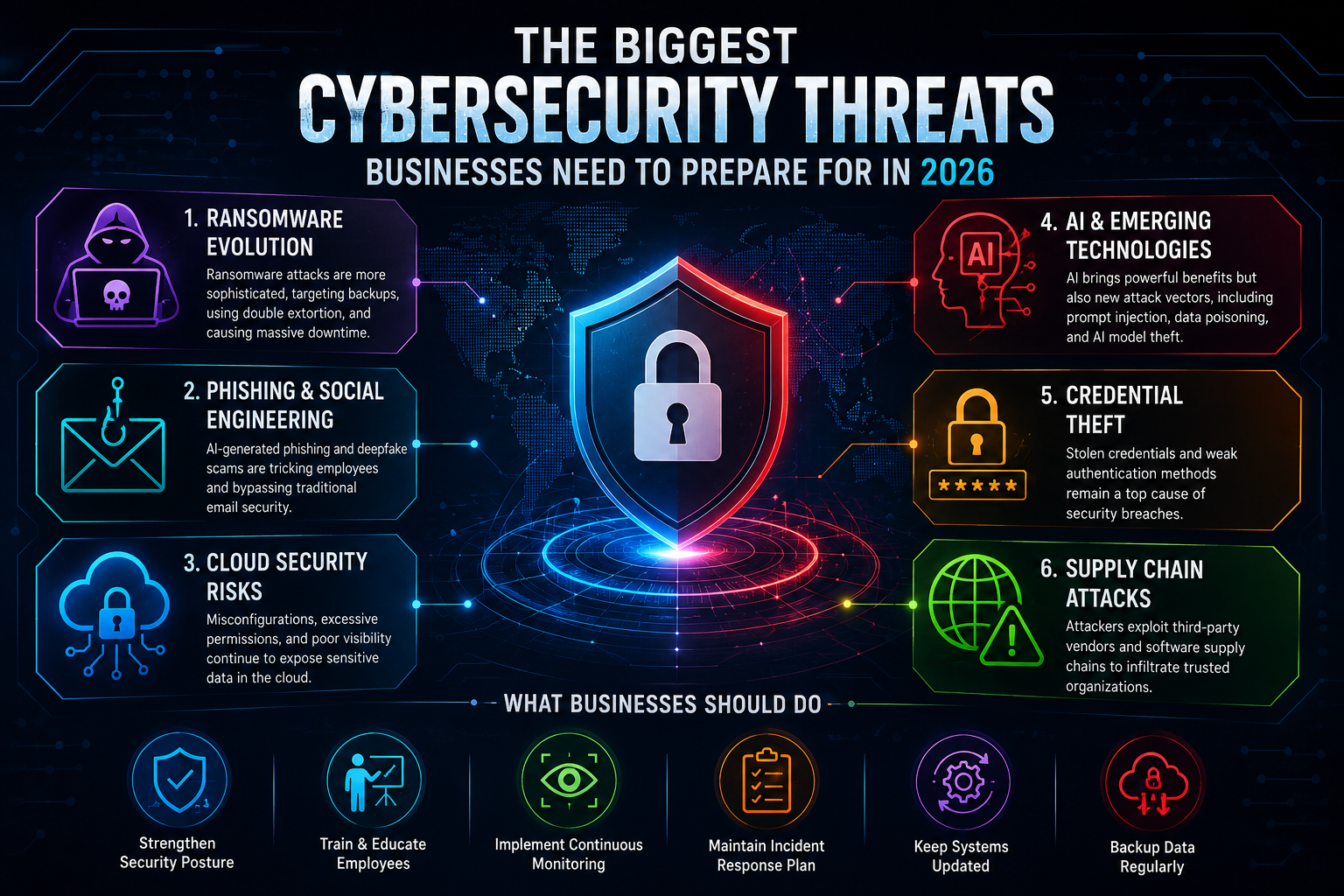
In 2026, businesses are facing an increasingly complex threat landscape. Artificial intelligence is helping both defenders and attackers, cloud environments are expanding, remote work remains common, and cybercriminal groups are becoming more organized. Traditional security measures alone are no longer enough to protect modern organizations.
Preparing for today’s threats requires understanding how attackers operate, identifying the most common risks, and implementing strong security practices before incidents occur. Here are the biggest cybersecurity threats businesses should prepare for in 2026.
AI-Powered Phishing Attacks
Phishing remains one of the most successful methods used by cybercriminals, but artificial intelligence has made these attacks much more convincing.
Instead of sending poorly written emails with obvious mistakes, attackers now use AI to generate personalized messages that closely resemble legitimate communications. These emails often imitate trusted brands, executives, business partners, or financial institutions.
AI can also analyze publicly available information to create highly targeted phishing campaigns that increase the chances of success.
Businesses should reduce phishing risks by:
- Providing regular employee awareness training
- Using advanced email security solutions
- Enabling multi-factor authentication
- Verifying unusual payment requests
- Encouraging employees to report suspicious emails immediately
Human awareness continues to be one of the strongest defenses against phishing attacks.
Ransomware Continues to Evolve
Ransomware remains one of the most damaging cyber threats facing organizations.
Modern ransomware groups no longer simply encrypt files. Many now steal confidential information before locking systems, threatening to publish sensitive data unless a ransom is paid.
Attackers often spend days or even weeks inside a network before launching encryption, allowing them to identify valuable systems and disable backups.
Businesses can reduce ransomware risks by:
- Maintaining secure offline backups
- Applying software updates promptly
- Restricting administrative privileges
- Monitoring unusual file activity
- Segmenting networks
- Testing recovery procedures regularly
Preparation is essential because recovery becomes much more difficult once ransomware spreads throughout an organization.
Supply Chain Attacks
Businesses increasingly rely on third-party software, cloud services, and technology vendors.
Unfortunately, attackers understand that compromising one trusted supplier can provide access to hundreds or even thousands of organizations.
Supply chain attacks target software updates, service providers, or trusted applications that customers install without suspicion.
To reduce these risks, businesses should:
- Evaluate vendor security practices
- Monitor third-party access
- Limit unnecessary permissions
- Review software updates carefully
- Maintain an inventory of external dependencies
Strong vendor management has become an important part of cybersecurity planning.
Cloud Security Risks
Cloud computing offers flexibility and scalability, but it also introduces new security challenges.
Many cloud-related incidents occur because of configuration mistakes rather than sophisticated hacking techniques.
Examples include:
- Publicly accessible storage
- Weak access controls
- Excessive user permissions
- Unsecured APIs
- Poor identity management
Organizations should regularly review cloud security settings and apply the principle of least privilege to minimize exposure.
Continuous monitoring is equally important because cloud environments change frequently.
Insider Threats
Not every cybersecurity incident originates from external attackers.
Employees, contractors, and business partners may accidentally or intentionally expose sensitive information.
Insider threats include:
- Accidental data leaks
- Stolen credentials
- Unauthorized file sharing
- Privilege misuse
- Malicious employees
Businesses should implement user activity monitoring, role-based access controls, and regular security awareness programs to reduce insider risks.
Promptly removing access for departing employees is also essential.
Credential Theft
Passwords continue to be one of the weakest points in cybersecurity.
Attackers frequently steal login credentials through phishing, malware, password reuse, and data breaches.
Once attackers obtain valid credentials, they can often bypass traditional security controls.
Organizations should strengthen authentication by:
- Requiring strong passwords
- Enforcing multi-factor authentication
- Monitoring unusual login activity
- Preventing password reuse
- Using password managers
Protecting user identities has become one of the highest cybersecurity priorities.
Business Email Compromise
Business Email Compromise (BEC) attacks continue to cause significant financial losses worldwide.
Rather than using malware, criminals impersonate executives, vendors, or finance departments to convince employees to transfer money or reveal confidential information.
Modern AI tools make these scams even more convincing by producing realistic writing styles and personalized messages.
Businesses should establish verification procedures for financial transactions and require multiple approvals for large payments.
Independent verification through phone calls or secure communication channels can prevent costly mistakes.
Internet of Things (IoT) Vulnerabilities
Many organizations now rely on connected devices, including security cameras, smart sensors, printers, industrial equipment, and medical devices.
Unfortunately, these devices often receive fewer security updates than traditional computers.
Common IoT risks include:
- Default passwords
- Outdated firmware
- Weak encryption
- Poor network segmentation
- Limited monitoring
Businesses should maintain an inventory of connected devices and ensure firmware updates are installed whenever available.
Separating IoT devices from critical business systems also reduces potential damage.
Deepfake and Social Engineering Attacks
Artificial intelligence has made deepfake technology more realistic than ever.
Cybercriminals can generate fake voice recordings or videos that appear to come from company executives or trusted partners.
These fake communications may instruct employees to approve payments, disclose confidential information, or change banking details.
Organizations should never rely solely on voice or video confirmation for important business decisions.
Independent verification procedures remain essential.
Zero-Day Vulnerabilities
Zero-day vulnerabilities are software flaws that attackers exploit before security patches become available.
Because there is no immediate fix, these vulnerabilities present significant risks.
Organizations should reduce exposure by:
- Monitoring threat intelligence
- Applying emergency patches quickly
- Limiting unnecessary software
- Using endpoint detection systems
- Segmenting networks
Rapid response helps minimize the impact of newly discovered vulnerabilities.
API Security Threats
Businesses increasingly rely on application programming interfaces (APIs) to connect services and applications.
Poorly secured APIs can expose sensitive customer information or provide attackers with unauthorized access.
Common API risks include:
- Weak authentication
- Broken authorization
- Excessive data exposure
- Rate limiting failures
- Misconfigured endpoints
Regular API testing and security reviews should become part of every software development process.
Distributed Denial-of-Service (DDoS) Attacks
DDoS attacks continue to disrupt businesses by overwhelming servers with massive amounts of traffic.
Although these attacks may not always steal information, they can make websites and online services unavailable for extended periods.
Organizations should prepare by:
- Using DDoS protection services
- Deploying content delivery networks
- Monitoring network traffic
- Establishing incident response procedures
- Testing infrastructure resilience
Fast detection and mitigation reduce downtime during an attack.
Remote Work Security Challenges
Hybrid and remote work environments continue to expand the attack surface for many businesses.
Employees often connect from personal networks and use multiple devices outside corporate offices.
Potential risks include:
- Unsecured Wi-Fi networks
- Personal devices
- Weak passwords
- Unpatched software
- Unauthorized applications
Organizations should require VPN usage, endpoint protection, multi-factor authentication, and regular device updates to secure remote access.
Artificial Intelligence Used by Cybercriminals
Artificial intelligence is helping defenders improve cybersecurity, but attackers are using the same technology.
Criminals now automate many tasks, including:
- Phishing campaign creation
- Malware development
- Password guessing
- Vulnerability scanning
- Social engineering research
This allows cybercriminals to launch attacks more quickly and at a larger scale than before.
Businesses should expect cyber threats to become increasingly automated over the coming years.
Data Privacy and Regulatory Risks
Businesses are collecting more customer information than ever before.
Failure to protect sensitive data can result in legal penalties, financial losses, and reputational damage.
Organizations should understand applicable privacy regulations and implement strong data protection practices, including encryption, access controls, secure backups, and regular compliance assessments.
Cybersecurity and data privacy have become closely connected.
Best Practices for Cybersecurity in 2026
Preparing for modern cyber threats requires a proactive security strategy rather than reacting after an incident occurs.
Businesses should consider the following best practices:
- Conduct regular cybersecurity risk assessments.
- Keep operating systems and software fully updated.
- Enable multi-factor authentication across all critical accounts.
- Provide ongoing cybersecurity awareness training.
- Monitor networks continuously for suspicious activity.
- Secure cloud environments with proper access controls.
- Maintain tested offline backups.
- Limit user permissions based on job responsibilities.
- Develop and regularly test an incident response plan.
- Review third-party vendor security practices.
Organizations that combine technology with employee awareness create stronger protection against evolving cyber threats.
Looking Ahead
Cybersecurity will continue to evolve as businesses adopt artificial intelligence, cloud computing, automation, and connected devices. While these technologies improve productivity, they also create new opportunities for attackers. Organizations that continuously monitor risks, invest in modern security technologies, and educate employees will be better positioned to defend against future threats. Cybersecurity should not be viewed as a one-time project but as an ongoing process that adapts alongside changing technologies and attack methods.
Conclusion
The cybersecurity landscape in 2026 is more challenging than ever. AI-powered phishing, ransomware, supply chain attacks, cloud security risks, insider threats, deepfakes, credential theft, and zero-day vulnerabilities are just some of the threats businesses must prepare for.
No organization is completely immune to cyberattacks, regardless of its size or industry. However, businesses that adopt a proactive approach by strengthening security controls, training employees, implementing modern detection technologies, and regularly reviewing their security posture can significantly reduce their risk. Cybersecurity is no longer just an IT responsibility. It is a business-wide priority that requires leadership, planning, and continuous improvement. Organizations that prepare today will be far better equipped to handle the cyber threats of tomorrow.

