Ransomware continues to be one of the most damaging cyber threats facing businesses, governments, and individuals. Over the past decade, these attacks have evolved from simple file encryption into highly organized cybercrime operations that steal sensitive information, disrupt critical services, and demand millions of dollars in ransom payments.
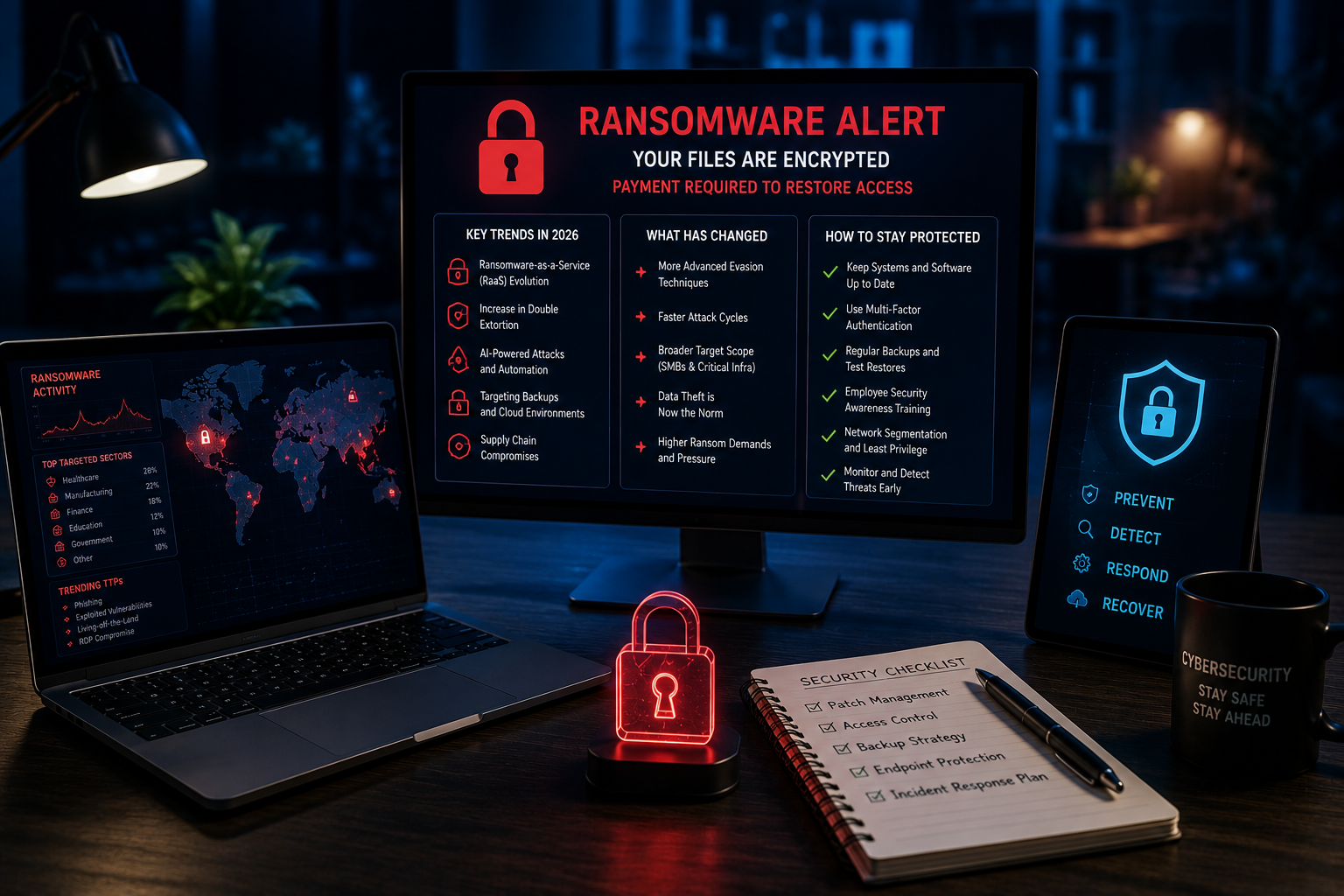
In 2026, ransomware is no longer just about locking files. Cybercriminals are using artificial intelligence, automation, stolen credentials, and advanced extortion techniques to maximize their chances of success. Many attacks now focus on stealing confidential data before encryption even begins, giving attackers additional leverage over their victims. Recent threat intelligence also points to growing use of AI-assisted ransomware and an increase in data-only extortion campaigns.
As ransomware tactics continue to evolve, organizations must rethink their cybersecurity strategies. Understanding today’s ransomware trends is the first step toward building stronger defenses.
How Ransomware Has Evolved
A few years ago, ransomware attacks mainly focused on encrypting files and demanding payment for a decryption key.
Today’s attacks are much more sophisticated.
Modern ransomware groups often spend days or even weeks inside a victim’s network before launching the attack. During this time, they gather information, identify valuable systems, steal confidential files, disable security tools, and attempt to compromise backup systems.
By the time the ransomware is activated, attackers already have enough information to pressure organizations into paying.
This shift has made ransomware one of the most complex cybersecurity challenges businesses face today.
AI Is Changing Ransomware Attacks
Artificial intelligence is transforming cybersecurity for both defenders and attackers.
Cybercriminals are increasingly using AI to automate phishing campaigns, generate convincing emails, identify vulnerable systems, and analyze stolen information.
Security researchers have even documented early examples of AI orchestrating ransomware operations with minimal human involvement, demonstrating how future attacks could become faster and more autonomous.
AI allows attackers to:
- Personalize phishing emails
- Automate vulnerability scanning
- Analyze stolen credentials
- Generate convincing social engineering messages
- Improve attack efficiency
This means organizations should expect ransomware campaigns to become more targeted and increasingly difficult to detect.
Data Theft Is Becoming More Important Than Encryption
One of the biggest changes in 2026 is the growing emphasis on data theft.
Instead of relying only on encrypted files, many ransomware groups now steal confidential information before launching their attack.
If a company refuses to pay, attackers threaten to publish or sell the stolen data online.
This strategy creates additional pressure because organizations must consider:
- Customer privacy
- Regulatory penalties
- Legal consequences
- Reputation damage
- Loss of competitive information
Security researchers have observed a continued shift toward data-leak extortion and, in some cases, attacks that prioritize data theft over encryption altogether.
Multi-Extortion Has Become Common
Traditional ransomware demanded payment for file recovery.
Today’s attackers often use multiple forms of extortion simultaneously.
These may include:
- Encrypting business systems
- Stealing confidential data
- Threatening public data leaks
- Launching distributed denial-of-service (DDoS) attacks
- Contacting customers or business partners directly
By attacking organizations from several directions, cybercriminals increase the pressure to pay quickly.
Attackers Are Targeting Cloud Environments
Cloud adoption has grown rapidly, making cloud services an attractive target.
Rather than focusing only on on-premises servers, attackers now search for:
- Misconfigured cloud storage
- Weak administrator accounts
- Exposed application programming interfaces (APIs)
- Poor identity management
- Unprotected cloud backups
A single compromised cloud account can provide access to thousands of sensitive documents.
Organizations must treat cloud security as an essential part of ransomware prevention.
Stolen Credentials Are a Major Entry Point
Many ransomware attacks no longer begin with sophisticated hacking techniques.
Instead, attackers purchase or steal legitimate login credentials.
These credentials may come from:
- Phishing emails
- Password reuse
- Previous data breaches
- Malware infections
- Credential marketplaces
Once attackers obtain valid credentials, they often bypass traditional security controls without triggering immediate suspicion.
Using strong passwords and enabling multi-factor authentication significantly reduces this risk.
Supply Chain Attacks Continue to Increase
Cybercriminals increasingly target software vendors, managed service providers, and technology suppliers.
Compromising one trusted vendor can provide access to hundreds or even thousands of customer networks.
Organizations should carefully evaluate third-party security practices and limit vendor access whenever possible.
Supply chain security has become an essential part of ransomware defense.
Critical Infrastructure Remains a Top Target
Healthcare organizations, manufacturing companies, transportation providers, energy companies, and government agencies continue to experience ransomware attacks.
These industries often rely on continuous operations, making downtime extremely expensive.
Attackers know these organizations may feel greater pressure to restore services quickly.
Protecting critical infrastructure requires continuous monitoring, network segmentation, and rapid incident response capabilities.
Small Businesses Are Still at Risk
Many small businesses mistakenly believe cybercriminals only target large corporations.
In reality, smaller organizations often have fewer security resources, making them attractive targets.
Attackers frequently exploit:
- Weak passwords
- Outdated software
- Unsecured remote access
- Limited cybersecurity awareness
- Poor backup practices
Every organization, regardless of size, should prepare for ransomware threats.
Why Ransomware Is Harder to Detect
Modern ransomware attacks often remain hidden long before encryption begins.
Attackers use legitimate administrative tools, valid user accounts, and encrypted communications to avoid detection.
Recent research shows many organizations do not discover an intrusion until after sensitive data has already been stolen.
This is why continuous monitoring and behavioral threat detection have become essential.
The Financial Impact of Ransomware
The cost of ransomware extends far beyond the ransom itself.
Organizations may face:
- Business interruption
- Data recovery expenses
- Legal costs
- Regulatory fines
- Customer compensation
- Lost productivity
- Reputation damage
Even businesses that successfully recover from an attack often spend months rebuilding trust and strengthening security.
How Organizations Can Stay Protected
Although ransomware continues to evolve, organizations can greatly reduce their risk by adopting strong cybersecurity practices.
Enable Multi-Factor Authentication
Multi-factor authentication adds an additional verification step beyond passwords.
Even if attackers steal login credentials, MFA makes unauthorized access much more difficult.
Keep Systems Updated
Software vendors regularly release patches to fix security vulnerabilities.
Installing updates quickly reduces opportunities for attackers to exploit known weaknesses.
This applies to:
- Operating systems
- Applications
- Network devices
- Cloud services
- Security software
Maintain Secure Backups
Reliable backups remain one of the strongest defenses against ransomware.
Organizations should:
- Create automatic backups
- Store backup copies offline or in isolated environments
- Encrypt backup data
- Test recovery procedures regularly
Backups should never be the only security measure, but they are essential for business continuity.
Train Employees
Human error continues to play a significant role in ransomware infections.
Employees should understand how to:
- Recognize phishing emails
- Avoid suspicious links
- Verify unusual requests
- Report suspicious activity
- Protect login credentials
Regular awareness training reduces successful phishing attacks.
Monitor Networks Continuously
Continuous monitoring helps detect unusual behavior before ransomware spreads.
Security teams should investigate:
- Unexpected data transfers
- Privilege escalation
- Suspicious login attempts
- Large file modifications
- Unauthorized administrative activity
Behavior-based monitoring often detects attacks earlier than traditional signature-based tools.
Limit User Permissions
Not every employee requires administrator access.
Applying the principle of least privilege limits the damage attackers can cause after compromising an account.
Permissions should be reviewed regularly and adjusted whenever job responsibilities change.
Segment Networks
Network segmentation prevents attackers from moving freely between systems.
If one department becomes infected, segmentation helps protect critical servers and sensitive databases from compromise.
The Role of Artificial Intelligence in Defense
While attackers increasingly use AI, defenders are using it as well.
Modern AI-powered security platforms help organizations:
- Detect unusual user behavior
- Identify malware faster
- Analyze millions of security events
- Prioritize critical alerts
- Automate incident response
AI allows security teams to respond more quickly and reduce the time attackers remain undetected.
However, AI works best alongside experienced cybersecurity professionals rather than replacing them.
Building a Strong Incident Response Plan
Even organizations with strong security controls should prepare for ransomware incidents.
An effective incident response plan should include:
- Procedures for identifying attacks
- Isolating affected systems
- Preserving evidence
- Communicating with stakeholders
- Recovering business operations
- Reviewing lessons learned after the incident
Regular tabletop exercises help employees understand their responsibilities before an actual emergency occurs.
Looking Ahead
Ransomware will continue to evolve as cybercriminals adopt new technologies and refine their tactics. AI-driven automation, multi-extortion campaigns, credential theft, and cloud-focused attacks are expected to remain major trends throughout the coming years. Threat intelligence also shows ransomware groups becoming more specialized while accelerating their operations and expanding data-focused extortion strategies.
Organizations that invest in proactive security, employee education, continuous monitoring, and resilient recovery plans will be in a much stronger position to defend against future attacks.
Conclusion
Ransomware in 2026 is far more advanced than it was only a few years ago. Attackers are combining artificial intelligence, stolen credentials, cloud exploitation, and multi-stage extortion to maximize their success. Rather than simply encrypting files, many groups now focus on stealing sensitive information and disrupting business operations before demanding payment.
Although the threat continues to grow, organizations are not powerless. Strong authentication, regular software updates, secure backups, continuous monitoring, employee awareness, and well-tested incident response plans can significantly reduce the likelihood and impact of a ransomware attack.
Cybersecurity is an ongoing process, not a one-time project. Businesses that remain vigilant and adapt to emerging ransomware trends will be far better prepared to protect their systems, data, and customers in the years ahead.

