In 2026, messaging apps are no longer just about chatting. They are about privacy, control, and trust. With increasing concerns about surveillance, data collection, and cyber threats, people are asking a simple question: Which messaging app actually protects my privacy?
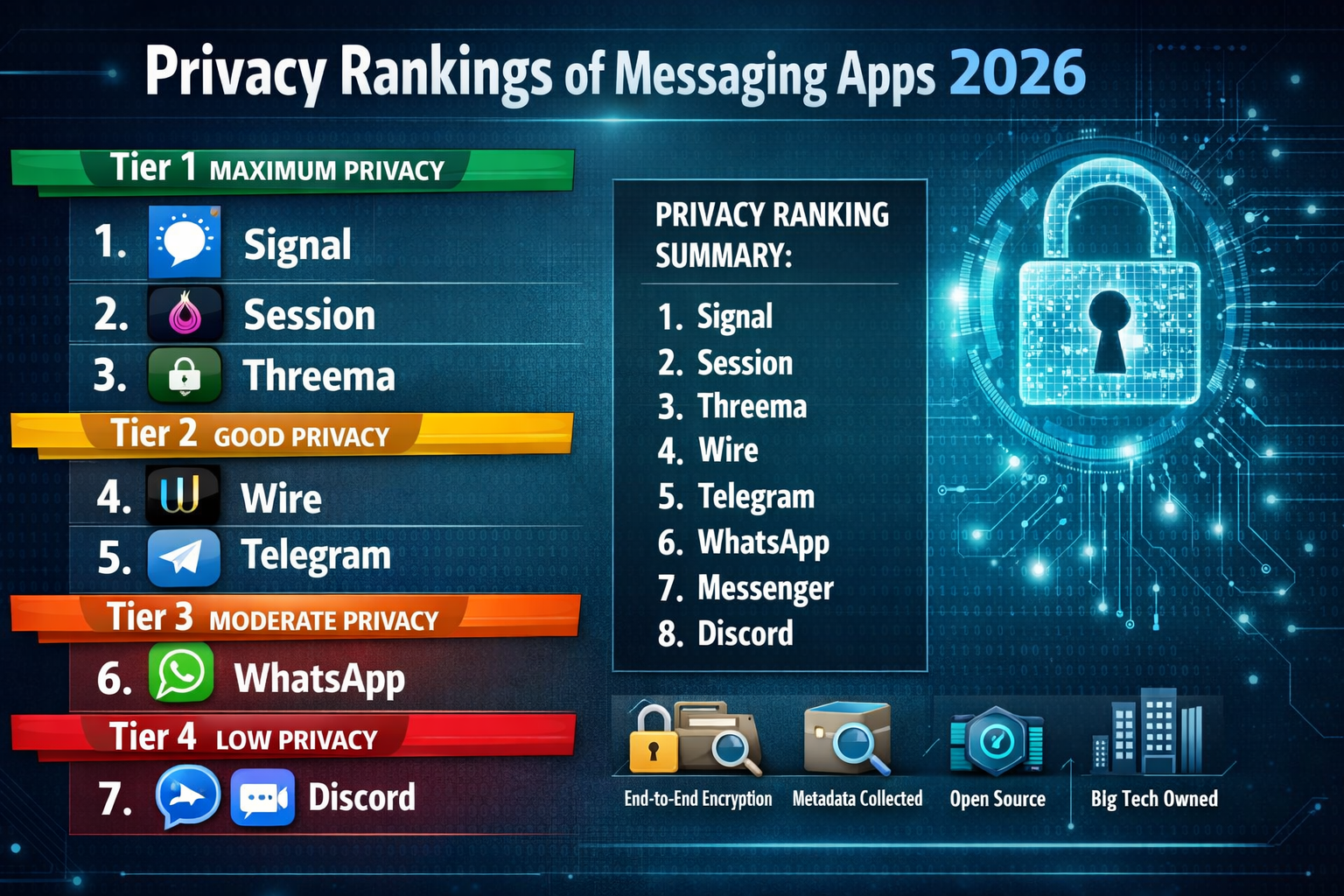
This article breaks down the privacy rankings of popular messaging apps in 2026 in a simple, human way. No complicated jargon—just clear insights to help you decide which app fits your needs.
What “Privacy” Really Means in Messaging Apps
Before ranking apps, it’s important to understand what privacy actually includes.
A messaging app is considered private when it offers:
-
End-to-end encryption (E2EE) – Only you and the receiver can read messages
-
Minimal data collection – The app collects little to no personal data
-
Metadata protection – It hides who you talk to, when, and how often
-
Open-source transparency – Code can be audited by experts
-
No tracking or ads
Even if messages are encrypted, apps can still track behavioral data and metadata, which can reveal a lot about you
🏆 Privacy Ranking of Messaging Apps (2026)
1. Signal – The Gold Standard
Signal continues to dominate privacy rankings in 2026—and for good reason.
Why Signal ranks #1:
-
End-to-end encryption is on by default for everything
-
Collects almost no user data
-
Fully open-source and nonprofit
-
Messages and data stored locally on your device
-
No ads, no tracking
Experts consistently consider Signal the most secure messaging app because of its minimal metadata collection and strong encryption
The human takeaway
If privacy is your top priority, Signal is the closest thing to “invisible messaging.” It’s simple, clean, and built for security—not profit.
2. Threema – Maximum Anonymity
Threema is less popular but extremely powerful when it comes to anonymity.
Why it ranks high:
-
No phone number or email required
-
Uses anonymous IDs instead of personal data
-
Stores data locally instead of cloud servers
-
Strong encryption across all messages
It offers some of the best metadata protection available today
The human takeaway
Threema feels like a private vault. It’s ideal for people who want to stay completely anonymous—even from the app itself.
3. Session – True Anonymous Messaging
Session is built for people who want zero traceability.
Key features:
-
No phone number needed
-
Uses a decentralized network
-
Routes messages through multiple nodes
-
Designed to eliminate metadata tracking
It is considered one of the best apps for anonymous communication
The human takeaway
Session is not just private—it’s designed to make tracking nearly impossible. Perfect for activists, journalists, or anyone needing extreme privacy.
4. Briar – Offline and Censorship-Resistant
Briar takes a very different approach to messaging.
Why it stands out:
-
Works without internet (Bluetooth, Wi-Fi Direct)
-
No central servers
-
Highly resistant to censorship and surveillance
The human takeaway
Briar is not for everyday chatting—but in situations where networks are blocked or monitored, it becomes incredibly powerful.
5. WhatsApp – Secure but Data-Hungry
WhatsApp is one of the most used apps in the world—but privacy is complicated.
The good:
-
Uses end-to-end encryption (Signal protocol)
-
Secure message content
The concerns:
-
Collects metadata (contacts, usage patterns, device info)
-
Owned by Meta (data-driven business model)
-
Cloud backups may not always be encrypted
Even though messages are encrypted, WhatsApp still gathers significant user data, which raises privacy concerns
The human takeaway
WhatsApp is safe for conversations—but not fully private. It’s like talking in a locked room while someone logs who enters and leaves.
6. Telegram – Feature-Rich but Not Fully Private
Telegram is often misunderstood as a secure app—but the reality is mixed.
The truth:
-
End-to-end encryption is NOT enabled by default
-
Group chats are not end-to-end encrypted
-
Messages often stored on cloud servers
Experts warn that Telegram is less private than most people think
The human takeaway
Telegram is great for communities and features—but not ideal if privacy is your main concern.
7. Facebook Messenger & Instagram DMs – Lowest Privacy
These platforms rank lowest in privacy.
Why:
-
Heavy data collection and tracking
-
Ads and profiling
-
Encryption not always enabled by default
The human takeaway
These apps are built for engagement and business—not privacy.
📊 Quick Comparison Table
| App | Encryption | Data Collection | Anonymity | Privacy Rank |
|---|---|---|---|---|
| Signal | Full E2EE | Minimal | Medium | ⭐⭐⭐⭐⭐ |
| Threema | Full E2EE | Very Low | High | ⭐⭐⭐⭐⭐ |
| Session | Full E2EE | None | Very High | ⭐⭐⭐⭐⭐ |
| Briar | Full E2EE | None | High | ⭐⭐⭐⭐ |
| E2EE | High | Low | ⭐⭐⭐ | |
| Telegram | Partial | Medium | Low | ⭐⭐ |
| Messenger | Limited | Very High | Very Low | ⭐ |
⚠️ The Truth Most People Ignore
Here’s something important:
Even the most private app cannot fully protect you if:
-
You back up chats to the cloud
-
You use weak passwords
-
You share personal data freely
-
Your device is compromised
Privacy is not just about the app—it’s about your behavior.
🔮 Trends Shaping Messaging Privacy in 2026
Messaging privacy is evolving fast. Here are the biggest trends:
1. Rise of decentralized apps
Apps like Session are moving away from central servers.
2. Growing concern over metadata
Experts now say metadata can be more revealing than messages themselves
3. Increased government scrutiny
Messaging apps are under pressure to balance privacy and regulation.
4. Users becoming more aware
People are slowly shifting from convenience to privacy-first platforms.
🧠 Final Thoughts
In 2026, choosing a messaging app is no longer just about features—it’s about how much of your digital life you’re willing to share.
-
If you want maximum privacy → Signal, Session, or Threema
-
If you want balance and convenience → WhatsApp
-
If you want features over privacy → Telegram
There is no perfect app. Only trade-offs.
But one thing is clear:
Privacy is no longer optional—it’s a choice you actively make every day.

