Cybersecurity threats are becoming more common and more sophisticated every year. Organizations of all sizes face risks from ransomware attacks, phishing campaigns, data breaches, insider threats, and other cyber incidents that can disrupt operations and damage reputations. While many businesses invest heavily in cybersecurity tools and technologies, having security software alone is not enough. Companies also need to know how they will respond when a cyberattack happens.
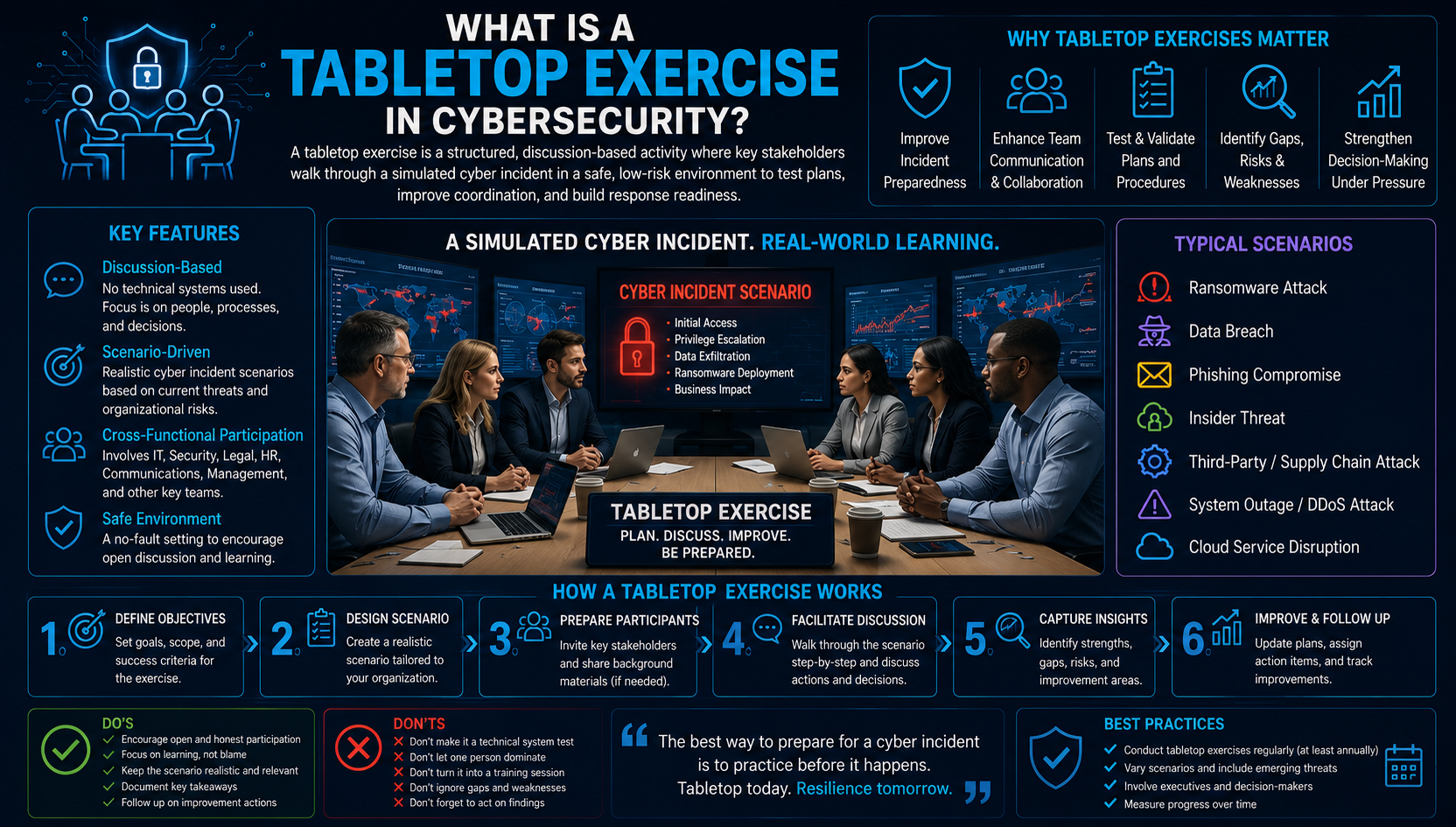
This is where a tabletop exercise in cybersecurity becomes important. A tabletop exercise is a practical way for organizations to test their incident response plans, evaluate decision-making processes, and prepare teams for real-world cyber incidents. Instead of waiting for an actual attack to discover weaknesses in a response strategy, businesses can simulate a cyber crisis in a controlled environment and learn valuable lessons before a real emergency occurs.
Understanding what a tabletop exercise in cybersecurity is and why it matters can help organizations improve their readiness and strengthen their overall security posture.
Understanding a Tabletop Exercise in Cybersecurity
A tabletop exercise in cybersecurity is a discussion-based simulation that allows participants to walk through a hypothetical cyber incident. During the exercise, team members discuss how they would respond to a specific cybersecurity scenario, such as a ransomware attack, data breach, insider threat, or system compromise.
Unlike live simulations that involve technical systems and hands-on testing, a tabletop exercise focuses on communication, coordination, decision-making, and response procedures. Participants gather in a meeting room or virtual environment and review a realistic scenario presented by facilitators. As the scenario unfolds, participants explain the actions they would take, identify responsibilities, discuss response options, and evaluate whether existing policies and procedures are sufficient. The goal is not to test technical skills but to assess organizational preparedness and improve response planning.
Why Tabletop Exercises Are Important
Cyber incidents often create confusion and pressure. During an actual attack, teams may face uncertainty, limited information, media attention, customer concerns, and executive scrutiny. Even organizations with strong cybersecurity defenses can struggle if they are unprepared to manage a crisis effectively.
A tabletop exercise helps organizations identify gaps before a real incident occurs. It gives stakeholders an opportunity to practice their roles and understand how different departments work together during an emergency. These exercises encourage communication between IT teams, security professionals, executives, legal departments, public relations teams, and business leaders. Since cyber incidents affect more than just technical systems, involving multiple departments helps create a coordinated response strategy.
Tabletop exercises also help organizations validate incident response plans. Many companies create response documents but never test them. An exercise reveals whether those plans are realistic, practical, and easy to follow during stressful situations.
How a Cybersecurity Tabletop Exercise Works
A cybersecurity tabletop exercise usually begins with planning and scenario development. Facilitators create a realistic cyber incident that reflects threats relevant to the organization. For example, the scenario may involve ransomware spreading through the company network after an employee clicks a malicious email link. The exercise may begin with reports of unusual system activity and gradually introduce new information as the scenario progresses.
Participants are asked questions throughout the exercise. They discuss how they would investigate the issue, who they would notify, whether systems should be isolated, how customers would be informed, and what actions leadership should take. As the scenario develops, facilitators may introduce additional challenges. These might include media inquiries, customer complaints, regulatory reporting requirements, or evidence that sensitive data has been stolen. The discussion continues until the incident reaches a conclusion. Afterward, participants review their performance, identify strengths and weaknesses, and discuss opportunities for improvement.
Common Cybersecurity Scenarios Used in Tabletop Exercises
Organizations can use many different scenarios depending on their industry, size, and risk profile. Ransomware remains one of the most popular tabletop exercise scenarios because it affects organizations across all sectors. Participants must determine how to contain the attack, restore operations, communicate with stakeholders, and manage business continuity.
Data breach scenarios are also common. These exercises focus on how organizations detect unauthorized access, investigate affected systems, notify regulators, and protect customer information. Phishing attacks provide another realistic scenario. Teams evaluate how they would respond if employees unknowingly provided credentials to attackers or downloaded malicious software.
Insider threat exercises explore situations where employees misuse access privileges or intentionally steal sensitive information. These scenarios help organizations assess monitoring processes, investigation procedures, and legal considerations. Supply chain attacks have become increasingly relevant as businesses rely on third-party vendors and service providers. A tabletop exercise may examine how an organization would respond if a trusted vendor experienced a cybersecurity breach.
Who Should Participate in a Tabletop Exercise?
One of the biggest misconceptions about cybersecurity tabletop exercises is that they are only for IT teams. In reality, cyber incidents impact the entire organization. Security professionals and IT personnel play important roles because they understand technical systems and response procedures. However, executives must also participate because major incidents often require strategic decisions about business operations, communications, and risk management.
Legal teams help address regulatory obligations, privacy laws, and potential liability concerns. Human resources personnel may be involved if employees are affected or disciplinary actions become necessary. Public relations and communications teams play a critical role in managing external messaging. During a cybersecurity incident, customers, partners, investors, and the media may seek information about what happened.
Business unit leaders should also participate because operational disruptions can affect productivity, revenue, and customer service. By involving multiple departments, organizations can gain a more complete understanding of how a cyber incident affects the business as a whole.
Benefits of Conducting Tabletop Exercises
One of the primary benefits of tabletop exercises is improved preparedness. Teams become more familiar with response procedures and gain confidence in their ability to manage cyber incidents. Exercises also improve communication. During a real emergency, misunderstandings can delay response efforts and increase damage. Practicing communication during a simulation helps teams establish clear reporting structures and decision-making processes.
Another benefit is identifying weaknesses in incident response plans. Organizations often discover outdated contact information, unclear responsibilities, missing procedures, or insufficient documentation during an exercise. Tabletop exercises can also reveal technology gaps. While the focus is primarily on processes and communication, discussions often uncover limitations in monitoring tools, backup systems, or recovery capabilities.
From a compliance perspective, tabletop exercises demonstrate a commitment to cybersecurity readiness. Many regulatory frameworks and industry standards encourage or require organizations to test their incident response plans regularly. Perhaps most importantly, these exercises create a culture of security awareness. Employees and leaders become more engaged in cybersecurity efforts and develop a better understanding of organizational risks.
Challenges Organizations May Face
Although tabletop exercises provide significant value, organizations may encounter challenges during implementation. Some participants may view the exercise as a formality rather than a learning opportunity. To be effective, exercises should encourage honest discussion and active engagement.
Another challenge is creating realistic scenarios. Overly simple scenarios may fail to test important processes, while extremely complex situations can overwhelm participants and reduce learning effectiveness. Time constraints can also limit participation. Busy executives and department leaders may struggle to allocate time for cybersecurity exercises. However, investing a few hours in preparation can save organizations from significant disruption during a real incident.
Organizations must also avoid treating tabletop exercises as one-time events. Cyber threats evolve continuously, and response plans should be tested regularly to remain effective.
Best Practices for Successful Tabletop Exercises
A successful tabletop exercise begins with clear objectives. Organizations should identify what they want to learn before developing a scenario.
Scenarios should be realistic and tailored to the organization’s specific risks. A healthcare provider, for example, may focus on patient data breaches, while a financial institution may prioritize fraud or ransomware incidents. Facilitators should encourage participation from all attendees. Every department offers valuable perspectives that contribute to a more comprehensive response strategy.
Documentation is also important. Observations, lessons learned, and improvement opportunities should be recorded and reviewed after the exercise. Following up on findings is essential. Identifying weaknesses has little value if organizations fail to address them. Response plans should be updated, training should be improved, and corrective actions should be implemented based on exercise outcomes. Regular testing helps maintain readiness and ensures that improvements remain effective over time.
The Future of Tabletop Exercises in Cybersecurity
As cyber threats continue to evolve, tabletop exercises are becoming an increasingly important part of cybersecurity programs. Organizations recognize that preparedness involves more than deploying security technologies. Effective incident response requires coordination, communication, and informed decision-making. Modern tabletop exercises are also evolving. Many organizations now conduct hybrid exercises that combine discussion-based scenarios with technical simulations. Others incorporate emerging threats such as artificial intelligence-driven attacks, cloud security incidents, and supply chain compromises.
Remote work environments have also influenced exercise design. Virtual tabletop exercises allow geographically distributed teams to participate and collaborate regardless of location. As businesses face increasingly complex cyber risks, tabletop exercises will remain a valuable tool for strengthening resilience and improving incident response capabilities.
Conclusion
A tabletop exercise in cybersecurity is a structured discussion that helps organizations prepare for cyber incidents before they occur. By simulating realistic attack scenarios, businesses can evaluate their response plans, improve communication, identify weaknesses, and build confidence among key stakeholders. Cybersecurity is not only about preventing attacks but also about responding effectively when incidents happen. Tabletop exercises provide a safe and practical environment for organizations to practice decision-making, test procedures, and strengthen overall preparedness.
In today’s threat landscape, every organization should consider tabletop exercises as an essential part of its cybersecurity strategy. Regular testing and continuous improvement can make the difference between a controlled response and a costly cybersecurity crisis. As threats continue to evolve, organizations that invest in preparedness will be better positioned to protect their operations, customers, and reputation.

