In today’s digital world, data has become one of the most valuable assets for businesses. Organizations collect and store customer information, employee records, financial details, and other sensitive data every day. While technology helps businesses grow and operate efficiently, it also creates opportunities for cybercriminals to target valuable information. This is why having a strong data breach response plan is no longer optional. It is an essential part of modern cybersecurity.
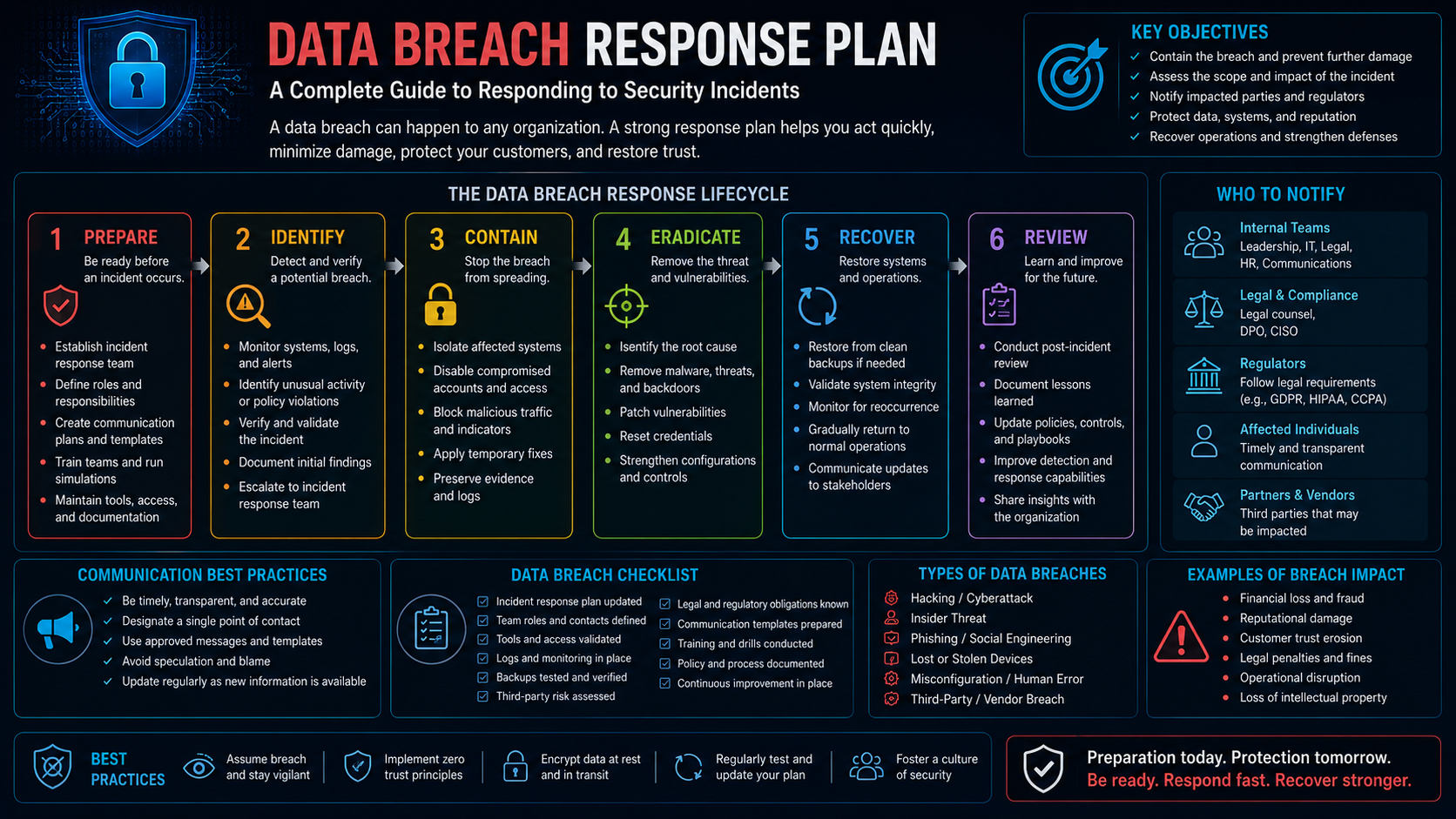
A data breach can happen to organizations of any size. Small businesses, large corporations, healthcare providers, educational institutions, and government agencies all face the risk of cyberattacks. When a breach occurs, every minute matters. The way an organization responds can determine the extent of the damage, the financial impact, and the trust it maintains with customers.
A well-designed data breach response plan helps organizations react quickly and effectively when sensitive information is exposed, stolen, or accessed without authorization. It provides a clear roadmap for managing the incident and reducing its impact.
What Is a Data Breach Response Plan?
A data breach response plan is a documented strategy that outlines the steps an organization should take after discovering a data breach. The purpose of the plan is to identify the breach, contain the damage, investigate the cause, notify affected parties, and restore normal operations as quickly as possible.
Without a response plan, organizations often struggle to make decisions during a crisis. Teams may not know who is responsible for specific tasks, leading to confusion, delays, and increased damage. A response plan eliminates uncertainty by providing clear guidance during stressful situations.
The goal is not only to recover from the breach but also to learn from the incident and strengthen security measures to prevent similar attacks in the future.
Why Every Business Needs a Data Breach Response Plan
Cyberattacks have become more sophisticated than ever before. Hackers use ransomware, phishing emails, malware, insider threats, and software vulnerabilities to gain access to sensitive information. Even organizations with strong security controls can become victims.
When a breach occurs, the consequences can be severe. Financial losses, legal penalties, regulatory fines, operational disruptions, and reputational damage can affect a business for years. Customers may lose confidence in a company that fails to protect their personal information.
A data breach response plan helps reduce these risks by enabling organizations to act quickly and confidently. Fast response times can limit data exposure, reduce recovery costs, and demonstrate accountability to customers, regulators, and business partners.
Organizations that prepare in advance are generally more successful at managing cyber incidents than those that react without a structured plan.
Understanding the Nature of Data Breaches
A data breach occurs when unauthorized individuals gain access to confidential information. This information may include customer records, payment card data, healthcare information, passwords, intellectual property, or sensitive business documents.
Data breaches can happen in many ways. A cybercriminal may exploit a software vulnerability, trick an employee into revealing credentials through phishing, or deploy malware that steals information. In some cases, data breaches result from human error, such as sending sensitive files to the wrong recipient or improperly configuring cloud storage.
Regardless of the cause, organizations must be prepared to respond immediately once suspicious activity is detected.
The Importance of Early Detection
One of the most critical aspects of a successful data breach response plan is early detection. The sooner a breach is discovered, the greater the chance of minimizing damage.
Organizations should continuously monitor their systems, networks, and user activities for unusual behavior. Security monitoring tools can help identify suspicious logins, unauthorized file access, unusual data transfers, and other warning signs.
Employees also play an important role in detection. Staff members should be trained to recognize potential cybersecurity threats and report suspicious activities immediately. Early reporting can significantly reduce the impact of a security incident.
Containing the Breach
Once a breach is identified, the immediate priority is containment. The goal is to prevent attackers from causing further damage or accessing additional information. Containment actions may involve disconnecting affected systems from the network, disabling compromised user accounts, blocking malicious IP addresses, or isolating infected devices.
Organizations must act carefully during this phase. While it is important to stop the attack, investigators also need to preserve evidence that may help determine how the breach occurred. Effective containment can significantly reduce the amount of data exposed and prevent the incident from spreading across the organization.
Investigating the Incident
After containment, the organization must conduct a thorough investigation. Understanding what happened is essential for making informed decisions and preventing future incidents.
The investigation should focus on identifying how attackers gained access, which systems were affected, what data was compromised, and how long the attackers remained in the environment. Cybersecurity professionals often analyze system logs, network traffic, user activities, and forensic evidence to reconstruct the timeline of the breach. A detailed investigation provides valuable insights that help organizations strengthen their defenses and close security gaps.
Assessing the Impact
Not every data breach has the same level of severity. Some incidents may involve a limited number of records, while others can affect millions of customers. Organizations must carefully assess the impact of the breach. This includes determining the type of information exposed, the number of affected individuals, and the potential risks associated with the compromised data.
For example, exposure of email addresses may present a different level of risk compared to exposure of financial information, medical records, or government identification numbers. A clear understanding of the impact helps guide communication strategies and regulatory reporting requirements.
Notification and Communication
Transparency is a key component of an effective data breach response plan. Once the organization understands the scope of the incident, it must communicate with affected parties.
Many countries and industries have regulations requiring organizations to notify customers, regulators, and other stakeholders within specific timeframes following a breach. Communication should be accurate, timely, and honest. Organizations should explain what happened, what information may have been affected, what actions are being taken, and what steps individuals can take to protect themselves. Poor communication can damage trust even more than the breach itself. Customers appreciate organizations that respond openly and responsibly during difficult situations.
Recovering from the Breach
Recovery involves restoring systems and returning operations to normal while ensuring that the threat has been fully eliminated. This process may include removing malware, patching vulnerabilities, restoring data from backups, strengthening access controls, and enhancing security monitoring. Organizations should carefully test systems before bringing them back online to ensure they are secure and functioning properly. Recovery is not simply about resuming operations. It is also an opportunity to improve security practices and reduce the likelihood of future incidents.
Learning from the Incident
Every data breach provides valuable lessons. After recovery, organizations should conduct a post-incident review to evaluate their response efforts. This review helps identify strengths, weaknesses, and areas for improvement within the existing response plan. Questions may include whether the breach was detected quickly, whether communication was effective, and whether response procedures worked as intended. The findings should be used to update security policies, improve employee training, and enhance incident response capabilities. Continuous improvement is essential because cyber threats constantly evolve.
The Role of Employee Training
Technology alone cannot prevent every data breach. Employees remain one of the most important defenses against cyber threats. Regular cybersecurity awareness training helps staff recognize phishing attacks, social engineering attempts, and other common threats. Employees should understand how to report suspicious activities and follow security best practices. Organizations that invest in employee education often experience fewer security incidents and faster detection of potential threats. A knowledgeable workforce strengthens the overall effectiveness of a data breach response plan.
Building a Strong Security Culture
A successful response plan is supported by a strong security culture. Cybersecurity should not be viewed as the responsibility of a single department. It should be integrated into every aspect of the organization. Leadership teams must demonstrate their commitment to security by supporting policies, allocating resources, and encouraging employee participation. When security becomes part of everyday business operations, organizations are better prepared to detect and respond to threats. A culture of security awareness helps reduce risks and improves resilience against cyberattacks.
Testing the Data Breach Response Plan
Creating a response plan is only the first step. Organizations must regularly test the plan to ensure it works effectively during real incidents. Simulated exercises allow teams to practice their roles and identify potential weaknesses before an actual breach occurs. These exercises improve coordination, communication, and decision-making under pressure. Testing also helps employees become familiar with procedures, reducing confusion during real emergencies. Regular updates and testing ensure that the plan remains relevant as technology, business operations, and threat landscapes change.
Conclusion
A well-prepared data breach response plan is one of the most important tools an organization can have in today’s cybersecurity environment. Data breaches are no longer a question of if but when. Organizations that prepare in advance can respond faster, reduce damage, protect customer trust, and recover more effectively.
The key to success lies in preparation, detection, containment, investigation, communication, recovery, and continuous improvement. By treating cybersecurity as an ongoing priority and regularly refining response procedures, businesses can build resilience against evolving threats.
In an age where data is a critical business asset, a comprehensive data breach response plan provides the confidence and structure needed to navigate security incidents successfully. Organizations that invest in planning today will be far better equipped to face the cybersecurity challenges of tomorrow.

