Artificial Intelligence has rapidly transformed the way businesses operate, communicate, and make decisions. From customer service chatbots and automated content creation to advanced data analysis and cybersecurity tools, AI is now part of everyday business operations. Organizations around the world are investing heavily in artificial intelligence because it helps improve efficiency, reduce costs, and increase productivity.
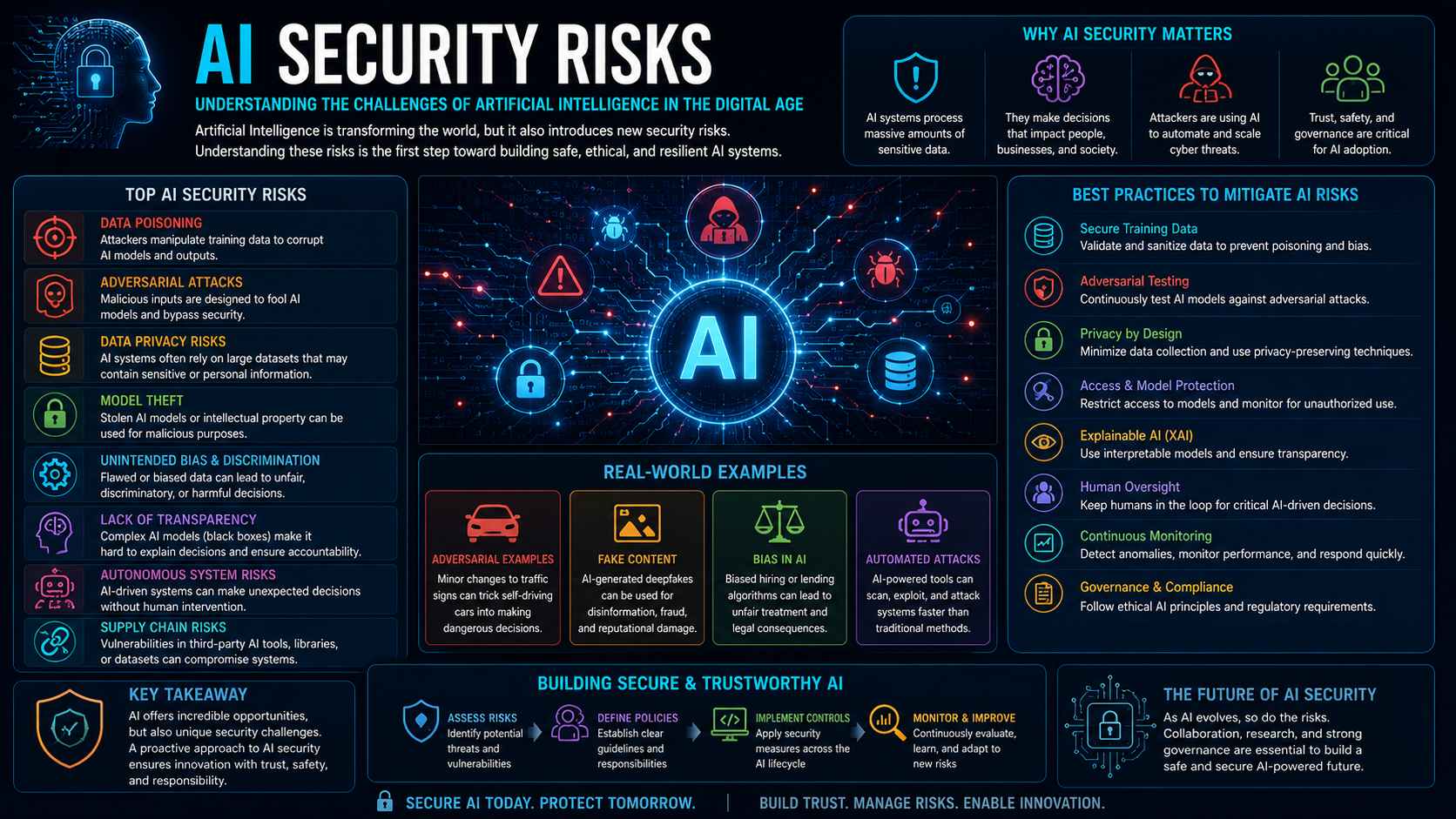
While the benefits of AI are impressive, there is another side to the technology that deserves equal attention. As AI systems become more powerful and widely adopted, concerns about AI security risks continue to grow. Businesses, governments, and individuals are realizing that artificial intelligence can introduce new vulnerabilities that cybercriminals may exploit.
Understanding AI security risks is essential for anyone using or planning to use artificial intelligence. By recognizing these challenges early, organizations can take proactive measures to protect their systems, data, and users.
What Are AI Security Risks?
AI security risks refer to threats, vulnerabilities, and potential dangers associated with the development, deployment, and use of artificial intelligence systems. These risks can affect the confidentiality, integrity, and availability of information while creating opportunities for cybercriminals to exploit weaknesses.
Unlike traditional software, AI systems learn from data and make decisions based on patterns. This unique characteristic introduces new attack surfaces that may not exist in conventional technologies. If AI models are manipulated or compromised, the consequences can be significant. As organizations continue integrating AI into critical business functions, the need to address these security risks becomes increasingly important.
Why AI Security Risks Are Growing
The rise of AI adoption has created an attractive target for cybercriminals. Companies are feeding large amounts of sensitive information into AI systems, including customer data, financial records, intellectual property, and confidential business information.
At the same time, attackers are learning how to use AI for their own purposes. They are developing sophisticated techniques to bypass security controls, automate attacks, and exploit vulnerabilities faster than ever before. The combination of widespread AI adoption and increasingly advanced cyber threats has created a complex security environment where organizations must remain vigilant.
Data Poisoning Attacks
One of the most serious AI security risks involves data poisoning. AI models depend on training data to learn and make decisions. If attackers can manipulate this data, they may influence how the AI behaves.
For example, a malicious actor could introduce incorrect or misleading information into a training dataset. As a result, the AI system may generate inaccurate outputs or make poor decisions. In cybersecurity applications, a poisoned model might fail to detect malicious activities, allowing attackers to operate unnoticed. Data poisoning is particularly dangerous because the manipulation often occurs during the training process, making it difficult to detect later.
Prompt Injection Threats
As generative AI tools become more popular, prompt injection attacks have emerged as a growing concern. These attacks involve crafting specific instructions designed to manipulate an AI system into revealing sensitive information or performing unintended actions.
Prompt injection can affect AI-powered customer support systems, enterprise assistants, and automated workflows. Attackers may use carefully designed prompts to bypass restrictions, access confidential information, or influence system behavior. Organizations using large language models must implement safeguards to reduce the risk of prompt manipulation and unauthorized access.
Sensitive Data Exposure
Many users unknowingly share confidential information with AI tools. Employees may enter customer records, internal documents, passwords, financial data, or proprietary information into AI platforms while seeking assistance.
If appropriate security controls are not in place, this information may be exposed or stored in ways that create privacy concerns. Data leakage remains one of the most common AI security risks facing businesses today. Organizations must educate employees about responsible AI usage and establish clear policies regarding the types of information that can be shared with AI systems.
Model Theft and Intellectual Property Risks
Developing advanced AI models often requires substantial investments in time, expertise, and resources. As a result, AI models themselves have become valuable intellectual property assets. Cybercriminals may attempt to steal AI models through unauthorized access or reverse engineering techniques. Once stolen, these models can be copied, modified, or sold to competitors. Model theft not only causes financial losses but may also compromise a company’s competitive advantage. Protecting AI assets should therefore be a key component of every organization’s cybersecurity strategy.
Deepfakes and Identity Manipulation
One of the most visible AI security risks is the rise of deepfake technology. AI can now generate highly realistic images, videos, and audio recordings that closely resemble real individuals. While this technology has legitimate applications in entertainment and education, it can also be used maliciously. Criminals may create fake videos of executives, politicians, or public figures to spread misinformation or conduct fraud.
In some cases, attackers have used AI-generated voices to impersonate company leaders and authorize fraudulent financial transactions. These incidents demonstrate how AI can amplify traditional social engineering attacks. As deepfake technology continues to improve, verifying the authenticity of digital content will become increasingly challenging.
Automated Cyber Attacks
Artificial intelligence is not only being used for defense. Cybercriminals are also leveraging AI to automate attacks and improve their effectiveness. AI-powered tools can scan networks for vulnerabilities, identify potential targets, and launch attacks at a scale that would be impossible manually. Attackers can also use AI to analyze stolen data, craft convincing phishing emails, and adapt their tactics based on victim responses. This increased automation enables cybercriminals to operate more efficiently and target larger numbers of organizations simultaneously.
AI-Generated Phishing Campaigns
Traditional phishing emails often contain grammatical errors and suspicious wording. However, AI has significantly improved the quality of phishing messages.
Modern AI tools can generate personalized emails that appear professional, convincing, and relevant to the recipient. By analyzing publicly available information, attackers can create highly targeted messages that increase the likelihood of success. Employees may find it more difficult to distinguish between legitimate communications and AI-generated scams, making awareness training more important than ever.
Bias and Manipulation Risks
AI systems learn from historical data, which may contain biases or inaccuracies. If these biases are not identified and addressed, AI systems may produce unfair or discriminatory outcomes. Beyond ethical concerns, biased AI systems can create security risks. Attackers may exploit known weaknesses in decision-making algorithms or manipulate inputs to achieve desired outcomes. Organizations must regularly test and evaluate their AI systems to ensure that decisions remain accurate, fair, and secure.
Supply Chain Vulnerabilities
Modern AI systems often rely on third-party components, external datasets, open-source libraries, and cloud-based services. Each dependency introduces potential security risks.
If a third-party provider experiences a security breach, organizations using those services may also be affected. Similarly, compromised software components can introduce hidden vulnerabilities into AI environments. Supply chain attacks have become increasingly common, making vendor security assessments an important part of AI risk management.
Lack of Transparency
Many advanced AI systems operate as “black boxes,” meaning their internal decision-making processes are difficult to understand. This lack of transparency creates security challenges because organizations may struggle to identify why an AI system produced a specific result. When unexpected behavior occurs, security teams may find it difficult to investigate the root cause. Improving explainability and transparency can help organizations detect anomalies, identify vulnerabilities, and strengthen trust in AI systems.
Regulatory and Compliance Concerns
Governments and regulatory bodies around the world are introducing new rules governing the use of artificial intelligence. Organizations that fail to comply with these regulations may face legal penalties, financial losses, and reputational damage.
AI security risks often intersect with privacy requirements, data protection laws, and industry-specific compliance standards. Companies must ensure that their AI systems align with applicable regulations while maintaining strong security practices. Staying informed about evolving regulatory requirements is becoming an essential part of AI governance.
How Organizations Can Reduce AI Security Risks
Reducing AI security risks requires a comprehensive approach that combines technology, policies, and employee awareness. Organizations should begin by identifying where AI is being used and what types of data are involved. Understanding the AI landscape within the organization helps security teams assess potential vulnerabilities and implement appropriate controls.
Regular security testing should be conducted to identify weaknesses before attackers can exploit them. AI models, training data, and supporting infrastructure should all be included in security assessments. Strong access controls are equally important. Only authorized individuals should have access to sensitive datasets, AI models, and administrative functions. Multi-factor authentication and role-based access controls can help reduce the risk of unauthorized access.
Employee education also plays a critical role. Staff members should understand how to use AI responsibly and recognize common threats such as phishing, prompt injection, and data leakage. Continuous monitoring can help organizations detect unusual behavior and respond quickly to potential incidents. AI environments should be treated with the same level of security attention as other critical business systems.
The Future of AI Security
As artificial intelligence continues to evolve, security challenges will evolve alongside it. New capabilities will create new opportunities, but they will also introduce new risks that organizations must manage carefully. The future of AI security will likely involve stronger regulations, improved defensive technologies, and greater collaboration between industry leaders, researchers, and governments. Organizations that prioritize security from the beginning will be better positioned to benefit from AI while minimizing potential threats. Rather than viewing AI security as an obstacle, businesses should see it as an essential component of successful AI adoption. Building secure and trustworthy AI systems will help organizations unlock the full potential of artificial intelligence while protecting their customers, employees, and valuable information.
Conclusion
AI security risks are becoming one of the most important cybersecurity challenges of the modern era. From data poisoning and prompt injection attacks to deepfakes and automated cyber threats, artificial intelligence introduces a wide range of vulnerabilities that require careful attention. Despite these challenges, AI remains a powerful technology capable of delivering significant benefits when used responsibly. Organizations that understand the risks and implement strong security practices can confidently embrace AI while reducing their exposure to potential threats. As artificial intelligence becomes more deeply integrated into everyday life and business operations, maintaining a strong focus on security will be essential for building trust, protecting sensitive information, and ensuring long-term success.

