Cybersecurity threats have become a daily concern for organizations around the world. Businesses of every size face the risk of ransomware attacks, phishing campaigns, insider threats, and data breaches that can disrupt operations and damage customer trust. While preventing attacks is an important part of cybersecurity, no organization can guarantee complete protection from every threat. This is why having a strong incident response process is essential.
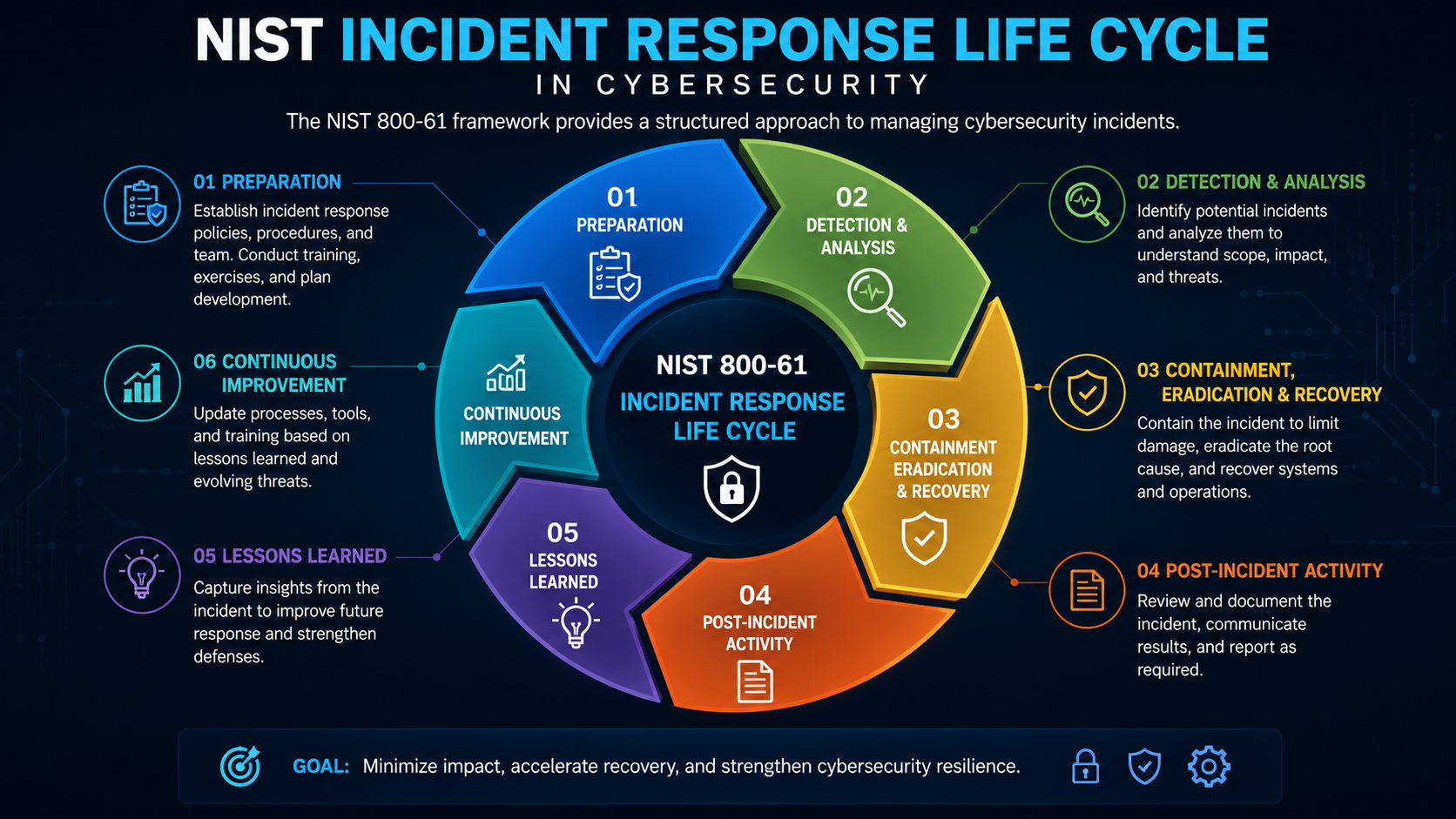
The NIST Incident Response Life Cycle provides a structured framework that helps organizations prepare for, detect, manage, and recover from cybersecurity incidents. Developed by the National Institute of Standards and Technology (NIST), this approach is widely respected because it offers practical guidance that organizations can follow regardless of their size or industry.
A cybersecurity incident can happen without warning. A single employee clicking a malicious email link or an unpatched vulnerability can give attackers access to sensitive systems. When such incidents occur, organizations need a clear process to minimize damage and restore normal operations. The NIST Incident Response Life Cycle helps achieve this goal by providing a methodical approach that improves decision-making during stressful situations.
Understanding the NIST Incident Response Life Cycle
The NIST Incident Response Life Cycle is a framework designed to help organizations manage cybersecurity incidents effectively. Rather than reacting in a chaotic manner, organizations can follow a structured process that guides them through every stage of incident management.
The framework recognizes that cybersecurity incidents are not isolated events. They are part of an ongoing cycle that involves preparation, detection, response, recovery, and continuous improvement. By following this life cycle, organizations can reduce confusion, improve communication, and strengthen their overall security posture. One of the reasons the NIST framework remains popular is its flexibility. It can be applied to government agencies, private companies, healthcare institutions, educational organizations, and financial institutions. The core principles remain the same regardless of the environment.
The Importance of Preparation
Preparation is often considered the most important phase of the NIST Incident Response Life Cycle because it establishes the foundation for every future response effort. Organizations that fail to prepare usually struggle when a real incident occurs.
Preparation involves creating policies, procedures, and response plans that define how incidents will be handled. It also includes establishing an incident response team and ensuring that team members understand their responsibilities. Security tools must be deployed and configured properly so that suspicious activities can be identified quickly. Employee awareness also plays a major role in preparation. Human error remains one of the leading causes of security incidents. Employees who understand how to recognize phishing emails, suspicious links, and social engineering attempts can help prevent attacks before they become serious problems.
Organizations should regularly conduct training exercises and simulated attacks. These exercises help teams practice their response procedures and identify weaknesses in their plans. Just as firefighters conduct drills before an emergency occurs, cybersecurity teams must prepare for incidents before they happen. Without proper preparation, even a minor security event can become a major crisis. Preparation ensures that organizations can respond quickly and confidently when threats emerge.
Detection and Analysis: Identifying the Threat
No matter how strong an organization’s defenses are, incidents may still occur. The next phase of the NIST Incident Response Life Cycle focuses on detecting suspicious activity and determining whether a genuine security incident has taken place.
Modern organizations generate enormous amounts of security data every day. Firewalls, endpoint protection platforms, intrusion detection systems, and security monitoring tools continuously collect information about network activity. Within this vast amount of data, security teams must identify signs of potential threats. Detection begins when an alert, unusual behavior, or suspicious event is discovered. However, not every alert indicates a real attack. Security analysts must investigate the situation carefully to separate genuine threats from false alarms.
Analysis involves examining available evidence to understand what happened, when it happened, and how it may affect the organization. Analysts work to determine the scope of the incident, identify affected systems, and assess the potential impact on business operations. For example, a security monitoring system may detect repeated login attempts from an unfamiliar location. Analysts would investigate whether the activity is related to a legitimate employee traveling abroad or an attacker attempting to gain unauthorized access. This analysis helps determine the appropriate response.
Accurate detection and analysis are critical because poor decisions at this stage can delay containment efforts or lead to unnecessary disruption. The goal is to gather enough information to make informed decisions while acting quickly enough to prevent further damage.
Containment: Limiting the Damage
Once a cybersecurity incident has been confirmed, the immediate priority becomes containment. The purpose of containment is to prevent the threat from spreading further throughout the organization. Cyber attackers often attempt to move laterally within networks after gaining initial access. If security teams fail to contain the incident quickly, attackers may reach additional systems, steal more data, or deploy malware across the environment.
Containment measures vary depending on the nature of the incident. In some situations, security teams may disconnect affected devices from the network. In other cases, they may disable compromised user accounts, block malicious traffic, or isolate infected servers.
The challenge during containment is balancing security needs with business operations. Completely shutting down critical systems may stop the attack, but it can also disrupt essential services. Organizations must carefully evaluate the situation and choose containment strategies that reduce risk while maintaining business continuity whenever possible. Effective containment limits the impact of the incident and creates a safer environment for further investigation. It serves as a critical bridge between detection and full recovery.
Eradication: Removing the Root Cause
After the threat has been successfully contained, organizations can focus on eradication. This phase involves identifying and eliminating the root cause of the incident. Containment may stop an attack from spreading, but it does not necessarily remove the threat entirely. Attackers may leave behind malware, unauthorized accounts, malicious scripts, or backdoor access mechanisms that allow them to return later.
During eradication, security teams conduct detailed investigations to identify all traces of the attack. They remove malicious software, close exploited vulnerabilities, update security controls, and eliminate unauthorized access points. For example, if attackers gained access through an unpatched software vulnerability, simply removing the malware would not be enough. The vulnerable software must also be updated to prevent future exploitation.
Eradication requires patience and thoroughness. Missing even a small piece of malicious code can allow attackers to regain access after recovery efforts begin. Security teams must verify that all traces of the threat have been removed before moving forward. A successful eradication phase gives organizations confidence that the environment is clean and secure enough to begin restoring normal operations.
Recovery: Restoring Business Operations
Recovery focuses on returning affected systems and services to normal operation while ensuring that the threat has been fully eliminated. This phase often involves restoring data from backups, rebuilding compromised systems, validating system integrity, and carefully monitoring for signs of continued malicious activity. Recovery is not simply about turning systems back on. It is about restoring them in a secure and controlled manner. Organizations must verify that recovered systems function properly and no longer contain indicators of compromise. Additional monitoring may be necessary to detect any lingering threats that were not identified during earlier phases.
Recovery can be particularly challenging after major incidents such as ransomware attacks. Organizations may need to restore large amounts of data, rebuild infrastructure, and communicate with customers regarding service disruptions. The success of recovery efforts often depends on the quality of preparation conducted before the incident occurred. Organizations with strong backup strategies and well-documented recovery procedures can typically resume operations much faster than those without such measures. A carefully managed recovery process helps restore confidence among employees, customers, and stakeholders while reducing the long-term impact of the incident.
Learning from the Incident
One of the most valuable aspects of the NIST Incident Response Life Cycle is its emphasis on continuous improvement. Once systems have been restored and normal operations have resumed, organizations should not simply move on and forget the incident. Every cybersecurity incident provides an opportunity to learn. Security teams should conduct a thorough review to understand what happened, how the organization responded, and where improvements can be made.
These reviews often reveal valuable insights. An organization may discover weaknesses in its monitoring capabilities, communication procedures, employee training programs, or technical controls. Addressing these weaknesses helps strengthen future defenses. Documentation is also important during this stage. Detailed records of the incident, response actions, and lessons learned create valuable resources for future investigations and training efforts.
Organizations that consistently learn from incidents become more resilient over time. Each experience helps refine processes, improve readiness, and strengthen overall cybersecurity maturity.
Why Organizations Trust the NIST Framework
The NIST Incident Response Life Cycle has earned widespread recognition because it offers a practical and proven approach to incident management. Rather than relying on improvisation during a crisis, organizations can follow a structured process that guides their actions from beginning to end.
The framework improves coordination among teams, supports faster decision-making, and helps reduce the overall impact of cybersecurity incidents. It also aligns well with regulatory requirements and industry best practices, making it valuable for organizations operating in highly regulated environments. Perhaps most importantly, the framework promotes a culture of continuous improvement. Cyber threats continue to evolve, and organizations must evolve with them. The lessons learned from one incident can help prevent future attacks and strengthen security across the organization.
Conclusion
The NIST Incident Response Life Cycle remains one of the most respected frameworks in cybersecurity because it provides a clear roadmap for handling security incidents. By focusing on preparation, detection and analysis, containment, eradication, recovery, and continuous improvement, organizations can respond to threats in a structured and effective manner.
Cybersecurity incidents are no longer a question of if they will happen but when they will happen. Organizations that invest in a strong incident response capability are better prepared to minimize damage, protect sensitive information, and maintain business continuity during challenging situations. As cyber threats become increasingly sophisticated, the NIST Incident Response Life Cycle continues to serve as a valuable guide for organizations seeking to strengthen their resilience and build a more secure future.

