In today’s digital world, cybersecurity is no longer just a technical concern—it’s a personal and business necessity. Whether you’re browsing social media, managing an online business, or simply checking emails, you are constantly exposed to potential cyber threats. These threats are becoming more advanced every day, targeting individuals, organizations, and even governments.
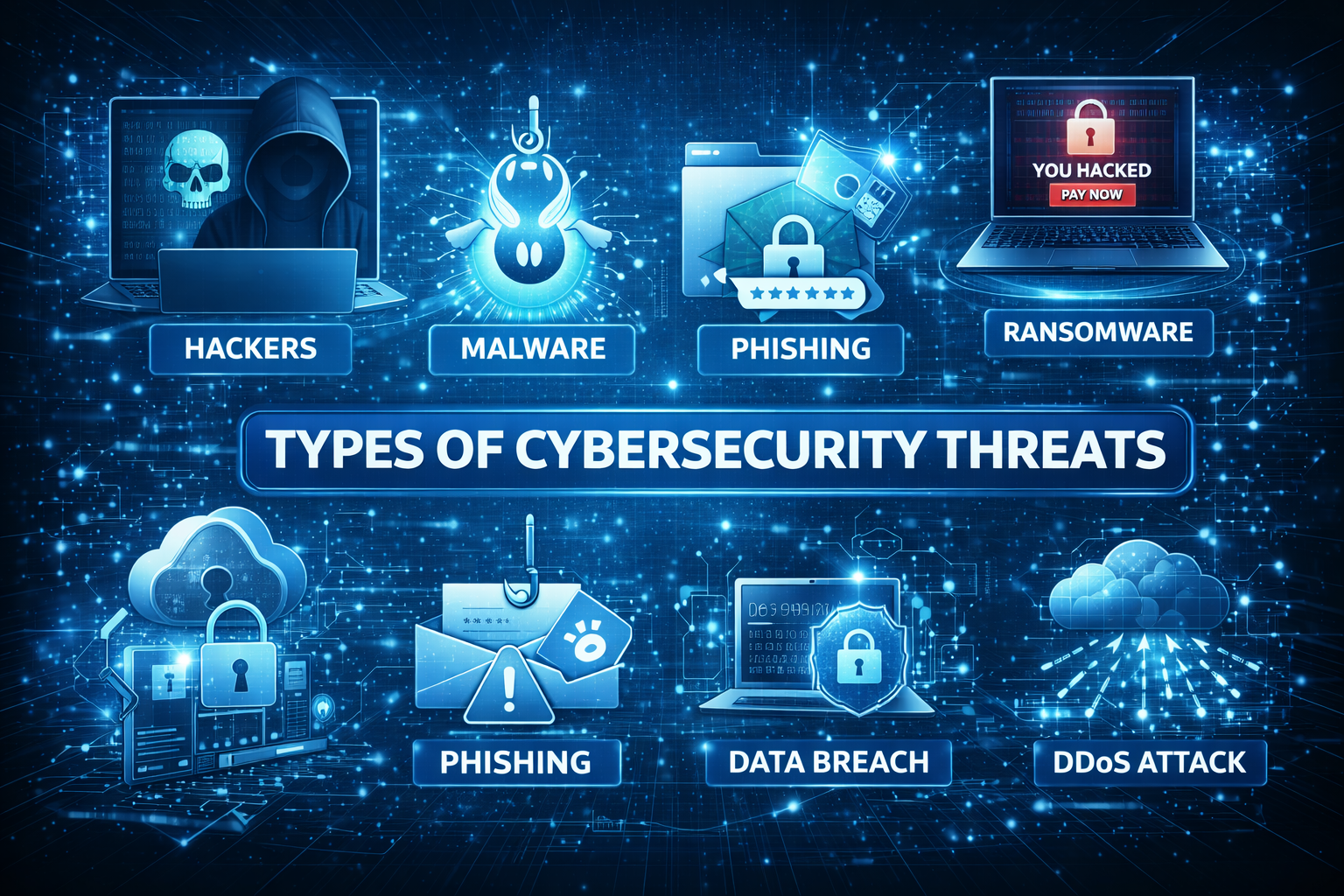
Understanding the different types of cybersecurity threats is the first step toward protecting yourself. This article explains the most common threats in a simple, human way so you can recognize and avoid them before they cause harm.
1. Malware Attacks
Malware is one of the most common and dangerous cybersecurity threats. The word “malware” stands for malicious software, and it includes any program designed to harm your device or steal your data.
There are several types of malware:
- Viruses – Attach themselves to files and spread when those files are shared
- Worms – Spread automatically across networks without user action
- Trojans – Disguise themselves as safe software but carry harmful code
- Spyware – Secretly tracks your activities and steals information
- Adware – Displays unwanted ads and may slow down your system
Malware usually enters your system through suspicious downloads, email attachments, or infected websites. Once inside, it can corrupt files, steal passwords, or even lock your entire system.
2. Phishing Attacks
Phishing is a type of social engineering attack where cybercriminals trick you into revealing sensitive information like passwords, credit card numbers, or login details.
These attacks often come in the form of:
- Fake emails that look like they’re from banks or companies
- Messages asking you to “verify your account”
- Links that redirect you to fake websites
Phishing works because it plays on human emotions—fear, urgency, or curiosity. For example, you might receive an email saying your account will be blocked unless you act immediately. The key to avoiding phishing is to always double-check links, email addresses, and never share sensitive information unless you are sure of the source.
3. Ransomware Attacks
Ransomware is a specific type of malware that locks your files or entire system and demands payment (ransom) to restore access.
Imagine turning on your computer and seeing a message saying:
“Your files are encrypted. Pay within 48 hours or lose everything.”
That’s ransomware.
These attacks are particularly dangerous because:
- They can target both individuals and large companies
- Payment does not guarantee file recovery
- Important data can be permanently lost
Ransomware usually spreads through email attachments, malicious downloads, or weak security systems.
4. Denial-of-Service (DoS) Attacks
A Denial-of-Service (DoS) attack aims to make a website or service unavailable by overwhelming it with traffic. A more advanced version is called a Distributed Denial-of-Service (DDoS) attack, where multiple systems flood the target simultaneously.
For example:
- A website suddenly receives millions of requests
- The server becomes overloaded
- Real users can no longer access the service
These attacks are often used to disrupt businesses, damage reputations, or demand ransom.
5. Man-in-the-Middle (MitM) Attacks
In a Man-in-the-Middle attack, a hacker secretly intercepts communication between two parties.
For example:
- You connect to public Wi-Fi at a café
- A hacker intercepts your data
- They capture your login credentials or financial details
You think you are communicating securely, but someone is listening in. This type of attack is especially common on unsecured networks. Using secure connections (HTTPS) and avoiding public Wi-Fi for sensitive tasks can help reduce the risk.
6. SQL Injection Attacks
SQL Injection is a technique used by attackers to manipulate a website’s database.
Here’s how it works:
- A hacker enters malicious code into a website form
- The website fails to validate the input
- The attacker gains access to the database
This can result in:
- Data theft
- Unauthorized access
- Complete control over the website
SQL injection is a major threat to businesses that store user data online.
7. Zero-Day Exploits
A zero-day exploit targets a software vulnerability that is unknown to the developer.
“Zero-day” means the developers have had zero days to fix the issue.
These attacks are extremely dangerous because:
- There is no patch available
- Users are completely unprotected
- Hackers can exploit the system before anyone realizes the problem
Cybercriminals often use zero-day vulnerabilities to launch large-scale attacks before security updates are released.
8. Insider Threats
Not all threats come from outside. Sometimes, the danger lies within an organization.
Insider threats occur when employees, contractors, or trusted individuals misuse their access.
There are two types:
- Malicious insiders – Intentionally steal or damage data
- Negligent insiders – Accidentally cause security breaches
For example:
- Sharing passwords
- Clicking on phishing emails
- Leaking sensitive company information
Insider threats are difficult to detect because the person already has authorized access.
9. Password Attacks
Passwords are often the weakest link in cybersecurity.
Hackers use various methods to crack passwords:
- Brute force attacks – Trying multiple combinations
- Dictionary attacks – Using common words and phrases
- Credential stuffing – Using leaked passwords from other sites
If you use the same password everywhere, one breach can expose all your accounts. Strong, unique passwords and two-factor authentication (2FA) can significantly reduce this risk.
10. Social Engineering Attacks
Social engineering is the art of manipulating people into giving away confidential information.
Unlike technical attacks, this focuses on human behavior.
Examples include:
- Pretending to be IT support
- Calling someone and asking for login details
- Creating fake emergencies to gain trust
These attacks are effective because they exploit human psychology rather than system weaknesses.
11. Botnets
A botnet is a network of infected devices controlled by a hacker.
These devices (called “bots”) can include:
- Computers
- Smartphones
- IoT devices (like smart TVs or cameras)
Once infected, your device can be used without your knowledge to:
- Launch DDoS attacks
- Send spam emails
- Spread malware
Botnets can involve thousands or even millions of devices worldwide.
12. Advanced Persistent Threats (APTs)
APTs are long-term, targeted attacks where hackers gain access to a system and remain undetected for a long time.
These attacks are usually carried out by:
- Organized cybercriminal groups
- Nation-state actors
The goal is not immediate damage but continuous data theft.
For example:
- Monitoring communications
- Stealing sensitive information over months or years
APTs are highly sophisticated and difficult to detect.
13. Cryptojacking
Cryptojacking involves secretly using someone’s device to mine cryptocurrency.
Instead of stealing your data, hackers steal your computing power.
Signs of cryptojacking include:
- Slow device performance
- Overheating
- Increased electricity usage
This type of attack often runs silently in the background, making it hard to notice.
14. IoT-Based Attacks
As smart devices become more common, they also become targets.
IoT (Internet of Things) devices include:
- Smart home systems
- Security cameras
- Wearable devices
Many of these devices lack strong security, making them easy to hack.
Once compromised, they can be used in botnets or to spy on users.
15. Cloud Security Threats
With more data stored in the cloud, attackers are focusing on cloud environments.
Common cloud threats include:
- Misconfigured storage
- Weak access controls
- Data breaches
If not properly secured, cloud systems can expose large amounts of sensitive information.
How to Protect Yourself from Cybersecurity Threats
Understanding threats is important, but taking action is even more critical.
Here are some simple steps you can follow:
- Use strong, unique passwords for every account
- Enable two-factor authentication (2FA)
- Avoid clicking on suspicious links or attachments
- Keep your software and systems updated
- Use antivirus and firewall protection
- Avoid public Wi-Fi for sensitive activities
- Regularly back up your data
Even small habits can make a big difference in your online safety.
Final Thoughts
Cybersecurity threats are constantly evolving, and no one is completely immune. From malware and phishing to advanced persistent threats, each type of attack has its own method and impact. The good news is that awareness is your strongest defense. Once you understand how these threats work, you can recognize warning signs and take preventive steps. In a world where almost everything is connected, staying secure is not just about technology—it’s about being smart, alert, and informed every day. By learning about these types of cybersecurity threats, you are already one step ahead of many attackers.

