Cybersecurity has changed dramatically over the past decade. Organizations are no longer dealing with simple viruses or basic hacking attempts. Today’s threats are sophisticated, automated, and often invisible until real damage is done. Businesses invest heavily in firewalls, antivirus software, endpoint protection, and monitoring tools, yet breaches still happen. This creates a critical question: how do you know if your security actually works?
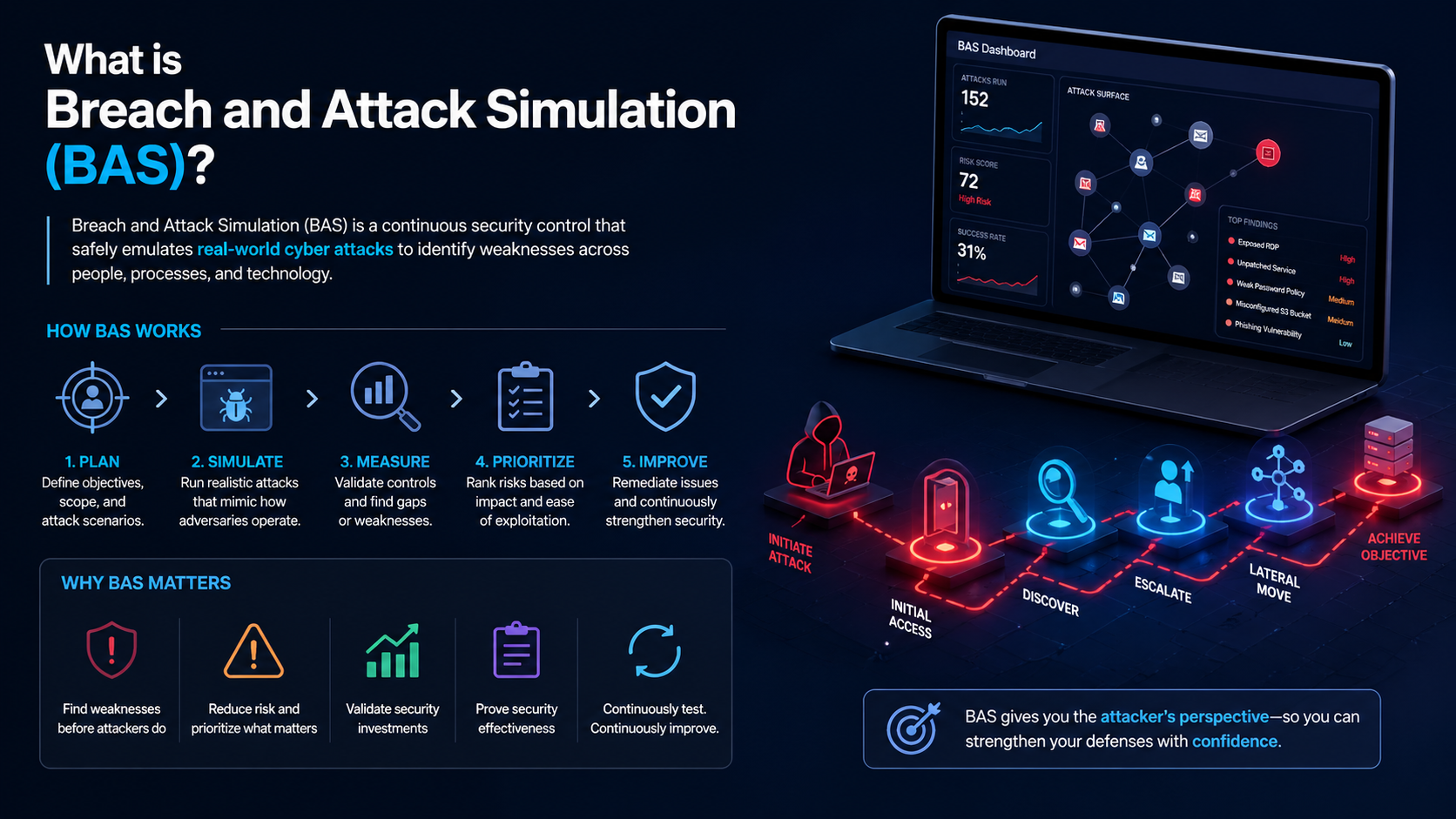
This is where Breach and Attack Simulation, often called BAS, enters the picture. It offers a proactive way to test defenses before attackers do. Instead of waiting for a real incident, BAS allows organizations to simulate attacks continuously and safely, revealing weaknesses that would otherwise stay hidden.
What is Breach and Attack Simulation?
Breach and Attack Simulation is a cybersecurity approach that mimics real-world cyberattacks in a controlled environment. It tests how well your existing security systems can detect, prevent, and respond to threats. Think of BAS as a constant “practice drill” for your security setup. Just like fire drills prepare people for emergencies, BAS prepares your digital infrastructure for actual cyberattacks. It runs automated scenarios that behave like hackers, malware, ransomware, or insider threats, but without causing harm. The goal is not to break your system, but to expose gaps, misconfigurations, and blind spots so they can be fixed before a real attacker finds them.
Why Traditional Security Testing Is Not Enough
For many years, companies relied on penetration testing and vulnerability scanning. While these methods are still useful, they have limitations. Penetration testing is usually done once or twice a year. It provides a snapshot of your security at a specific moment. But cyber threats evolve daily. What was secure last month may not be secure today. Vulnerability scanners focus on known issues, such as outdated software or missing patches. They do not show how an attacker might actually move through your system or exploit multiple weaknesses together. BAS fills this gap by offering continuous testing. It doesn’t just identify vulnerabilities; it shows how those vulnerabilities can be used in real attack scenarios.
How BAS Works in Practice
Breach and Attack Simulation tools operate by simulating different stages of an attack. These stages often follow the same path that real attackers use. The process usually begins with reconnaissance, where the system identifies potential entry points. Then it moves into initial access, attempting to exploit weak credentials or vulnerabilities. After gaining access, it simulates lateral movement, showing how an attacker could spread within the network.
Finally, BAS tests data exfiltration or impact scenarios, helping organizations understand what could be at risk if a breach occurs. All of this happens automatically and safely. The simulations do not damage systems or disrupt operations. Instead, they provide detailed insights into how security controls perform under pressure.
Continuous Testing for Continuous Threats
One of the biggest advantages of BAS is its ability to run continuously. Cybersecurity is not a one-time task; it requires constant attention. New vulnerabilities are discovered every day. Software updates, system changes, and new user behaviors can all introduce risks. BAS keeps testing in the background, ensuring that defenses remain strong over time. This continuous approach helps organizations stay ahead of attackers rather than reacting after an incident has already occurred.
Real-World Attack Scenarios
BAS platforms are designed to replicate real-world threats. These are not theoretical tests but practical simulations based on actual attack techniques used by hackers. For example, BAS can simulate phishing attacks to test whether users and email filters can detect them. It can mimic ransomware behavior to see if systems can stop encryption attempts. It can also replicate insider threats, where someone with legitimate access misuses their privileges. By using realistic scenarios, BAS provides a clear picture of how an organization would respond to an actual cyberattack.
Identifying Hidden Weaknesses
Many security issues are not obvious. A system may appear secure on the surface but still contain hidden vulnerabilities.
BAS helps uncover these hidden weaknesses. It can reveal misconfigured firewalls, weak access controls, or ineffective detection rules. It can also show gaps between different security tools that attackers could exploit. These insights are valuable because they go beyond simple checklists. They show how security systems interact in real situations and where they fail.
Improving Security Teams’ Confidence
Cybersecurity teams often work under pressure, trying to protect systems against unknown threats. Without proper testing, it can be difficult to know whether their defenses are truly effective. BAS provides clarity and confidence. It allows teams to see how their systems perform in simulated attacks. This helps them understand what is working and what needs improvement. It also supports better decision-making. Instead of guessing where to invest resources, teams can focus on the areas that BAS identifies as weak.
Supporting Compliance and Risk Management
Many industries have strict cybersecurity regulations. Organizations must demonstrate that they are actively managing risks and protecting sensitive data. BAS can support these requirements by providing evidence of continuous testing and improvement. It shows that security is not just a set of tools but an ongoing process. This can be especially important for industries like finance, healthcare, and e-commerce, where data protection is critical.
BAS vs Penetration Testing
It is important to understand that BAS does not replace penetration testing. Instead, the two approaches complement each other. Penetration testing is usually manual and performed by experts who think creatively like attackers. It can uncover complex vulnerabilities that automated tools might miss. BAS, on the other hand, is automated and continuous. It provides regular insights and ensures that defenses remain effective over time. When used together, they create a stronger security strategy. Penetration testing offers deep analysis, while BAS provides ongoing validation.
The Role of Automation in BAS
Automation is a key feature of Breach and Attack Simulation. Without it, continuous testing would not be possible. BAS platforms use automation to run thousands of attack scenarios quickly and efficiently. This saves time and reduces the workload on security teams. It also ensures consistency. Manual testing can vary depending on the tester, but automated simulations follow predefined methods, providing reliable and repeatable results.
Adapting to Modern Cyber Threats
Cyber threats are constantly evolving. Attackers are using advanced techniques such as artificial intelligence, automation, and social engineering. BAS platforms are designed to keep up with these changes. They regularly update their simulation libraries to include the latest attack methods. This ensures that organizations are not just protecting against old threats but are also prepared for new ones.
Benefits of Breach and Attack Simulation
The impact of BAS goes beyond technical improvements. It changes the way organizations approach cybersecurity. It encourages a proactive mindset, where security is tested continuously rather than assumed. It reduces the risk of breaches by identifying weaknesses early. It also improves collaboration between security teams, IT departments, and management. Perhaps most importantly, it provides peace of mind. Knowing that your defenses are being tested regularly helps reduce uncertainty and stress.
Challenges and Considerations
While BAS offers many advantages, it is not without challenges. Organizations need to choose the right platform and ensure that it integrates well with existing systems. There is also a learning curve. Security teams must understand how to interpret BAS results and take appropriate action. Another consideration is balance. Too many simulations can create noise, while too few may miss important issues. Finding the right level of testing is key. Despite these challenges, the benefits of BAS often outweigh the difficulties, especially in today’s threat landscape.
The Future of BAS
As cybersecurity continues to evolve, BAS is becoming an essential part of modern security strategies. It is no longer a luxury but a necessity for organizations that want to stay ahead of attackers. Future developments may include more advanced simulations, deeper integration with other security tools, and greater use of artificial intelligence. These improvements will make BAS even more effective and accessible. Organizations that adopt BAS early will be better prepared for the challenges ahead.
Conclusion
Breach and Attack Simulation represents a shift in how we think about cybersecurity. Instead of reacting to threats after they happen, it allows organizations to test and strengthen their defenses proactively. By simulating real-world attacks in a safe and controlled way, BAS provides valuable insights into how systems perform under pressure. It uncovers hidden weaknesses, improves confidence, and supports better decision-making.
In a world where cyber threats are constantly evolving, relying on static security measures is no longer enough. Continuous testing through BAS ensures that defenses remain strong and adaptable. For any organization serious about protecting its data, systems, and reputation, Breach and Attack Simulation is not just an option. It is a critical step toward building a resilient and future-ready security strategy.

