Cybersecurity has changed a lot in the past decade. What once worked for protecting computers and networks is no longer enough in today’s connected world. Businesses now deal with cloud platforms, remote workers, mobile devices, and constantly evolving cyber threats. In this environment, traditional security tools often fail to provide complete protection. This is where XDR comes into the picture.
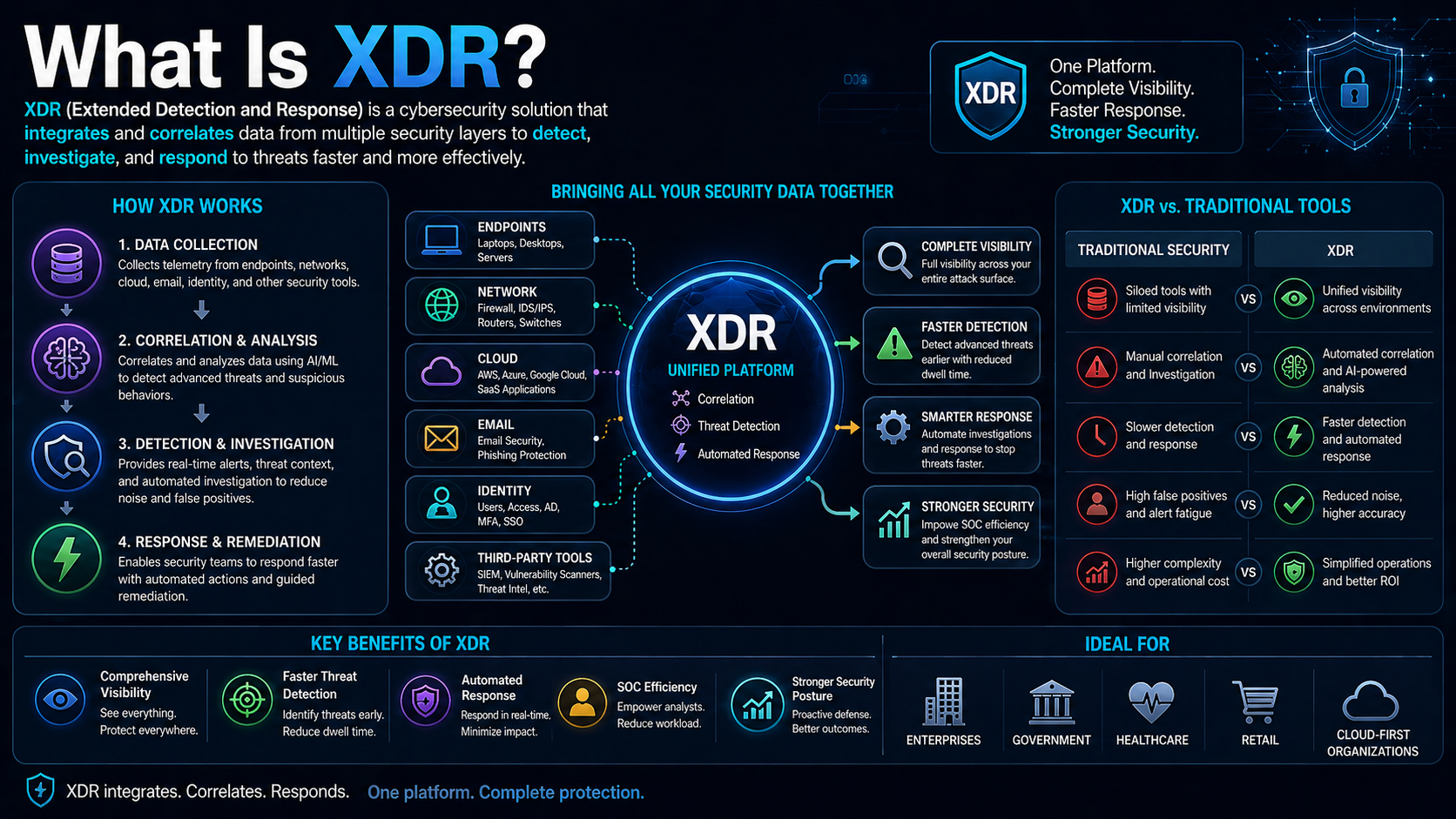
XDR stands for Extended Detection and Response. It is a modern approach to cybersecurity that brings together multiple security layers into one unified system. Instead of relying on separate tools for endpoints, networks, and servers, XDR connects everything and helps security teams detect and respond to threats more effectively. To understand XDR better, it helps to look at how cybersecurity tools evolved over time.
The Evolution of Cybersecurity
Earlier, companies used antivirus software as their main line of defense. These tools focused on identifying known malware and blocking it. As threats became more advanced, antivirus alone was not enough. This led to the development of Endpoint Detection and Response (EDR), which monitors devices like laptops and servers for suspicious activity. At the same time, Network Detection and Response (NDR) tools were created to monitor traffic flowing through networks. Cloud security tools also emerged to protect data and applications stored online.
While each of these tools works well on its own, they often operate in isolation. This creates gaps in security. Attackers take advantage of these gaps by moving across systems without being detected. XDR was introduced to solve this problem by combining multiple security tools into a single platform.
What Does XDR Actually Do?
XDR collects data from different sources across an organization’s IT environment. This includes endpoints, networks, cloud systems, email platforms, and more. It then analyzes this data to detect threats and suspicious behavior.
The key strength of XDR lies in its ability to correlate information. Instead of looking at events in isolation, it connects the dots between different activities. For example, a login attempt on a device, followed by unusual network traffic, and then access to sensitive data might not seem dangerous individually. But when combined, they could indicate a serious attack. XDR uses advanced analytics, automation, and sometimes artificial intelligence to identify these patterns quickly. Once a threat is detected, XDR helps security teams respond immediately. This can include isolating infected devices, blocking malicious traffic, or stopping unauthorized access.
Why XDR Is Important Today
Modern cyber threats are more complex than ever. Attackers use multiple techniques to breach systems and often remain undetected for long periods. Traditional tools struggle to keep up because they only provide a partial view of the environment.
XDR addresses this challenge by offering a complete picture. It reduces blind spots and makes it easier to identify attacks early. Another important reason for the rise of XDR is the shortage of skilled cybersecurity professionals. Many organizations do not have large security teams. XDR simplifies operations by automating tasks and reducing the workload on analysts. This means even smaller teams can manage advanced security threats effectively.
How XDR Works in Real Life
Imagine a scenario where an employee unknowingly clicks on a malicious email link. This link installs malware on their device. The malware then tries to communicate with an external server and spread across the network. In a traditional setup, the email security tool might detect the suspicious link, the endpoint tool might notice unusual activity, and the network tool might see strange traffic. But these alerts may not be connected, making it harder to understand the full picture.
With XDR, all these signals are combined. The system recognizes the attack chain and alerts the security team with clear insights. It may even take automatic action to stop the threat before it spreads further. This ability to see the entire attack lifecycle is what makes XDR so powerful.
Key Features of XDR
XDR platforms come with several features that help improve security operations. One of the most important features is centralized visibility. Security teams can monitor everything from a single dashboard. This eliminates the need to switch between different tools. Another key feature is threat detection. XDR uses advanced techniques to identify both known and unknown threats. It looks for unusual behavior rather than just relying on signatures. Automated response is also a major advantage. XDR can take immediate action when a threat is detected, reducing response time and limiting damage. Data correlation is what sets XDR apart from other solutions. By combining data from multiple sources, it provides deeper insights and more accurate detection.
Benefits of Using XDR
Organizations that adopt XDR experience several benefits. One of the biggest advantages is improved threat detection. Since XDR analyzes data from multiple sources, it can detect attacks that might go unnoticed by traditional tools. Another benefit is faster response times. Automation allows threats to be contained quickly, reducing the impact on the business. XDR also improves efficiency. Security teams spend less time investigating alerts because the system provides detailed context and analysis. Cost savings can also be significant. Instead of managing multiple security tools, organizations can rely on a single integrated platform.
Finally, XDR enhances overall security posture. By reducing gaps and improving visibility, it makes it much harder for attackers to succeed.
XDR vs EDR: What’s the Difference?
It is common to confuse XDR with EDR, but they are not the same. EDR focuses only on endpoints such as computers and servers. It monitors activity on these devices and helps detect threats. XDR goes beyond endpoints. It includes data from networks, cloud services, email systems, and more. This broader scope allows it to detect complex attacks that span multiple areas. In simple terms, EDR is a part of XDR. XDR builds on EDR and expands its capabilities.
Challenges of Implementing XDR
While XDR offers many benefits, it is not without challenges. One of the main challenges is integration. Organizations may already use various security tools, and integrating them into an XDR platform can take time and effort. Another challenge is data management. XDR collects large amounts of data, which needs to be processed and stored efficiently. There is also a learning curve. Security teams need to understand how to use the platform effectively to get the most out of it. Despite these challenges, the long-term benefits of XDR often outweigh the initial difficulties.
Who Should Use XDR?
XDR is suitable for organizations of all sizes. Large enterprises benefit from its ability to manage complex environments. Small and medium businesses can use XDR to simplify their security operations. Companies that handle sensitive data, such as financial institutions, healthcare providers, and e-commerce platforms, can particularly benefit from XDR. It is also a good choice for organizations with limited security staff, as it reduces manual workload and improves efficiency.
The Future of XDR
The future of cybersecurity is moving towards more integrated and intelligent solutions. XDR is a step in that direction. As technology evolves, XDR platforms are expected to become even more advanced. They will likely include better automation, improved artificial intelligence, and deeper integration with other systems. Cloud-based XDR solutions are also becoming more popular, offering scalability and flexibility. In the coming years, XDR may become a standard part of cybersecurity strategies for organizations around the world.
Final Thoughts
XDR represents a shift in how organizations approach cybersecurity. Instead of using separate tools that work independently, it brings everything together into a unified system. By providing better visibility, faster detection, and automated response, XDR helps organizations stay ahead of modern threats. It simplifies security operations and makes it easier to protect valuable data and systems. In a world where cyber attacks are becoming more sophisticated, relying on traditional methods is no longer enough. XDR offers a smarter and more effective way to defend against these threats. Understanding what XDR is and how it works is an important step for anyone looking to improve their cybersecurity strategy.

