Cyber threats are no longer rare or occasional events. They have become a daily reality for businesses of all sizes. From small startups to large enterprises, every organization connected to the internet faces risks such as ransomware, phishing, and data breaches. Traditional security tools like antivirus software and firewalls are no longer enough to keep attackers out. This is where Managed Detection and Response, often called MDR, comes into play.
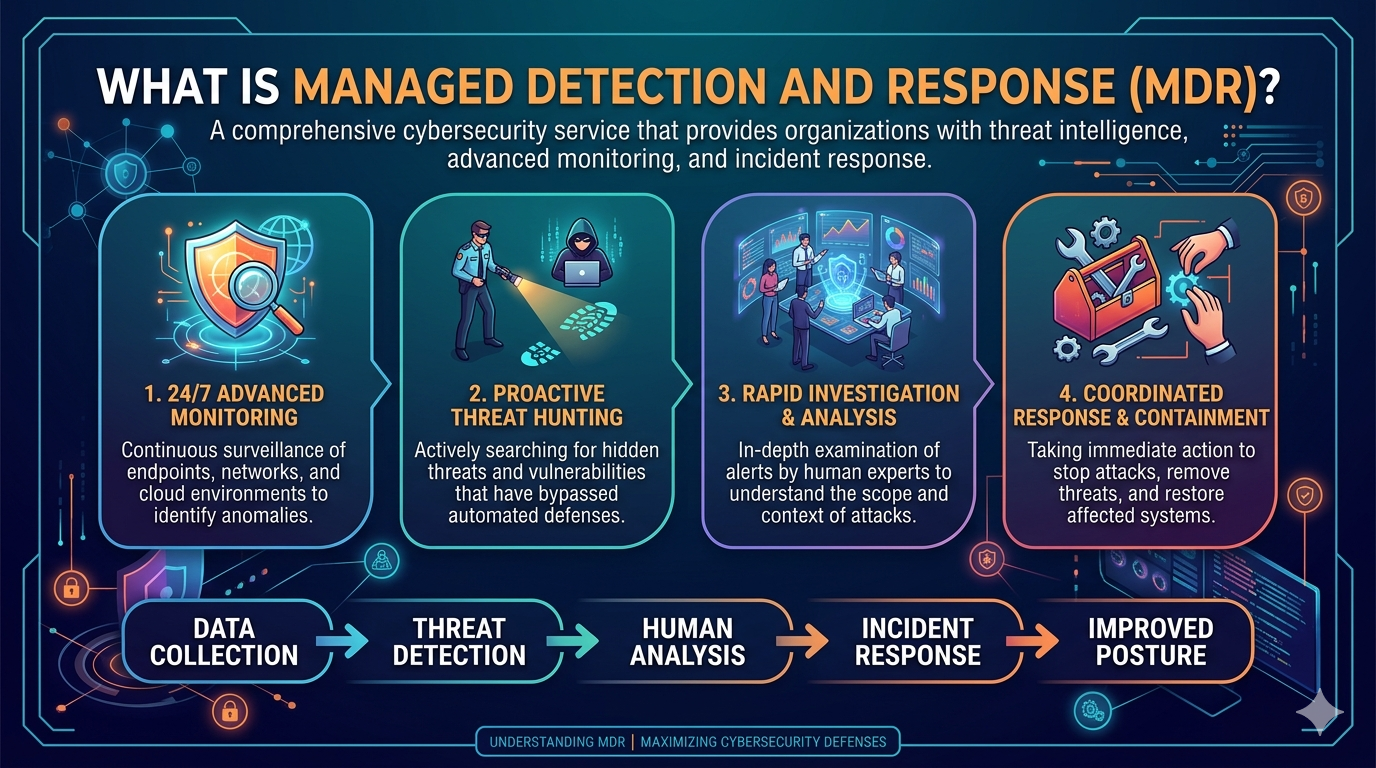
Managed Detection and Response is a modern cybersecurity service designed to actively monitor, detect, and respond to threats in real time. It combines advanced technology with human expertise to provide a stronger, more proactive defense against cyberattacks. Instead of simply blocking threats, MDR focuses on identifying suspicious behavior and stopping attacks before they cause serious damage.
Understanding Managed Detection and Response
Managed Detection and Response is a fully managed security service that continuously monitors an organization’s systems, networks, and endpoints. It looks for unusual activity, investigates potential threats, and takes immediate action to contain and eliminate risks. Unlike traditional security solutions that rely heavily on automated alerts, MDR involves skilled security analysts who review and analyze threats. This human involvement is critical because cybercriminals are becoming more sophisticated, often using techniques that can bypass automated systems.
MDR services typically include threat detection, incident response, threat hunting, and ongoing monitoring. The goal is not just to detect threats but to respond quickly and effectively, minimizing damage and downtime.
Why MDR Is Important Today
The digital world has changed rapidly over the past few years. Businesses are moving to cloud environments, employees are working remotely, and data is being shared across multiple platforms. While these changes bring flexibility and efficiency, they also create more entry points for attackers.
Cybercriminals are using advanced techniques such as fileless malware, zero-day exploits, and social engineering attacks. These methods are designed to avoid detection and exploit human behavior. As a result, traditional security tools often fail to catch these threats in time. Managed Detection and Response addresses this gap by providing continuous monitoring and expert analysis. It ensures that threats are identified early and handled before they escalate into major incidents. This proactive approach is essential in today’s fast-changing threat landscape.
How MDR Works
Managed Detection and Response operates through a combination of technology and human expertise. It starts with collecting data from various sources such as endpoints, servers, networks, and cloud environments. This data is then analyzed using advanced tools like artificial intelligence and machine learning. The system looks for patterns and behaviors that indicate potential threats. When something suspicious is detected, it is flagged for further investigation. This is where human analysts step in. They review the alert, determine whether it is a real threat, and decide on the appropriate response.
If a threat is confirmed, the MDR team takes immediate action. This may include isolating infected devices, blocking malicious activity, or removing harmful files. The goal is to stop the attack as quickly as possible and prevent it from spreading. In addition to responding to active threats, MDR also involves threat hunting. This means proactively searching for hidden threats that may not have triggered alerts. It is a critical part of staying ahead of attackers.
Key Components of MDR
Managed Detection and Response is built on several important components that work together to provide comprehensive security. One of the core elements is continuous monitoring. MDR services operate around the clock, ensuring that threats are detected at any time of day or night. This is especially important because cyberattacks can happen at any moment.
Another key component is advanced threat detection. MDR uses sophisticated tools to identify both known and unknown threats. This includes analyzing behavior patterns rather than relying solely on signatures. Incident response is also a crucial part of MDR. When a threat is detected, the response must be fast and effective. MDR teams are trained to handle incidents quickly, reducing the impact on the organization. Threat intelligence is another important aspect. MDR providers use global threat data to stay updated on the latest attack techniques. This helps them identify and respond to new threats more effectively.
Difference Between MDR and Traditional Security
Traditional security solutions are mainly focused on prevention. Tools like firewalls and antivirus software are designed to block known threats. While they are still important, they are not enough to handle modern cyberattacks.
Managed Detection and Response takes a different approach. Instead of relying only on prevention, it focuses on detection and response. It assumes that some threats will get through and prepares to handle them effectively. Another major difference is the level of expertise involved. Traditional tools are often managed by internal IT teams who may not have specialized security skills. MDR, on the other hand, provides access to experienced security professionals who are trained to deal with complex threats. This combination of advanced technology and human expertise makes MDR a more powerful solution for modern cybersecurity challenges.
Benefits of Using MDR
Managed Detection and Response offers several advantages that make it an attractive option for businesses. One of the biggest benefits is improved threat detection. MDR can identify threats that traditional tools might miss. This includes advanced attacks that use stealth techniques to avoid detection. Another advantage is faster response times. When a threat is detected, the MDR team acts quickly to contain it. This reduces the risk of data loss and minimizes disruption to business operations.
MDR also helps reduce the workload on internal IT teams. Managing cybersecurity can be complex and time-consuming. By outsourcing this responsibility to experts, organizations can focus on their core activities. Cost efficiency is another important benefit. Building an in-house security team with the same level of expertise as an MDR provider can be very expensive. MDR offers a more affordable way to access high-level security services.
Who Needs MDR
Managed Detection and Response is suitable for a wide range of organizations. Small and medium-sized businesses can benefit from MDR because they often lack the resources to maintain a dedicated security team. Large enterprises also use MDR to strengthen their existing security measures. Even organizations with advanced security systems can benefit from the additional expertise and monitoring that MDR provides.
Industries that handle sensitive data, such as healthcare, finance, and e-commerce, are particularly good candidates for MDR. These sectors are frequent targets for cyberattacks and require strong protection.
Challenges and Considerations
While MDR offers many benefits, it is important to understand some of the challenges involved. One consideration is trust. When using an MDR service, organizations are relying on an external provider to handle their security. It is important to choose a provider with a strong reputation and proven experience. Another challenge is integration. MDR needs to work with existing systems and tools. This may require some initial setup and configuration.
There is also the question of cost. While MDR is generally more affordable than building an in-house team, it still requires an investment. Organizations need to evaluate their budget and choose a service that meets their needs.
The Future of MDR
The future of Managed Detection and Response looks promising. As cyber threats continue to evolve, the demand for advanced security solutions will grow. MDR is expected to become more intelligent and automated, with greater use of artificial intelligence and machine learning. This will improve threat detection and reduce response times even further. At the same time, the human element will remain important. Cybersecurity is not just about technology. It also requires critical thinking and decision-making, which only skilled professionals can provide. As businesses continue to adopt digital technologies, MDR will play a key role in protecting their assets and ensuring their security.
Conclusion
Managed Detection and Response is a powerful solution for modern cybersecurity challenges. It goes beyond traditional security measures by focusing on continuous monitoring, advanced threat detection, and rapid response.
In a world where cyber threats are becoming more sophisticated, MDR provides the protection that organizations need to stay secure. By combining technology with human expertise, it offers a proactive approach to cybersecurity that can prevent serious damage and keep businesses running smoothly. For organizations looking to strengthen their security posture, MDR is not just an option. It is becoming a necessity in today’s digital landscape.

