Artificial Intelligence has quickly become part of everyday life. From chatbots answering questions to tools helping write emails, generate images, or even code, AI feels almost magical at times. But like any powerful technology, it has its flaws. One of the most important—and often misunderstood—issues is something called an AI hallucination.
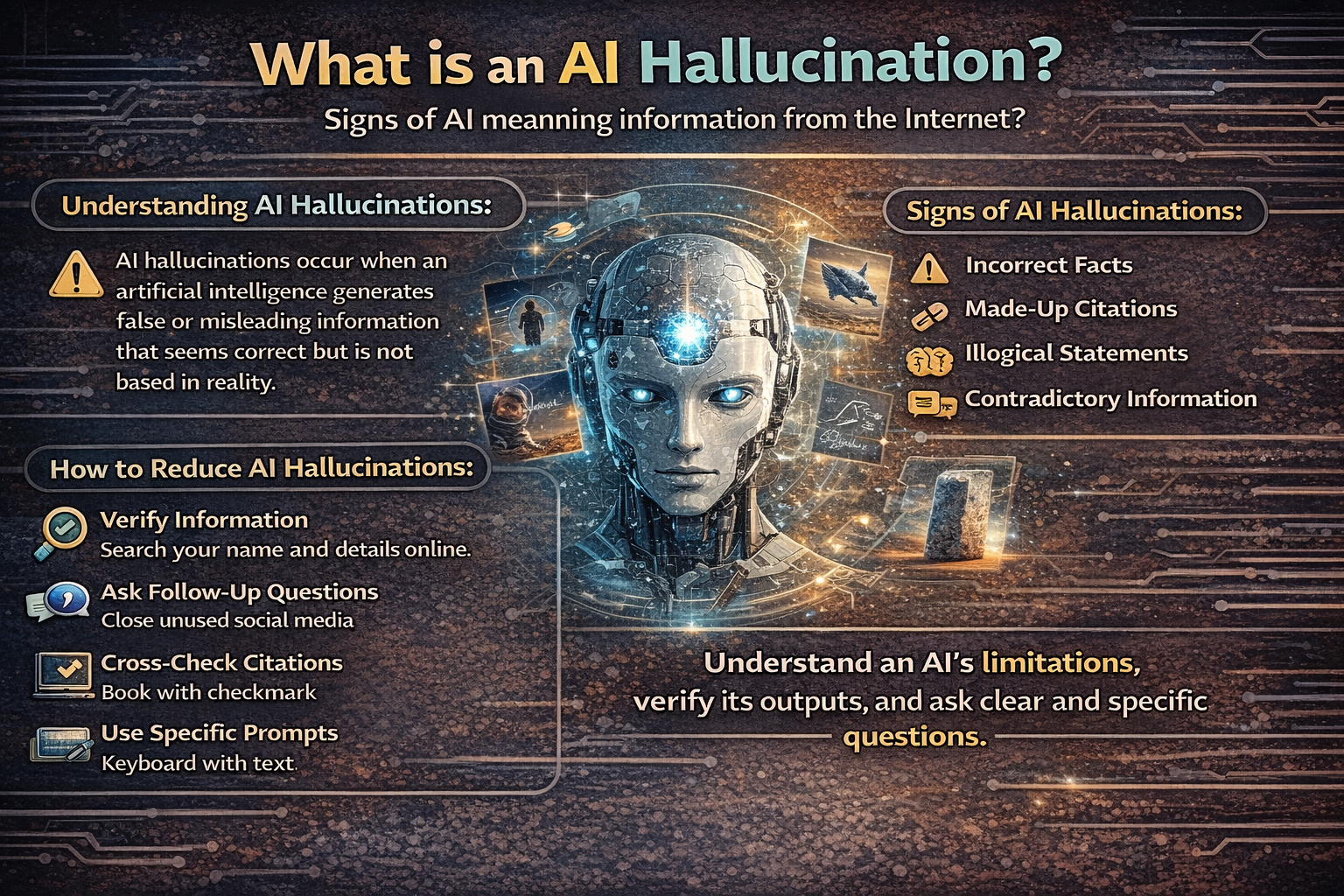
Let’s break it down in a simple, human way so you can clearly understand what it is, why it happens, and how to deal with it.
Understanding AI Hallucination in Simple Terms
An AI hallucination happens when an AI system generates information that sounds believable but is actually incorrect, misleading, or completely made up. In other words, the AI is not lying on purpose—it just doesn’t know it’s wrong. Imagine asking a friend a question they’re unsure about, but instead of saying “I don’t know,” they confidently give you an answer that sounds right but isn’t. That’s very similar to what AI does during a hallucination.
Why Is It Called a “Hallucination”?
The word “hallucination” might sound strange in this context, but it fits surprisingly well. In humans, hallucination means seeing or hearing something that isn’t real. For AI, it means producing information that doesn’t exist in reality but appears convincing.
The key idea is:
-
It’s not intentional
-
It’s not based on real facts
-
But it feels real to the user
How AI Actually Works (And Why Mistakes Happen)
To understand hallucinations, you need a basic idea of how AI models work.
AI doesn’t “know” things like humans do. It doesn’t have beliefs, awareness, or real understanding. Instead, it:
-
Learns patterns from large amounts of data
-
Predicts the next word or answer based on those patterns
-
Generates responses that look logical and fluent
This means AI is essentially very good at guessing what sounds right, not necessarily what is right.
And that’s where hallucinations come in.
Common Types of AI Hallucinations
AI hallucinations can appear in different forms. Let’s look at some common ones.
1. Fabricated Facts
The AI might create facts that don’t exist.
Example:
-
Giving a fake statistic
-
Mentioning a study that was never conducted
2. Fake Sources or References
Sometimes AI will confidently cite:
-
Non-existent research papers
-
Fake websites
-
Made-up authors
This is especially risky when users trust AI for academic or professional work.
3. Incorrect Details
The AI may mix up:
-
Dates
-
Names
-
Events
Even small errors can lead to big misunderstandings.
4. Logical but Wrong Answers
Sometimes the response sounds perfectly logical, but it’s still incorrect.
That’s what makes hallucinations dangerous—they don’t look wrong at first glance.
Real-Life Examples of AI Hallucinations
To make it more relatable, here are a few simple scenarios:
Example 1: Student Research
A student asks AI for sources on a topic. The AI provides a list of references that look real—but don’t exist.
Example 2: Medical Advice
Someone asks about symptoms, and the AI gives confident but inaccurate information, potentially leading to confusion or fear.
Example 3: Coding Help
A developer asks for code. The AI writes code that looks correct but contains subtle errors that break the program.
Why Do AI Hallucinations Happen?
There are several reasons behind this issue.
1. Lack of True Understanding
AI doesn’t truly understand meaning. It works on patterns, not real knowledge.
2. Training Data Limitations
AI is trained on large datasets, but:
-
The data may contain errors
-
Some information may be outdated
-
Some topics may be missing
3. Overconfidence in Output
AI is designed to respond smoothly and confidently, even when it’s unsure. It doesn’t naturally say, “I might be wrong.”
4. Ambiguous Questions
If a question is unclear, AI may “fill in the gaps” with assumptions—and those assumptions can be wrong.
Why AI Hallucinations Matter
You might think, “It’s just a small mistake.” But in reality, hallucinations can have serious consequences.
1. Misinformation Spread
Incorrect information can spread quickly, especially when people trust AI-generated content.
2. Loss of Trust
If users repeatedly encounter wrong answers, they may lose confidence in AI tools.
3. Professional Risks
In fields like healthcare, law, or finance, even a small error can lead to major problems.
4. Academic Issues
Students using AI-generated content without verification risk submitting false or misleading work.
Can AI Hallucinations Be Fixed?
The short answer: They can be reduced, but not completely eliminated (yet).
AI developers are constantly working to improve:
-
Accuracy
-
Fact-checking abilities
-
Transparency
However, because of how AI fundamentally works, hallucinations are still possible.
How to Spot an AI Hallucination
Here are some simple ways to identify when AI might be wrong:
1. Too Confident, No Sources
If the answer sounds very certain but doesn’t provide evidence, double-check it.
2. Unfamiliar References
If you see strange or unknown sources, verify them online.
3. Inconsistent Information
If different parts of the answer contradict each other, that’s a red flag.
4. Complex but Vague Explanations
Sometimes AI uses complicated language to hide uncertainty.
How to Protect Yourself from AI Hallucinations
You don’t need to stop using AI—you just need to use it wisely.
1. Always Verify Important Information
Especially for:
-
Health advice
-
Legal matters
-
Financial decisions
2. Cross-Check with Trusted Sources
Use:
-
Official websites
-
Verified publications
-
Expert opinions
3. Ask Follow-Up Questions
You can challenge the AI:
-
“Are you sure?”
-
“Can you provide sources?”
-
“What is the evidence?”
4. Use AI as a Starting Point, Not the Final Answer
Think of AI as a helper, not the ultimate authority.
The Human Side of AI Hallucinations
Here’s something important to remember: AI hallucinations reflect something very human.
Humans also:
-
Make assumptions
-
Misremember facts
-
Speak confidently even when unsure
The difference is that AI does it faster and at a larger scale.
Understanding this makes it easier to use AI responsibly, without blindly trusting it.
Are AI Hallucinations Always Bad?
Not necessarily.
In some creative fields, hallucinations can actually be useful:
-
Story writing
-
Brainstorming ideas
-
Generating creative concepts
In these cases, “making things up” can be a feature, not a bug.
The problem arises when hallucinations are mistaken for factual truth.
The Future of AI and Hallucinations
AI is improving rapidly, and future systems are likely to:
-
Provide better citations
-
Admit uncertainty more clearly
-
Reduce false information
However, human awareness will always play a key role.
No matter how advanced AI becomes, critical thinking will remain essential.
Final Thoughts
AI hallucinations are not a sign that AI is broken—they’re a reminder of how it works.
AI doesn’t “know” things. It predicts, generates, and imitates patterns. Most of the time, it does this incredibly well. But sometimes, it creates information that simply isn’t true.
The key takeaway is simple:
-
Use AI as a powerful tool
-
Stay curious and cautious
-
Always verify important information
When you combine AI’s speed with human judgment, you get the best of both worlds.

