In today’s connected world, businesses rely heavily on digital systems to run operations, store sensitive data, and communicate with customers. As organizations grow, so do the risks associated with cyber threats. This is where an enterprise firewall becomes essential. It is not just a tool but a critical layer of defense that helps protect an organization’s entire network from unauthorized access, cyberattacks, and data breaches.
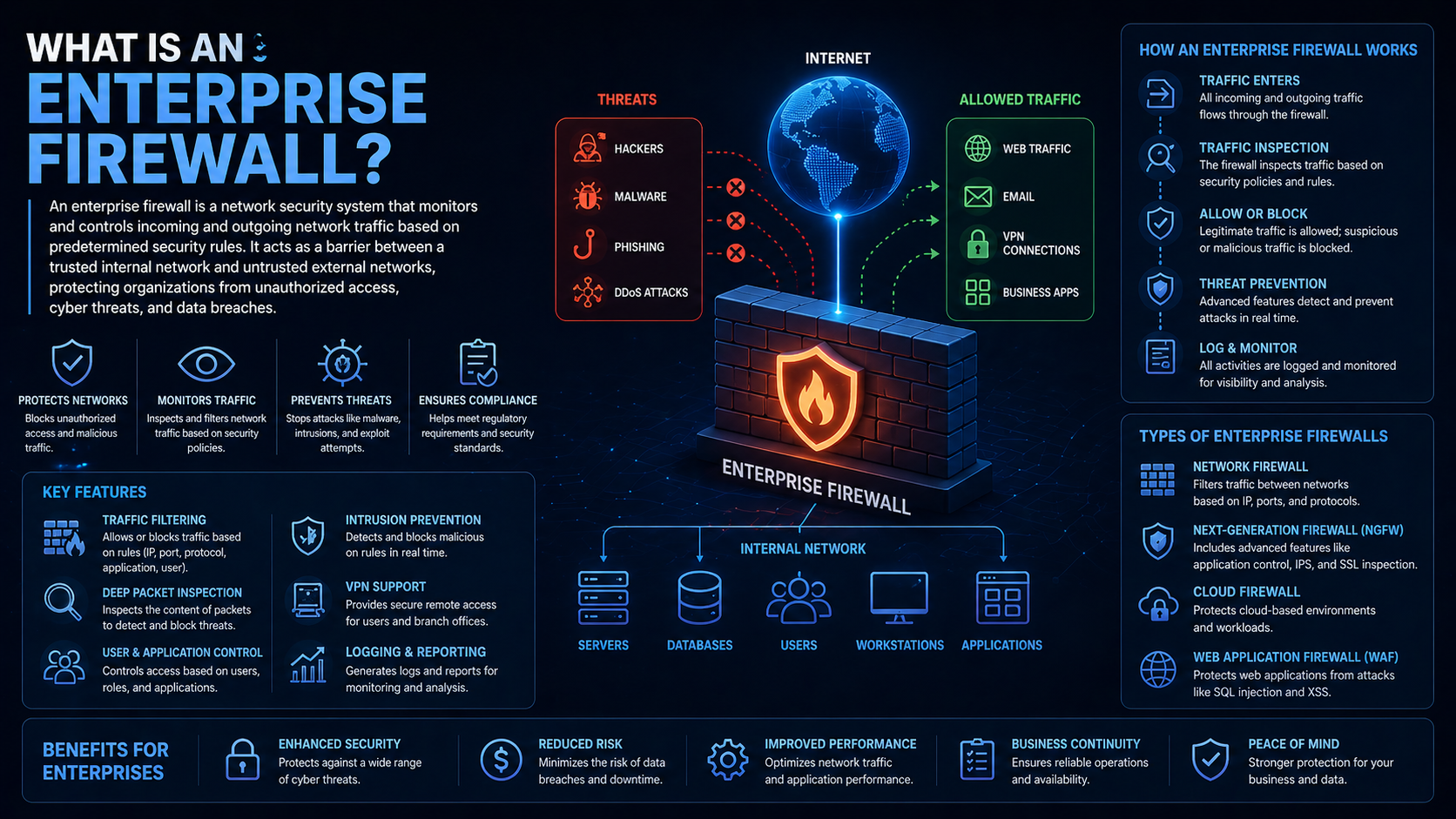
An enterprise firewall is a sophisticated security system designed to monitor, filter, and control incoming and outgoing network traffic based on predefined security rules. Unlike basic firewalls used in homes or small offices, enterprise firewalls are built to handle complex environments with large volumes of data, multiple users, and diverse applications. They provide deep visibility into network activity and allow organizations to enforce strict security policies across all systems.
Understanding the Role of an Enterprise Firewall
At its core, an enterprise firewall acts as a gatekeeper between a trusted internal network and untrusted external networks such as the internet. Every piece of data entering or leaving the network passes through the firewall. The firewall evaluates this traffic and decides whether to allow or block it based on rules set by the organization.
This process might sound simple, but in enterprise environments, it involves analyzing thousands or even millions of data packets in real time. Modern firewalls do more than just allow or deny traffic. They inspect the content of data, identify threats, and even predict potential risks using advanced technologies.
For example, if a suspicious file tries to enter the network or if an unusual pattern of activity is detected, the firewall can immediately block it and alert administrators. This proactive approach helps prevent attacks before they can cause damage.
Why Businesses Need Enterprise Firewalls
As businesses expand, they become more attractive targets for cybercriminals. Sensitive information such as customer data, financial records, and intellectual property is constantly at risk. A simple security breach can lead to financial loss, legal issues, and damage to reputation.
An enterprise firewall provides a strong defense by controlling who can access the network and what actions they can perform. It ensures that only authorized users and applications are allowed, reducing the chances of unauthorized access.
Another important reason businesses rely on enterprise firewalls is compliance. Many industries have strict regulations regarding data security. Organizations must demonstrate that they have proper security measures in place. An enterprise firewall helps meet these requirements by offering detailed logs, monitoring capabilities, and policy enforcement.
How Enterprise Firewalls Work
To understand how enterprise firewalls function, it helps to look at the different layers of inspection they perform. Traditional firewalls relied on basic filtering methods such as checking IP addresses and port numbers. While this approach is still useful, it is not enough to stop modern cyber threats.
Enterprise firewalls use advanced techniques such as deep packet inspection. This means they examine the actual content of data packets, not just their source or destination. By doing this, they can detect hidden threats like malware, ransomware, or unauthorized applications.
They also use stateful inspection, which tracks the state of active connections. This allows the firewall to understand whether a packet is part of a legitimate session or an attempt to exploit the network.
In addition, many enterprise firewalls include intrusion prevention systems. These systems actively monitor network traffic for known attack patterns and automatically block them. This adds an extra layer of protection beyond simple filtering.
Key Features of an Enterprise Firewall
Enterprise firewalls come with a wide range of features designed to provide comprehensive security. One of the most important features is application awareness. Instead of just looking at ports and protocols, the firewall can identify specific applications and control how they are used within the network.
Another important feature is user identity integration. This allows the firewall to apply policies based on user roles rather than just IP addresses. For example, employees in different departments can have different levels of access depending on their responsibilities.
Advanced threat protection is also a key component. This includes capabilities such as malware detection, sandboxing, and threat intelligence integration. These features help identify and stop new and emerging threats that traditional methods might miss.
Enterprise firewalls also offer centralized management. This allows administrators to control security policies across multiple locations from a single interface. It simplifies management and ensures consistency in security practices.
Types of Enterprise Firewalls
There are different types of enterprise firewalls, each designed to meet specific needs. Network-based firewalls are installed at the perimeter of the network and protect the entire infrastructure. They are ideal for organizations with large and complex networks.
Host-based firewalls, on the other hand, are installed on individual devices such as servers or workstations. They provide an additional layer of protection by controlling traffic at the device level.
Next-generation firewalls represent the most advanced category. They combine traditional firewall functions with advanced features such as deep packet inspection, intrusion prevention, and application control. These firewalls are designed to handle modern threats and provide a higher level of security.
Cloud-based firewalls are becoming increasingly popular as more businesses move to cloud environments. These firewalls protect cloud infrastructure and ensure secure access to applications and data hosted online.
Benefits of Using an Enterprise Firewall
One of the biggest advantages of an enterprise firewall is improved security. It acts as the first line of defense against cyber threats and helps prevent unauthorized access to the network.
Another benefit is better visibility. Enterprise firewalls provide detailed insights into network activity, allowing administrators to identify potential issues and respond quickly. This level of visibility is crucial for maintaining a secure environment.
Performance is also an important factor. Modern enterprise firewalls are designed to handle high volumes of traffic without slowing down the network. They use advanced processing techniques to ensure smooth and efficient operation.
Scalability is another key advantage. As businesses grow, their security needs change. Enterprise firewalls can be scaled to accommodate increased traffic and new requirements without compromising performance.
Challenges and Considerations
While enterprise firewalls offer many benefits, they also come with challenges. One of the main challenges is complexity. Setting up and managing an enterprise firewall requires expertise and careful planning. Incorrect configurations can lead to security gaps or performance issues.
Another challenge is keeping up with evolving threats. Cybercriminals are constantly developing new techniques to bypass security measures. Organizations must regularly update their firewall systems and policies to stay protected.
Cost is also a consideration. Enterprise firewalls can be expensive, especially for small businesses. However, the cost of a security breach is often much higher, making the investment worthwhile.
The Future of Enterprise Firewalls
As technology continues to evolve, enterprise firewalls are becoming more intelligent and adaptive. Artificial intelligence and machine learning are being integrated into firewall systems to improve threat detection and response.
These technologies allow firewalls to analyze patterns and identify anomalies that might indicate a potential attack. This proactive approach helps organizations stay ahead of threats rather than just reacting to them.
Another trend is the shift toward zero trust security models. In this approach, no user or device is automatically trusted, even if they are inside the network. Enterprise firewalls play a key role in enforcing this model by continuously verifying access and monitoring activity.
Cloud integration is also shaping the future of enterprise firewalls. As businesses adopt hybrid and multi-cloud environments, firewalls are evolving to provide consistent security across all platforms.
Conclusion
An enterprise firewall is much more than a basic security tool. It is a comprehensive system that protects an organization’s network, data, and operations from a wide range of cyber threats. By monitoring and controlling network traffic, enforcing security policies, and providing advanced threat protection, it plays a crucial role in maintaining a secure digital environment.
For businesses of all sizes, investing in an enterprise firewall is not just a technical decision but a strategic one. It ensures that sensitive information remains protected, operations run smoothly, and trust is maintained with customers and partners.
As cyber threats continue to grow in complexity, the importance of enterprise firewalls will only increase. Organizations that prioritize strong network security will be better prepared to face the challenges of the digital age and build a resilient future.

